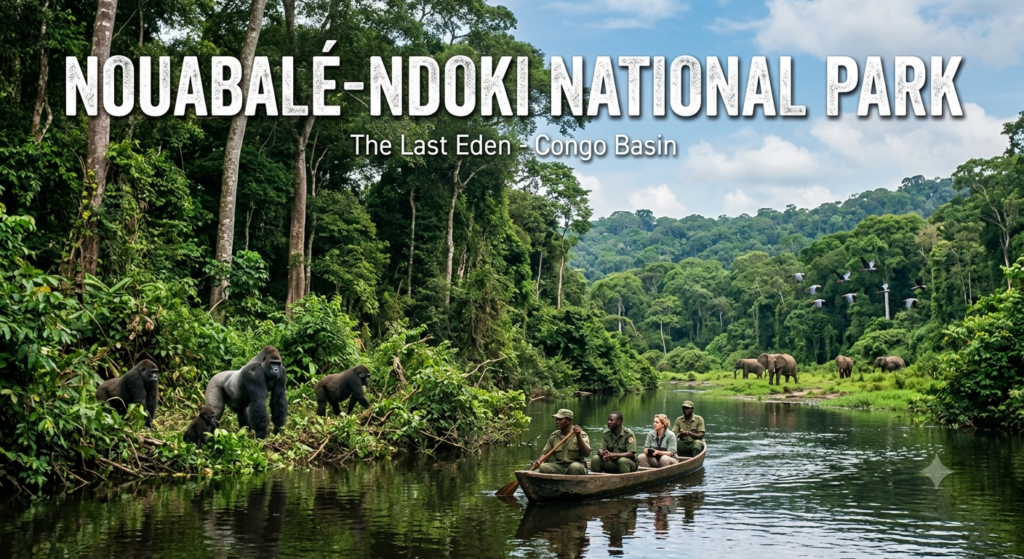
Deep in the northern Republic of Congo lies one of Central Africa’s most remarkable wilderness destinations: Nouabalé-Ndoki National Park. Established in 1993, the park protects more than 4,000 square kilometers of largely intact lowland rainforest and is home to western lowland gorillas, chimpanzees, forest elephants, and an extraordinary variety of plants and birds.
For travelers seeking an authentic African adventure away from heavily visited safari destinations, this protected rainforest offers a rare opportunity to experience wildlife in a natural environment. Beyond tourism, the park is also an important center for scientific research, community initiatives, and long-term conservation.
Where Is Nouabale Ndoki National Park?
Nouabale Ndoki National Park is located in the northern part of the Republic of Congo, more than 900 kilometers north of Brazzaville. It forms part of the larger Sangha Trinational landscape, which also includes Lobéké National Park in Cameroon and the Dzanga-Sangha Protected Areas in the Central African Republic. This transboundary conservation area was recognized as a UNESCO World Heritage Site in 2012.
The park is exceptionally remote. Unlike many safari destinations, it has no road network running through its interior, helping preserve its forests and wildlife. Its remoteness is one of its greatest attractions for adventurous travelers who want to explore a relatively untouched ecosystem.
Wildlife You Can Discover
One of the biggest reasons to visit this rainforest is its impressive wildlife. The park supports several globally important species, including western lowland gorillas, chimpanzees, and African forest elephants. These animals are considered flagship species because their presence provides valuable indications of forest health.
Forest elephants are particularly fascinating. They move through dense vegetation, create trails, disperse seeds, and influence the structure of the forest. Their role extends beyond simply being a popular wildlife attraction; they are important contributors to the functioning of the rainforest ecosystem.
Visitors may also encounter buffaloes, monkeys, forest birds, and numerous smaller creatures. Nouabale Ndoki National Park offers remarkable biodiversity, extending to plants and insects, including ancient mahogany trees and rare botanical species. Recent conservation information identifies hundreds of bird and mammal species across the protected landscape.
Gorilla and Chimpanzee Experiences
For wildlife enthusiasts, observing great apes in their natural rainforest habitat can be one of the most memorable parts of a Congo adventure.
The Mondika research site has been associated with long-term research and gorilla habituation. Researchers have studied western lowland gorillas there since the 1990s, creating opportunities to better understand their behavior and ecology.
The Goualougo area is also famous for its chimpanzee research. Early scientific expeditions documented chimpanzees that had little or no previous contact with humans, providing researchers with valuable opportunities to study natural behaviors.
Travelers should understand that rainforest wildlife encounters in Nouabale Ndoki National Park are different from conventional vehicle safaris. Animals live in dense vegetation and move freely, so sightings can never be guaranteed. The unpredictability makes every encounter especially rewarding.
Exploring Mbeli Baï and Wali Baï
Forest clearings known as baïs provide some of the most interesting wildlife-viewing opportunities in the park.
Wali Baï is accessible from Bomassa and features an elevated viewing platform overlooking a forest clearing. Elephants and buffaloes frequently visit the area to feed, drink, socialize, or interact with one another.
Mbeli Baï is another important wildlife-viewing location. The large clearing attracts different species seeking food, water, and rest. Spending time quietly at a viewing platform allows visitors to observe animal behavior without disturbing the surrounding habitat.
These experiences demonstrate why rainforest safaris can be so different from traditional savanna game drives. Instead of driving across open grasslands, visitors often slow down and observe the forest carefully.
Nature and Rainforest Landscapes
The landscape is dominated by tropical lowland rainforest, waterways, swamps, and forest clearings. Its relatively undisturbed condition makes it one of the Congo Basin’s important remaining intact ecosystems.
The forest is also botanically rich. Ancient trees, climbing plants, palms, fungi, and countless smaller species create a complex environment that supports wildlife at every level.
In 2024, Nouabale Ndoki National Park became the first site recognized under the Key Biodiversity Area Standard’s ecological integrity criteria, reflecting the exceptional condition of its ecosystems. Assessments highlighted its lack of roads and logging within the park and its importance for biodiversity and climate-related ecosystem services.
Conservation at the Heart of the Park
Conservation is central to the story of this destination. The park was created in 1993 following scientific studies that demonstrated the exceptional ecological value of the area.
Today, management involves the Republic of Congo’s Ministry of Forest Economy, the Wildlife Conservation Society, and the Nouabalé-Ndoki Foundation. Since 2014, the foundation has managed the park through a public-private partnership involving the Congolese government and WCS.
Conservation efforts include wildlife monitoring, scientific research, ranger patrols, anti-poaching initiatives, and partnerships with communities. The park’s management also supports sustainable economic opportunities and local employment.
Recent conservation results are encouraging. Park reporting indicates stable populations of large primates and forest elephants across several surveys, while no elephant poaching was detected inside the park during 2023 and 2024.
The Role of Local Communities
Conservation works best when local communities are included. The park supports employment, education, training, and sustainable livelihood initiatives around Bomassa and neighboring areas.
More than 200 permanent employees are associated with the park, with most being local residents, while education initiatives support hundreds of schoolchildren. Community tourism and other sustainable activities are also part of the broader conservation strategy.
For visitors, choosing responsible tourism operators can help ensure that travel contributes positively to conservation and local communities. Romaric Tour Guide can help travelers discover authentic African wildlife experiences while planning journeys around responsible and immersive tourism.
Best Time for a Rainforest Adventure
Travel conditions in the Congo rainforest can vary according to rainfall, river levels, and local operating conditions. Because this is a remote destination, travelers should plan carefully rather than relying only on a standard safari calendar.
What to Pack
A well-planned packing list can make a rainforest journey more comfortable. Consider bringing:
- Lightweight, breathable clothing
- Long-sleeved shirts and trousers
- Waterproof hiking footwear
- Rain protection
- Insect repellent
- Binoculars
- A good camera and spare batteries
- Reusable water bottles
- Personal medications and essential toiletries
- A small waterproof bag for electronics
Neutral-colored clothing is generally practical for wildlife observation, while lightweight layers can help with changing conditions.
Responsible Travel Tips
Responsible tourism is especially important in fragile rainforest ecosystems. Visitors should follow park regulations, listen to guides and researchers, avoid disturbing wildlife, and never feed animals.
Photography should also be respectful. Keep a safe distance, avoid loud noises, and follow instructions during gorilla, chimpanzee, and elephant encounters.
Travelers can further support conservation by choosing locally engaged operators, purchasing appropriate local services, and respecting community customs. Exploring Nouabale Ndoki National Park responsibly also helps visitors appreciate its unique biodiversity while supporting efforts to protect the rainforest. Every responsible visitor can contribute to protecting the environment that makes the experience possible.
Why Visit Nouabale Ndoki National Park?
A journey here is more than a conventional wildlife holiday. It offers an opportunity to enter one of Africa’s great rainforest landscapes and experience wildlife in an environment where natural processes remain remarkably intact.
From forest elephants gathering at baïs to the possibility of observing great apes, every experience can provide a deeper understanding of Central Africa’s biodiversity. The combination of wilderness, scientific research, cultural connections, and conservation makes the destination particularly appealing to adventurous travelers and nature enthusiasts.
For travelers looking for an authentic rainforest safari, Nouabale Ndoki National Park stands out as a destination where exploration and conservation come together. Planning with an experienced specialist such as Romaric Tour Guide can help create a meaningful journey focused on wildlife, nature, and responsible travel.
FAQs
1. What is Nouabale Ndoki National Park famous for?
It is famous for its exceptionally intact Congo Basin rainforest and populations of western lowland gorillas, chimpanzees, forest elephants, and other wildlife.
2. Where is Nouabale Ndoki National Park located?
The park is in northern Republic of Congo, more than 900 kilometers from Brazzaville.
3. Can visitors see gorillas in the park?
Gorilla research and habituation have taken place at the Mondika site, where researchers have studied western lowland gorillas for decades. Wildlife sightings, however, are naturally unpredictable.
4. Is the park part of a UNESCO World Heritage Site?
Yes. It forms part of the Sangha Trinational transboundary landscape, which has UNESCO World Heritage status.
5. Why is conservation important in Nouabale Ndoki?
The park protects a highly intact rainforest ecosystem and threatened wildlife while supporting scientific research, anti-poaching work, and community-focused conservation initiatives