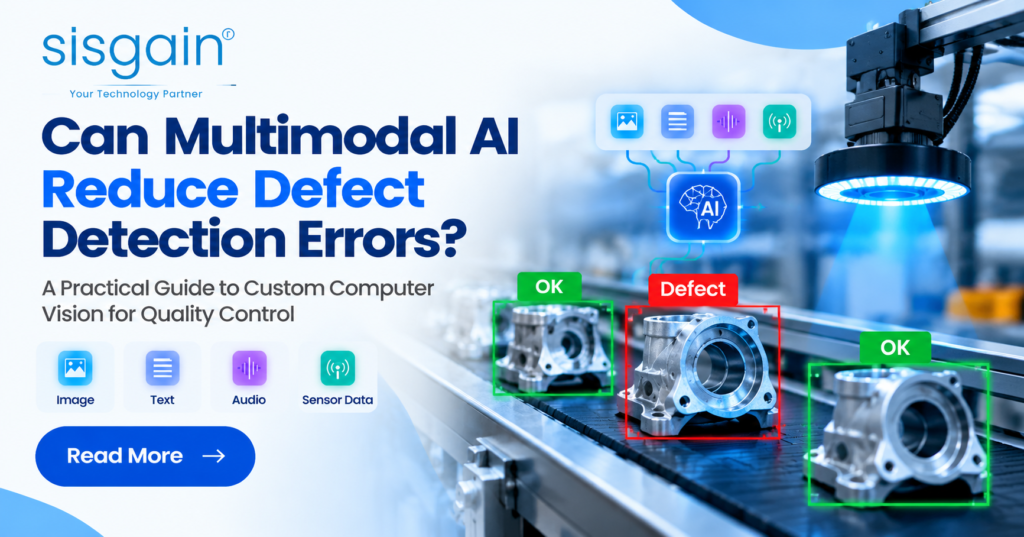
Multimodal AI can reduce defect detection errors by combining images with sensor readings, production records, and other process data. Custom computer vision models trained on your own product images and defect examples can catch subtle flaws that rule-based systems miss, and they can lower both false alarms and missed defects when they are validated under real production conditions.
Why Do Traditional Inspection Systems Make Errors?
Most legacy inspection systems rely on fixed rules: a pixel threshold, a dimension tolerance, or a template match. These rules work well for simple, repetitive defects. They struggle when defects are irregular, when products vary slightly from batch to batch, or when lighting changes across a shift.
Three problems show up repeatedly:
- Subtle and complex defects. A hairline crack, a faint colour variation, or a slightly misaligned label may not match any rule the engineers wrote.
- Environmental variation. Dust on a lens, reflections from a conveyor, or a change in ambient light can shift the image enough to trigger false alarms or hide real flaws.
- Product variation. A new colourway or a supplier change can break a rule set that was tuned for the old product.
The result is a familiar trade-off. Tighten the rules and the line flags good parts, which means rework and wasted time. Loosen them and defective products reach customers, which means returns and warranty claims. Both are costly.
ALSO READ – Losing Time and Money on Manual Inspections? How Computer Vision and Multimodal AI Can Help
What Is Multimodal AI in Quality Control?
Multimodal AI processes more than one type of input at the same time. In a manufacturing setting, those inputs might include:
- Camera images or video from one or more angles
- Thermal, depth, or X-ray data
- Vibration, temperature, pressure, or torque readings from machines
- Batch records, operator notes, and material certificates
Traditional computer vision looks only at pixels and returns a label such as “defect” or “no defect.” A multimodal system can ask richer questions. For example, it can check whether a surface mark appears only on parts produced when a particular machine ran at a higher temperature. That context often separates a real defect from a harmless cosmetic variation.
How Does Multimodal AI Reduce Defect Detection Errors?
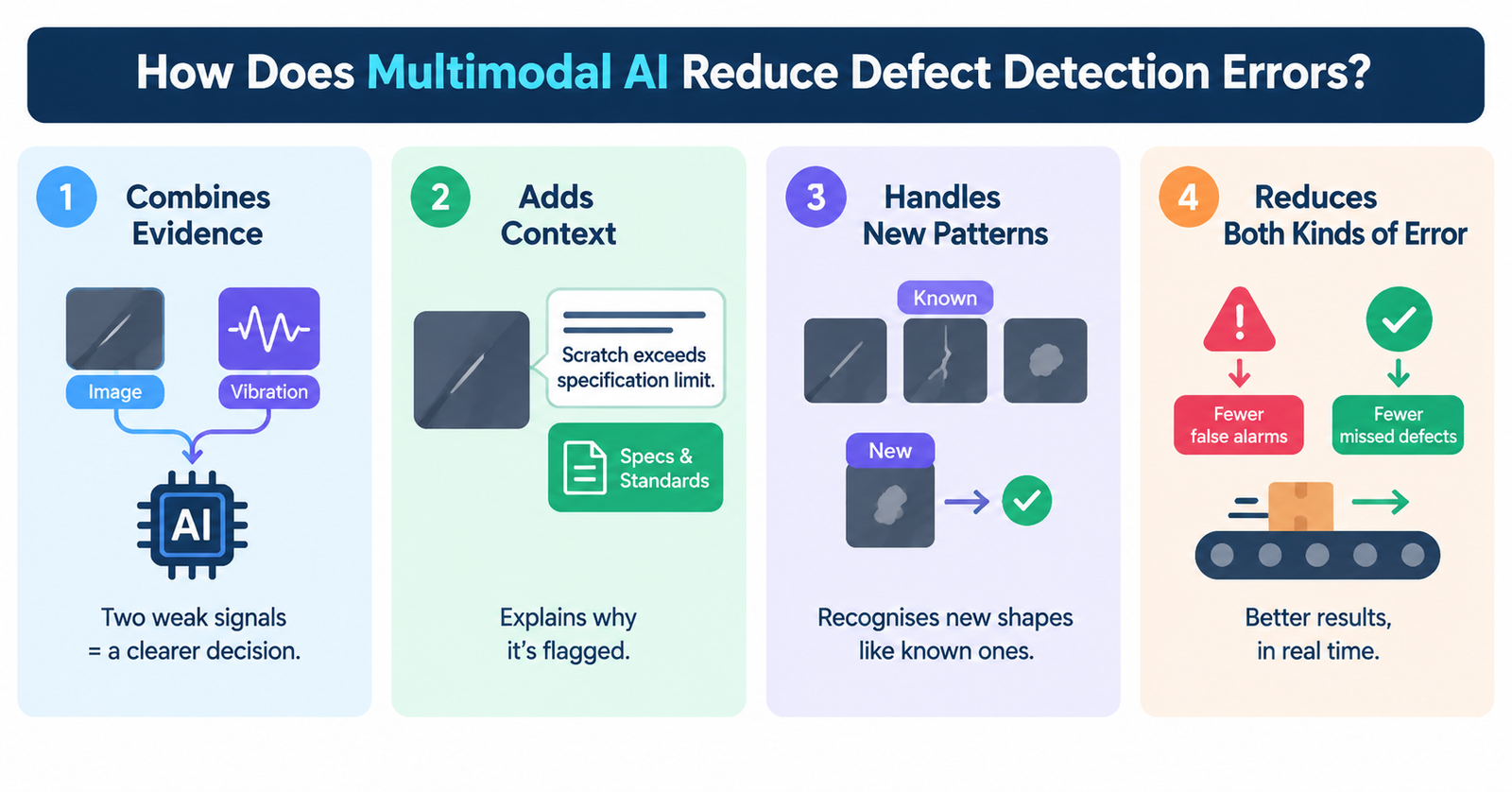
Multimodal AI reduces errors through four main mechanisms.
It combines evidence from several sources. A scratch that looks borderline in an image may become clearly significant when the system also sees that the same station recorded an abnormal vibration reading. Two weak signals together can give a more reliable decision than either one alone.
It adds context. Vision-language models can describe what they see and relate it to specifications or inspection standards. This helps inspectors understand why a part was flagged, which speeds up review.
It handles unfamiliar patterns better. Models trained on a broad range of normal and defective examples can recognise new defect shapes that resemble known categories, rather than failing silently.
It reduces both kinds of error. Fewer false alarms mean fewer good parts discarded. Fewer missed defects mean fewer escapes to customers. Real-time scoring also lets the line act on a result while the product is still in process.
What Is Custom Computer Vision?
Custom computer vision means building or fine-tuning a model on data from your own products, cameras, lighting, and defect types. Generic pre-trained models can recognise objects, but they do not know what a acceptable weld looks like on your bracket or how a specific resin shows a flow defect.
A custom approach typically involves:
- Collecting images under the same lighting and camera setup used on the production line
- Labelling defects with consistent definitions agreed by quality engineers
- Training models on the specific product families and failure modes that matter most
- Integrating the output with existing quality management, MES, or ERP systems
Many manufacturers look for a partner that can handle the full cycle. A specialist computer vision company can help with data strategy, model design, edge deployment, and ongoing monitoring, so that the internal team does not need to become an AI research group.
Which Technologies Power Multimodal Defect Detection?
Several techniques work together in a typical system:
- Image classification decides whether a part is defective or acceptable.
- Object detection locates visible defects, such as a scratch or a missing component, and draws a bounding box around them.
- Image segmentation outlines the exact boundary of a defect, which is useful for measuring area or depth.
- Vision-language models support contextual analysis and explanation.
- Sensor fusion combines visual outputs with machine data and process records.
Choosing the right mix depends on the defect type, the required speed, and how much labelled data is available.
Where Is Multimodal AI Used in Manufacturing?
Common applications include:
- Automotive components: detecting surface defects on castings, painted panels, and machined parts.
- Electronics: inspecting solder joints, component placement, and printed circuit boards.
- Textiles: identifying weave faults, stains, and colour inconsistencies at high line speeds.
- Pharmaceutical packaging: verifying labels, seals, blister integrity, and batch codes.
- Food processing: checking packaging seals, foreign objects, and fill levels.
In each case, the value comes from matching the inspection method to the cost of errors. A missed defect in pharmaceutical labelling carries a very different risk from a cosmetic flaw on a consumer product.
What Are the Main Benefits of Automated Multimodal Inspection?
When implemented well, the benefits are measurable:
- Higher defect detection accuracy with fewer false positives and false negatives
- Faster inspection and less manual workload for quality teams
- More consistent standards across shifts and production lines
- Lower rework costs and reduced material waste
- Better traceability, with each decision linked to images, sensor data, and timestamps
Results vary by process and data quality, so the most useful test is a pilot on your own line before scaling.
What Challenges Should Manufacturers Expect?
Implementation is rarely simple. The most common obstacles are:
- Data quality. Models learn from labels. Inconsistent labelling or too few examples of rare defects will limit performance.
- Integration. Connecting to older PLCs, MES platforms, or line controllers can take longer than the AI work itself.
- Real-time requirements. Inspection often needs decisions in milliseconds, which affects hardware and whether processing happens on the edge or in the cloud.
- Model drift. Changes in materials, suppliers, or lighting can degrade performance over time, so monitoring is essential.
- Governance. Image and production data may be sensitive, and access controls and retention policies should be defined from the start.
How Do You Build a Custom Multimodal Defect Detection Solution?
A practical roadmap has seven steps.
1. Define objectives and defect categories. Start with the cost of each error type. Agree on what counts as a defect and how severe each category is.
2. Collect and prepare data. Gather images and sensor readings under real production conditions, including good parts, defective parts, and borderline cases. Clean and align the data by timestamp and part ID.
3. Select models. Match the architecture to the task. A simple classifier may be enough for pass/fail decisions, while segmentation or multimodal fusion suits more complex diagnostics.
4. Train and fine-tune. Use domain-specific data and hold back a test set that the model never sees during training.
5. Validate under production conditions. Test across shifts, lighting levels, and product variants. Laboratory accuracy alone is not enough.
6. Integrate with workflows. Connect outputs to reject mechanisms, operator screens, and reporting systems. Define who reviews uncertain results.
7. Monitor and improve. Track performance continuously, collect new edge cases, and retrain on a schedule or when drift is detected.
Teams that want faster results often work with an experienced ai development company in dubai or elsewhere in the region, particularly when they need both model development and process automation. For manufacturers operating across the Gulf, a partner with regional deployment experience can also help with local infrastructure and support.
How Should You Measure Defect Detection Performance?
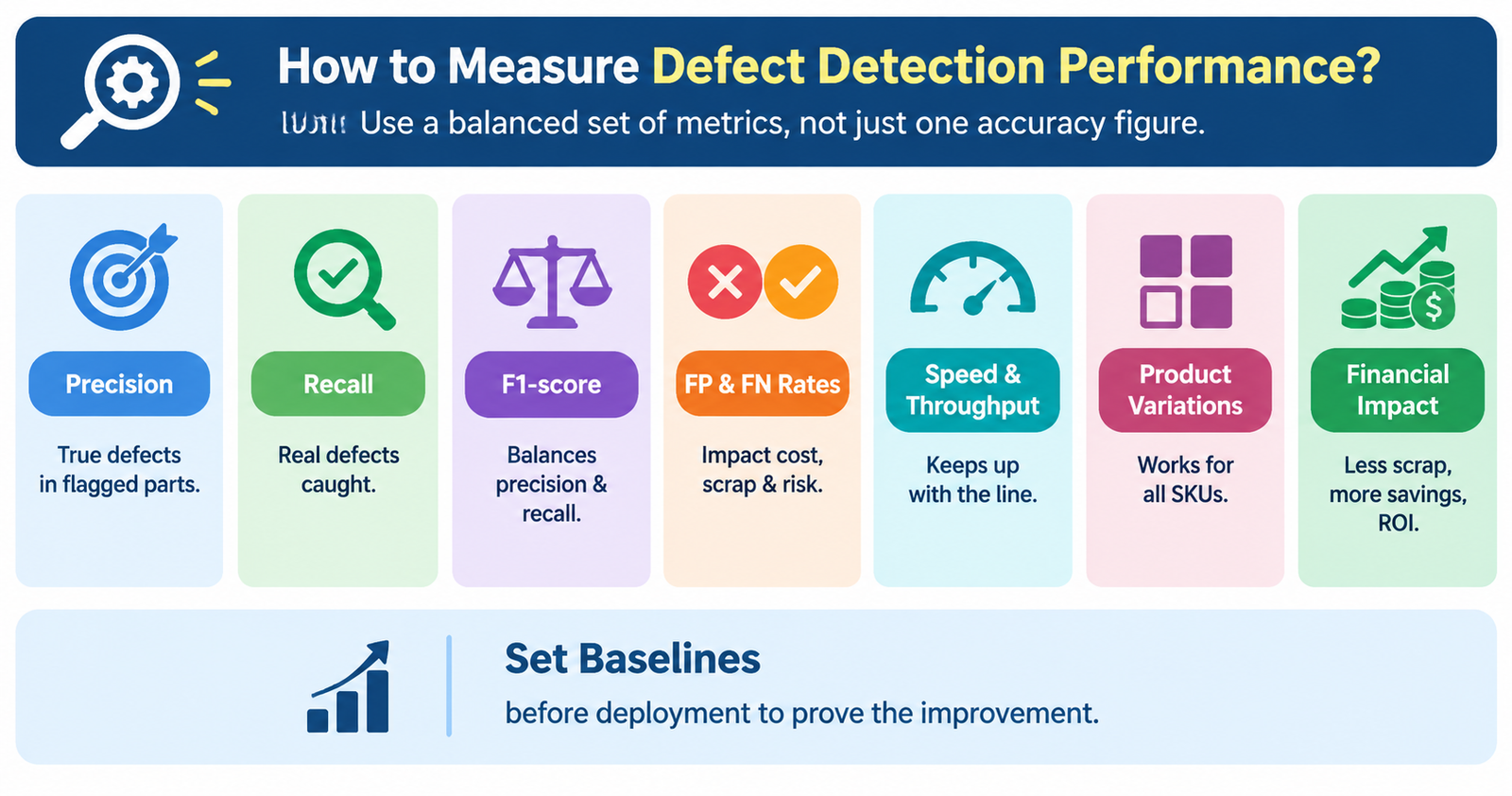
Use a balanced set of metrics rather than a single accuracy figure:
- Precision shows how many flagged parts are truly defective.
- Recall shows how many real defects the system catches.
- F1-score balances precision and recall into one number.
- False positive and false negative rates translate directly into cost, scrap, and customer risk.
- Inspection speed and throughput confirm the system keeps pace with the line.
- Performance across product variations shows whether results hold for all SKUs.
- Financial impact includes scrap reduction, labour savings, and return on investment.
Set baselines before deployment so you can prove the improvement.
Traditional Computer Vision or Multimodal AI: Which Should You Choose?
Traditional computer vision remains a strong choice when:
- The defect is visually clear and consistent
- The product and lighting are tightly controlled
- Speed and low cost matter more than contextual reasoning
Multimodal AI is usually worth the added complexity when:
- Defects depend on process conditions, not just appearance
- Product variation is high
- Explanations and root-cause analysis are needed
- Errors are expensive enough to justify richer data integration
Many manufacturers use both: a fast vision model for first-pass screening and a multimodal system for borderline cases.
What Does the Future Look Like?
Several trends are shaping the next generation of inspection systems:
- Edge AI will bring real-time decisions closer to the camera, reducing latency and dependence on network connections.
- Explainable AI will help quality engineers understand why a part was flagged, which builds trust and supports audits.
- Adaptive models will adjust more gracefully to new materials and production conditions.
- Smart factory integration will connect inspection data with planning, maintenance, and supply chain systems, supporting Industry 4.0 goals.
For companies looking to expand these capabilities, a provider offering full-stack computer vision solutions can help connect hardware, models, and business systems into a single workflow. Businesses in the UAE that want to automate this work alongside other operations often search for a multimodal operations dubai partner, since integrated automation across inspection, logistics, and reporting usually delivers more value than isolated tools.
Conclusion
Multimodal AI can reduce defect detection errors because it uses more evidence than a single image and more context than a fixed rule. Custom computer vision, trained on your own products and validated under real conditions, is what makes that approach reliable. Success depends on good data, honest validation, and continuous monitoring after deployment.
Manufacturers that start with a focused pilot, measure results against clear baselines, and expand step by step are the most likely to see lasting gains.
Frequently Asked Questions
Can multimodal AI improve defect detection accuracy?
Yes, in many cases. Combining visual data with sensor and process data gives the model more evidence, which can reduce both false alarms and missed defects. The actual improvement depends on data quality and validation.
What is the difference between multimodal AI and computer vision?
Computer vision analyses images. Multimodal AI analyses several types of input together, such as images, sensor readings, and text, to reach a more informed decision.
How does custom computer vision detect manufacturing defects?
It learns from labelled examples of good and defective parts captured on your own production line. The model then classifies, locates, or outlines defects based on those patterns.
Can multimodal AI reduce false positives in quality inspection?
It can, particularly when sensor or process context helps confirm whether a visual anomaly is a real defect. Careful threshold tuning and review of borderline cases also matter.
Which industries benefit most from AI-powered defect detection?
Automotive, electronics, pharmaceuticals, food processing, and textiles are among the most active adopters, especially where errors are costly or regulated.
How much data is required to train a custom defect detection model?
It varies widely. Simple classification tasks may need a few thousand labelled images, while complex or multimodal systems need more. Rare defects often require targeted data collection or synthetic augmentation.
Can multimodal AI integrate with existing quality control systems?
Yes. Most solutions connect to existing MES, ERP, PLC, and quality management platforms through standard interfaces, though integration effort depends on the age and openness of the current systems.