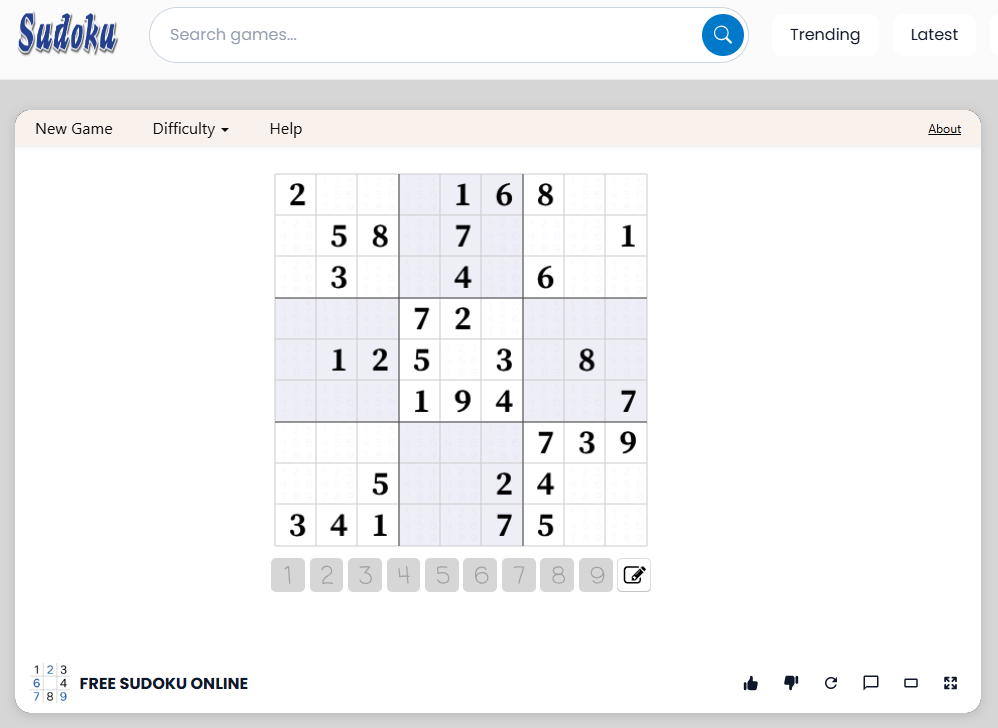
Sudoku is one of the most popular logic puzzle games in the world. Millions of players enjoy Sudoku every day because it offers a perfect combination of entertainment, concentration, and mental exercise. Unlike many games that depend on luck, Sudoku rewards logical thinking, careful observation, and strategic decision-making. Players of all ages can enjoy the challenge, whether they are complete beginners or experienced puzzle enthusiasts.
The classic Sudoku puzzle consists of a 9×9 grid divided into nine smaller 3×3 sections. The goal is simple: fill every empty space with a number from 1 to 9 while following specific rules. Each row, each column, and each 3×3 section must contain every number exactly once. Although the rules are easy to understand, solving a Sudoku puzzle can become increasingly challenging as difficulty levels rise.
Why Sudoku Remains Popular Around the World
Sudoku has maintained global popularity for many years because it offers a unique experience that appeals to different types of players. Some people enjoy Sudoku as a relaxing daily activity, while others see it as a way to sharpen cognitive skills.
One major reason for the enduring success of Sudoku is accessibility. The game requires no special equipment and can be played almost anywhere. Printed newspapers, puzzle books, websites, and mobile applications all provide convenient access to Sudoku puzzles.
Another reason for widespread popularity is the balance between simplicity and depth. New players can quickly learn the rules, yet advanced puzzles continue to challenge even the most experienced solvers. This combination keeps the game fresh and engaging over time.
A Puzzle for Every Skill Level
Sudoku offers a variety of difficulty settings. Easy puzzles provide a welcoming introduction for beginners, while medium and hard puzzles require more advanced reasoning techniques. Expert-level challenges can test patience, concentration, and analytical thinking for extended periods.
Because multiple difficulty levels exist, Sudoku remains enjoyable throughout a player’s journey from novice to expert.
Suitable for Different Age Groups
Children can benefit from Sudoku by developing logical thinking and pattern recognition skills. Adults often use Sudoku as a mental workout or stress-relief activity. Older players frequently enjoy Sudoku as a way to keep the mind active and engaged.
The universal appeal of Sudoku helps explain why the game continues to attract new players every year.
Understanding the Basic Rules of Sudoku
Learning Sudoku starts with understanding a few straightforward rules. Every puzzle follows the same foundation regardless of difficulty.
First, each row must contain the numbers 1 through 9 exactly once. No duplicate numbers can appear within the same row.
Second, each column must also contain the numbers 1 through 9 exactly once. Repeating a number in a column is not allowed.
Third, each 3×3 section must include all numbers from 1 to 9 without repetition. This rule creates additional constraints that guide the solving process.
When all three conditions are satisfied, the puzzle is complete.
Identifying Possible Numbers
Before placing a number into an empty cell, players should examine the corresponding row, column, and 3×3 section. Any number already present in these areas cannot be used in the empty space.
By eliminating impossible options, players can narrow down potential candidates and make logical decisions.
Building Confidence Through Practice
Beginners often improve rapidly through regular practice. As familiarity with common patterns increases, solving puzzles becomes faster and more intuitive. Repetition helps players recognize opportunities that may not be obvious during early attempts.
Effective Strategies for Solving Sudoku
Although every Sudoku puzzle is unique, several proven strategies can improve solving efficiency and accuracy.
One useful technique involves scanning rows and columns for missing numbers. When only a few spaces remain empty, identifying the correct placement often becomes much easier.
Another strategy focuses on individual 3×3 sections. Examining these smaller areas can reveal clues that might be overlooked when viewing the entire grid.
Using the Process of Elimination
The process of elimination is one of the most important Sudoku techniques. By identifying numbers that cannot fit into a specific cell, players gradually reduce available options until only one possibility remains.
This method forms the foundation of many successful solving approaches and remains valuable across all difficulty levels.
Looking for Hidden Patterns
More advanced Sudoku puzzles often require pattern recognition. Certain arrangements of candidate numbers can reveal valuable information about future placements.
As experience grows, players become more comfortable identifying these patterns and using them to solve complex sections of the puzzle.
Benefits of Playing Sudoku Regularly
Sudoku offers more than simple entertainment. Regular participation can provide several cognitive and personal benefits.
Many players enjoy the sense of accomplishment that comes from completing a challenging puzzle. Each solved grid represents a successful application of logic and persistence.
Sudoku also encourages focused attention. During gameplay, distractions often fade as concentration shifts toward analyzing the puzzle structure and available clues.
Supporting Logical Thinking
Every move in Sudoku requires reasoning based on existing information. Players continuously evaluate possibilities, eliminate incorrect options, and draw conclusions from observed patterns.
This process strengthens analytical thinking skills that may prove useful in various everyday situations.
Encouraging Patience and Persistence
Some puzzles can take considerable time to complete. Difficult challenges often require repeated analysis and careful consideration before progress becomes visible.
Working through these challenges helps develop patience, determination, and problem-solving confidence.
Digital Sudoku and Modern Gaming Experiences
Technology has transformed the way people enjoy Sudoku. Modern applications and websites offer thousands of puzzles across different difficulty levels.
Digital platforms provide helpful features such as note-taking tools, mistake detection, progress tracking, and daily challenges. These enhancements create a convenient and enjoyable experience for both casual and dedicated players.
Many online platforms also introduce themed events, timed competitions, and achievement systems that add extra motivation for regular participation.
Mobile Accessibility
Smartphones and tablets allow players to enjoy Sudoku virtually anywhere. Whether commuting, relaxing at home, or taking a short break during the day, a puzzle is always within reach.
This convenience has helped expand the global Sudoku community and attract new generations of players.
Endless Puzzle Availability
Unlike traditional puzzle books with a limited number of challenges, digital Sudoku platforms can generate virtually endless puzzles. This constant availability ensures that players always have fresh content to explore.
Conclusion
Sudoku remains one of the most rewarding logic puzzle games available today. Its simple rules, engaging challenges, and meaningful mental benefits have contributed to lasting popularity across the world. Whether solving an easy puzzle for relaxation or tackling an expert-level challenge for intellectual stimulation, Sudoku offers a satisfying experience for every type of player. With regular practice, thoughtful strategies, and a willingness to learn, anyone can enjoy the fascinating world of Sudoku and continue improving puzzle-solving skills over time.