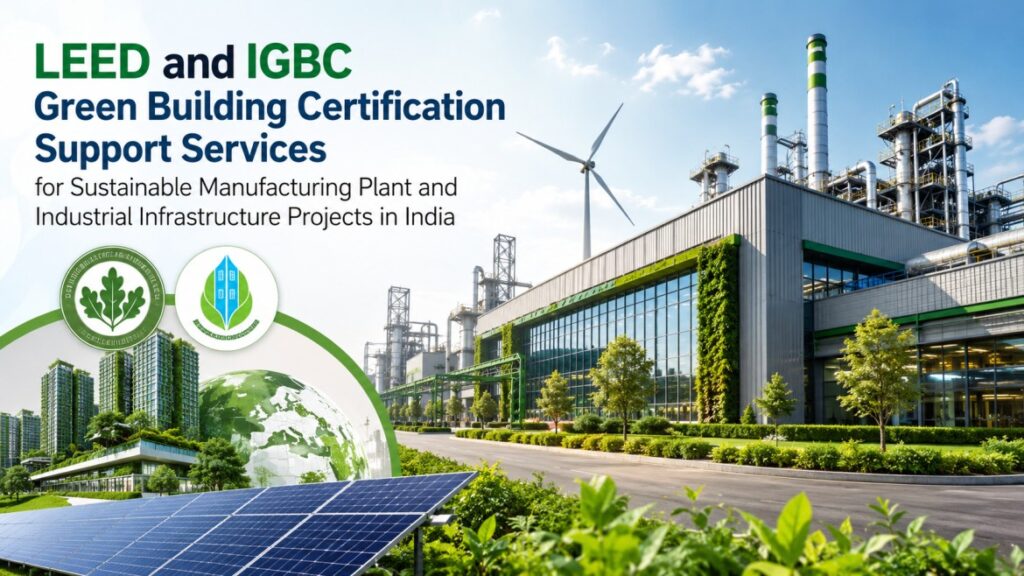
Industrial development in India is rapidly shifting toward sustainability, energy efficiency, and environmentally responsible infrastructure. Manufacturing companies, industrial park developers, logistics operators, and infrastructure investors are increasingly adopting green building standards to reduce operational costs, improve environmental performance, and align with global sustainability goals. In this transformation, LEED and IGBC certification frameworks have become highly important for modern industrial projects.
Businesses are now focusing on sustainable manufacturing facilities that support energy conservation, water efficiency, waste management, employee wellness, and long-term operational savings. This growing demand has significantly increased the requirement for professional green building certification support services across India.
Imarc Engineering offers comprehensive support for LEED and IGBC certification processes for industrial buildings, manufacturing plants, warehouses, processing units, and infrastructure facilities.
Speak with an EPCM Expert: https://www.imarcengineering.com/services/green-building-certification-support
Why Green Building Certification Matters for Industrial Projects in India
The industrial sector consumes a significant amount of energy, water, and natural resources. Traditional infrastructure practices often lead to high operational expenses, carbon emissions, and environmental inefficiencies. Green building certification systems help organizations design and operate facilities in a more sustainable and cost-effective manner.
LEED and IGBC certifications provide globally recognized frameworks for measuring environmental performance. These certifications encourage industries to implement energy-efficient systems, sustainable construction materials, smart water management strategies, and environmentally responsible operational practices.
For manufacturing companies, green certification offers several long-term advantages including:
- Reduced electricity and utility costs
- Better indoor environmental quality
- Lower environmental impact
- Improved ESG compliance
- Enhanced corporate reputation
- Higher asset value
- Better workforce productivity
- Easier regulatory alignment
Today, investors, multinational clients, and global supply chain partners increasingly prefer working with environmentally responsible manufacturers. This has made sustainable infrastructure consulting services an essential part of industrial project planning in India.
Understanding LEED and IGBC Certification Frameworks
LEED, developed by the U.S. Green Building Council, is one of the most recognized green building rating systems globally. It evaluates projects based on sustainability performance in areas such as energy efficiency, water conservation, indoor environmental quality, materials selection, and site sustainability.
IGBC, established by the Indian Green Building Council, focuses specifically on India’s environmental conditions, regulations, and construction practices. IGBC certification frameworks are widely adopted for factories, industrial parks, commercial facilities, educational institutions, and healthcare infrastructure across India.
Both certification systems provide rating levels based on project performance. These certifications help industries benchmark sustainability achievements and demonstrate commitment toward environmentally responsible infrastructure development.
Professional eco-friendly building certification consulting becomes essential because the certification process involves technical documentation, energy modeling, audits, compliance management, and coordination with multiple stakeholders.
Role of Sustainable Building Design Consultancy in Industrial Projects
Sustainability begins at the design stage of an industrial facility. Early planning decisions significantly influence energy consumption, operational efficiency, environmental impact, and lifecycle costs.
A professional sustainable building design consultancy helps industries integrate green infrastructure principles during conceptual planning, engineering design, and project execution phases. This proactive approach ensures that sustainability objectives are incorporated without increasing unnecessary project costs.
Key focus areas typically include:
- Building orientation optimization
- Natural lighting utilization
- Energy-efficient HVAC systems
- Water-efficient plumbing systems
- Renewable energy integration
- Sustainable material selection
- Waste reduction planning
- Smart industrial automation systems
- Heat reduction strategies
Manufacturing facilities often have unique operational requirements involving process equipment, production lines, ventilation systems, and heavy utility consumption. Therefore, green building strategies must be customized according to industrial operations rather than using generic commercial building approaches.
Imarc Engineering supports industries with practical sustainability planning aligned with production efficiency, operational feasibility, and certification requirements.
Green Building Compliance and Audit Services for Industrial Infrastructure
One of the most challenging aspects of green certification is maintaining compliance with technical standards and documentation requirements. Industrial projects involve multiple engineering disciplines, contractors, consultants, and operational teams, making coordination highly complex.
Professional green building compliance and audit services help organizations systematically manage certification requirements throughout the project lifecycle.
These services generally include:
- Sustainability gap analysis
- Compliance documentation review
- Construction phase monitoring
- Environmental performance assessment
- Material compliance verification
- Site audits and inspections
- Energy consumption analysis
- Water efficiency evaluation
- Waste management tracking
Regular compliance audits help identify potential non-conformities before certification submission. This reduces delays, minimizes rework, and improves the overall certification success rate.
Energy-Efficient Building Advisory Services for Manufacturing Facilities
Energy efficiency remains one of the most important pillars of green industrial infrastructure. Manufacturing plants are typically energy-intensive environments where electricity and fuel consumption significantly affect operating costs.
Professional energy-efficient building advisory services help industries optimize energy performance through engineering analysis, system optimization, and technology integration.
Major areas of energy optimization include:
HVAC System Efficiency
Industrial HVAC systems often contribute heavily to electricity consumption. Advanced ventilation controls, energy recovery systems, variable frequency drives, and efficient chillers can significantly reduce energy usage.
Lighting Optimization
LED lighting systems combined with occupancy sensors and daylight automation improve energy efficiency while enhancing workplace conditions.
Renewable Energy Integration
Solar rooftop systems, hybrid energy solutions, and renewable energy planning support sustainability targets and reduce grid dependency.
Process Utility Optimization
Industrial facilities rely on compressed air systems, steam systems, process cooling, and utility distribution networks. Optimizing these systems directly improves operational efficiency and green certification performance.
Building Envelope Performance
Proper insulation, reflective roofing, and energy-efficient glazing systems help reduce heat gain and cooling loads.
Strategic energy planning not only supports certification objectives but also delivers measurable operational savings over the long term.
Sustainable Infrastructure Consulting Services for Industrial Growth
India’s industrial growth is increasingly aligned with sustainable development initiatives, ESG commitments, and carbon reduction goals. Industrial developers and manufacturing companies are under growing pressure to establish environmentally responsible infrastructure that meets international standards.
Professional sustainable infrastructure consulting services help organizations integrate sustainability into large-scale industrial expansion plans.
These services support:
- Industrial corridor development
- Smart manufacturing infrastructure
- Green logistics parks
- Sustainable warehouses
- Industrial townships
- Export-oriented manufacturing facilities
- Food processing plants
- Pharmaceutical facilities
- Automotive manufacturing units
Modern industrial infrastructure requires a balance between operational productivity and environmental responsibility. Sustainability consultants help industries identify practical opportunities for reducing environmental impact without compromising business performance.
With increasing focus on ESG reporting and global sustainability standards, industrial investors are now prioritizing projects that demonstrate long-term environmental resilience and resource efficiency.
Importance of Green Factory Certification Consultancy in Modern Manufacturing
The concept of green factories is becoming increasingly important in India’s manufacturing ecosystem. Companies are now moving beyond traditional compliance models and adopting sustainability as a strategic business advantage.
Professional green factory certification consultancy helps manufacturing organizations create facilities that support:
- Lower carbon emissions
- Resource-efficient operations
- Sustainable production environments
- Employee health and wellness
- Environmental compliance
- Operational cost optimization
Green factory certifications also enhance brand credibility in global markets. International buyers and multinational corporations increasingly evaluate sustainability performance while selecting manufacturing partners and suppliers.
Industries such as automotive, electronics, pharmaceuticals, chemicals, textiles, and FMCG are actively investing in sustainable factory infrastructure to strengthen global competitiveness.
By implementing structured sustainability strategies, industries can improve environmental performance while achieving operational excellence.
Challenges in Achieving LEED and IGBC Certification
Although green certification provides multiple benefits, the implementation process can be technically demanding for industrial projects. Many organizations face challenges related to coordination, technical analysis, documentation, and compliance interpretation.
Common challenges include:
- Lack of sustainability planning during early design stages
- Difficulty in coordinating multiple stakeholders
- Incomplete compliance documentation
- Energy performance calculation complexities
- Limited awareness of certification prerequisites
- Construction phase deviations
- Material sourcing challenges
- Integration of sustainable systems with industrial operations
Professional certification consultants help industries overcome these challenges through structured planning, technical guidance, and project-specific sustainability strategies.
Future of Sustainable Industrial Infrastructure in India
India is witnessing rapid industrial expansion supported by government initiatives such as Make in India, smart manufacturing development, industrial corridor projects, and sustainable infrastructure programs.
At the same time, industries are increasingly expected to align with global sustainability standards, climate commitments, and ESG frameworks. This trend is accelerating the adoption of green building certifications across manufacturing and industrial infrastructure sectors.
Future industrial projects will increasingly focus on:
- Net-zero energy facilities
- Smart energy monitoring systems
- Carbon footprint reduction
- Circular economy models
- Sustainable material usage
- Renewable energy integration
- Water-positive infrastructure
- Green industrial ecosystems
Organizations that invest early in sustainable infrastructure development will gain long-term operational, financial, and reputational advantages.
Contact
IMARC Engineering
Phone: +91-120-433-0800
Email: sales@imarcengineering.com
India: C-130, Sector 2, Noida, Uttar Pradesh 201301
LinkedIn: https://www.linkedin.com/showcase/imarc-engineering/