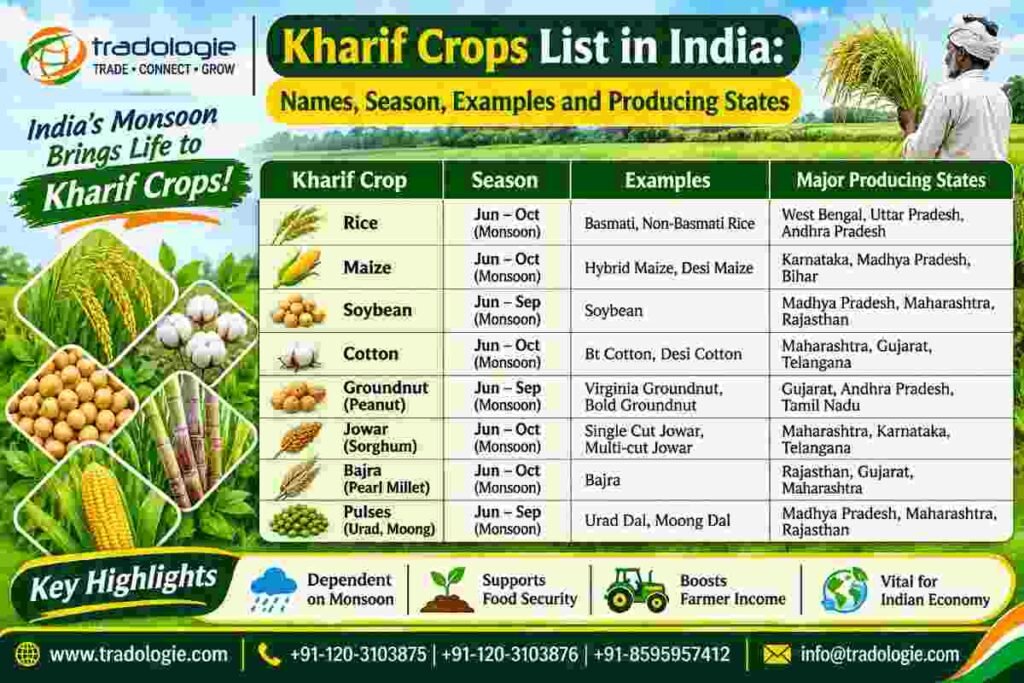
India’s monsoon season plays an important role in agricultural production. During this period, farmers cultivate several major crops, including rice, maize, cotton, soybean, groundnut, pulses and millets. These crops support food security, industrial manufacturing and agricultural trade. Understanding the Kharif crops list in India helps farmers, students, traders and agricultural businesses learn about seasonal cultivation, crop availability and major producing regions.
Kharif Crops List are generally sown with the arrival of the southwest monsoon and harvested towards the end of the rainy season or later, depending on the crop. Their growth is influenced by rainfall, temperature, soil conditions and regional farming practices.
What Are Kharif Crops?
Kharif crops are crops cultivated during India’s monsoon season. Sowing generally begins in June and July, when the southwest monsoon arrives, while harvesting usually starts from September and continues into November or later for some crops.
These crops generally require warm temperatures, suitable humidity and adequate water during their growing period. Rice, maize, soybean, cotton, groundnut and bajra are some common examples.
Quick Answer: Major Kharif crops in India include rice, maize, bajra, jowar, ragi, soybean, groundnut, cotton, sugarcane, arhar, moong and urad. Most are sown during June–July, with harvesting periods varying by crop and region.
Complete Kharif Crops List in India
The following Kharif Crops List covers major cereals, oilseeds, pulses, commercial crops, vegetables and spices grown during the monsoon season.
1. Cereal Kharif Crops
Cereals are an important category of monsoon crops and contribute significantly to India’s food supply.
- Rice (Paddy): West Bengal, Uttar Pradesh, Punjab, Andhra Pradesh and Telangana.
- Maize: Karnataka, Madhya Pradesh, Bihar and Andhra Pradesh.
- Bajra (Pearl Millet): Rajasthan, Gujarat, Haryana and Uttar Pradesh.
- Jowar (Sorghum): Maharashtra, Karnataka and Madhya Pradesh.
- Ragi (Finger Millet): Karnataka, Tamil Nadu and Andhra Pradesh.
Rice is one of India’s most important Kharif crops and is widely used for domestic consumption and international trade. Businesses interested in rice sourcing can explore Basmati Rice for relevant agricultural commodity categories.
2. Oilseed Kharif Crops
Oilseeds are used in edible oil production, food processing and several industrial applications.
- Soybean: Madhya Pradesh, Maharashtra and Rajasthan.
- Groundnut: Gujarat, Rajasthan, Andhra Pradesh and Tamil Nadu.
- Sesame (Til): West Bengal, Gujarat and Rajasthan.
- Castor: Gujarat, Rajasthan and Andhra Pradesh.
- Sunflower: Karnataka and Andhra Pradesh, including cultivation in suitable seasons.
Soybean and groundnut are particularly important because they contribute to India’s edible oil and oilseed supply chains.
3. Pulse Kharif Crops
Pulses are an important source of plant-based protein and are cultivated across different agricultural regions.
- Arhar (Tur Dal): Maharashtra, Karnataka, Madhya Pradesh and Uttar Pradesh.
- Moong (Green Gram): Rajasthan, Maharashtra and Andhra Pradesh.
- Urad (Black Gram): Madhya Pradesh, Uttar Pradesh and Andhra Pradesh.
- Moth Bean: Rajasthan and Gujarat.
These crops are used in households, food processing and wholesale commodity markets. Buyers can explore Pulses to discover different agricultural sourcing categories.
4. Cash and Fibre Kharif Crops
Commercial crops support industries such as textiles, sugar manufacturing and food processing.
- Cotton: Gujarat, Maharashtra, Telangana and Punjab.
- Sugarcane: Uttar Pradesh, Maharashtra, Karnataka and Tamil Nadu.
- Jute: West Bengal, Bihar and Assam.
Cotton is an important raw material for the textile industry, while sugarcane supports sugar and related manufacturing activities.
5. Vegetable and Spice Kharif Crops
Several vegetables and spices are also cultivated during the monsoon season.
Vegetables:
- Tomato
- Brinjal
- Okra (Bhindi)
- Bitter Gourd
- Bottle Gourd
Spices:
- Turmeric
- Ginger
- Chilli
These products support fresh produce markets, food processing companies and spice businesses. Explore Indian Spices for additional information about agricultural commodities.
Kharif Crops and Their Sowing and Harvesting Months
The sowing and harvesting periods of Kharif crops vary according to crop variety, rainfall and regional conditions.
| Crop | Sowing Period | Harvesting Period |
|---|---|---|
| Rice | June–July | September–November |
| Maize | June–July | September–October |
| Bajra | June–July | September–October |
| Jowar | June–July | September–October |
| Soybean | June–July | September–October |
| Groundnut | June–July | September–October |
| Arhar | June–July | October–December |
| Moong | June–July | September–October |
| Cotton | April–June, depending on region | October–December onwards |
| Turmeric | April–July, depending on region | January–March |
Difference Between Kharif and Rabi Crops
Kharif and Rabi are India’s two major cropping seasons. Their main difference is the weather conditions and time of cultivation.
| Feature | Kharif Crops | Rabi Crops |
|---|---|---|
| Season | Monsoon | Winter |
| Sowing | June–July | October–November |
| Harvesting | September onwards | March–April |
| Climate | Warm and humid | Cool and relatively dry |
| Water Source | Mainly monsoon rainfall | Mainly irrigation |
| Examples | Rice, Maize, Cotton | Wheat, Mustard, Gram |
Read our detailed Rabi Crops List in India to understand winter cultivation and its major crop varieties.
Importance of Kharif Crops in India’s Agricultural Trade
Kharif crops contribute to India’s food supply and support several industries. Rice, maize, cotton, soybean, groundnut and pulses are important commodities for farmers, wholesalers, manufacturers and exporters.
Understanding the Kharif crops list helps agricultural businesses:
- Plan procurement according to harvesting periods.
- Identify major crop-producing states.
- Understand seasonal commodity availability.
- Manage inventory and storage requirements.
- Explore domestic and international sourcing opportunities.
Tradologie is an AI-powered B2B trade platform connecting buyers and suppliers across agricultural and industrial product categories. Businesses can explore Agro Commodities and discover potential trading opportunities.
Interested businesses can register as a buyer or register as a seller to explore trade connections.
Frequently Asked Questions About Kharif Crops
1. What are the major Kharif crops in India?
Major Kharif crops include rice, maize, bajra, jowar, soybean, groundnut, cotton, sugarcane, arhar, moong and urad.
2. When are Kharif crops sown in India?
Most Kharif Crops List are sown during June and July with the arrival of the southwest monsoon. Actual sowing dates depend on rainfall and regional conditions.
3. Which is the most important Kharif crop in India?
Rice is one of India’s most important Kharif crops because it is a major staple food and an important agricultural commodity.
4. Which states are major producers of Kharif crops?
West Bengal, Uttar Pradesh, Punjab, Madhya Pradesh, Maharashtra, Gujarat, Rajasthan and Andhra Pradesh are among the important crop-producing states. The leading state differs by crop.
5. Are Kharif crops dependent on monsoon rainfall?
Yes. Most Kharif crops depend significantly on monsoon rainfall, although irrigation facilities can supplement water requirements when rainfall is insufficient.
Conclusion
Kharif Crops List are an essential part of India’s agricultural system. Rice, maize, soybean, cotton, groundnut, millets and pulses support food production, industrial activities and commodity markets.
Understanding the Kharif crops list in India, their sowing and harvesting periods and major producing states helps farmers and businesses make informed decisions about cultivation, procurement and trade. Better knowledge of seasonal crop availability can also help buyers and suppliers plan their agricultural business activities.