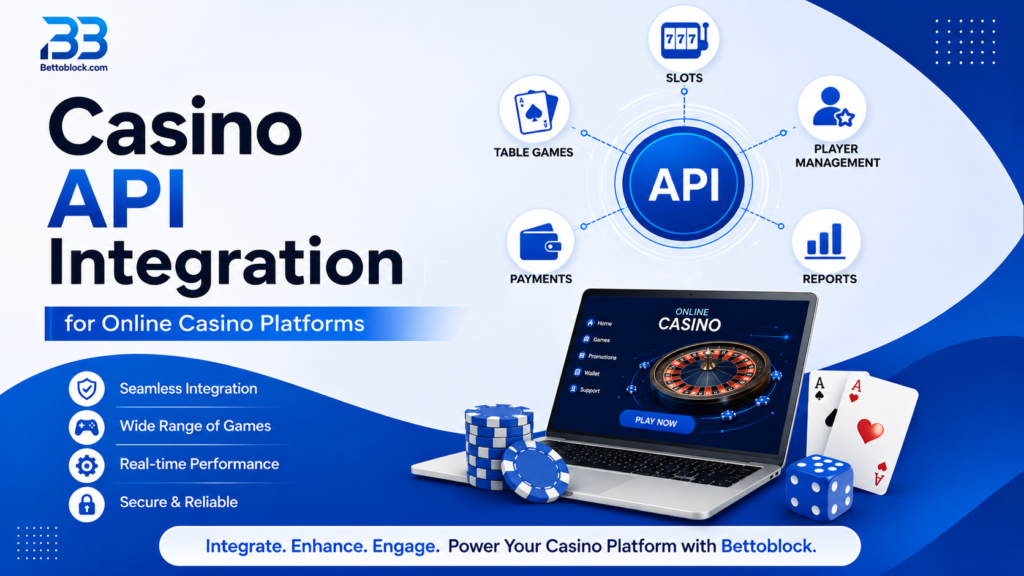
Building an iGaming platform requires multiple systems to communicate effectively, from casino games and player accounts to payments, reporting, promotions, and administrative tools. Connecting these components individually can increase development complexity. Casino APIs provide a structured way for gaming platforms to communicate with external services and add functionality without developing every component internally.
Working with suitable casino api providers can give businesses access to supported games, gaming content, data, and other platform functionality through defined technical connections. When API implementation is planned correctly, it can help businesses expand their game offerings, simplify certain development tasks, centralize platform management, and prepare their gaming products for future growth.
What Is Casino API Integration?
Casino API integration is the process of connecting an iGaming platform with an external gaming system through an Application Programming Interface.
An API defines how separate software systems request, receive, and exchange information.
Depending on the service being connected, casino APIs may support:
- Casino games
- Game categories
- Player sessions
- Game information
- Account functionality
- Transaction information
- Reporting
- Promotional functionality
- Platform management tools
- Third-party gaming services
The exact capabilities depend on the selected API.
Developers connect required endpoints to the platform backend and determine how external information should interact with user-facing and administrative systems.
1. Access to a Wider Game Portfolio
One of the main benefits of API integration is the ability to connect additional gaming content to an existing platform.
Developing every casino game internally can require significant design, development, testing, and maintenance resources.
APIs can provide another way to expand available content.
Depending on the connected services, businesses may be able to introduce different categories such as slots, card games, table games, instant games, or other supported products.
A broader selection can also help businesses organize their casino around different player preferences.
However, game quantity should not be the only consideration. Businesses should evaluate game quality, compatibility, technical requirements, and suitability for their intended audience.
2. Reduced Internal Development Requirements
Building every gaming component from the beginning can significantly increase project scope.
API integration allows development teams to connect existing external functionality where appropriate instead of recreating it internally.
This can allow internal development resources to focus on platform-specific requirements such as user experience, account functionality, administrative systems, reporting, and other business features.
The amount of work saved depends on the API.
External functionality still requires technical evaluation, implementation, testing, monitoring, and ongoing maintenance.
Businesses should therefore view APIs as development components rather than instant plug-and-play solutions.
3. Faster Addition of New Gaming Content
An iGaming platform may need additional games or services as its product strategy develops.
A properly structured integration architecture can make this expansion easier to manage.
Instead of rebuilding major parts of the platform whenever new content is introduced, developers can connect supported services through established integration processes.
This can reduce repetitive development work.
Before implementation, developers should still review documentation, authentication methods, data structures, endpoint behavior, and other technical requirements.
Each external service can operate differently, even when it provides similar functionality.
4. Centralized Platform Experience
Players generally expect gaming content to feel like part of the same platform.
A professional casino api integration service can connect external gaming functionality with the platform’s existing frontend and backend systems according to the technical capabilities of the API.
This can help businesses provide more consistent navigation and user journeys.
For example, users may be able to access different game categories through a common interface rather than moving between disconnected systems.
Developers should carefully determine which information and functionality can be centralized.
Some external systems may need to operate independently due to technical or business requirements.
5. Better Game Organization
A large game library can become difficult to navigate if content is not properly organized.
API data can help development teams classify supported games according to available information.
The frontend can then organize content into relevant categories.
These might include game types, popular titles, recently added games, or other groupings supported by the platform’s content strategy.
Search and filtering can also help users locate games more efficiently.
The exact navigation structure should depend on the size of the game catalog and the needs of the intended audience.
6. Support for Multi-Device Gaming
Casino platforms are commonly accessed through different devices.
API-based backend communication can support frontend applications designed for desktop computers, smartphones, and tablets.
The player interface still needs to be developed responsively.
Buttons, menus, game categories, search tools, account options, and other controls should remain usable on smaller screens.
Performance also requires attention.
Large game assets, unnecessary requests, and inefficient frontend code can affect mobile loading behavior.
API implementation should therefore be considered alongside frontend performance rather than treated as an isolated technical task.
7. Easier Platform Expansion
Businesses may launch with a limited gaming catalog and expand over time.
A modular architecture can make future additions easier to manage because external services are connected through defined interfaces.
Developers can understand which systems depend on each integration and how information moves between them.
This can be useful when introducing new games, payment services, analytics tools, communication systems, or other external functionality.
Future expansion should still be planned realistically.
Adding too many unnecessary integrations can increase maintenance requirements and make the overall architecture more difficult to manage.
8. Improved Backend Management
Casino API implementation can also support operator-facing functionality.
Depending on the connected service, relevant information may be processed and made available through administrative systems.
Operators may need access to areas such as:
- Game management
- Player activity
- Platform settings
- Reports
- Promotions
- Transaction information
- Integration monitoring
- User permissions
A clear administration system can reduce the amount of time teams spend moving between different management interfaces.
However, available functionality depends on what the external API provides and what the development team implements.
9. More Flexible Technical Architecture
APIs can help separate different parts of an iGaming platform.
Instead of developing one large application where every feature is tightly connected, development teams can structure external services around defined integration points.
This can make it easier to understand dependencies between systems.
For example, a game content service can be handled separately from a payment service or communication platform.
If one external service experiences an issue, developers can design the platform so unrelated functionality is not unnecessarily affected.
The exact architecture should be based on project requirements, security considerations, provider terms, and expected usage.
10. Better Monitoring and Error Management
External integrations need monitoring.
API requests can fail because of authentication problems, service interruptions, request limits, timeouts, or unexpected responses.
A properly developed integration can include logging, monitoring, alerts, and controlled error handling.
These systems help technical teams understand what happened when an issue occurs.
Developers should also test failure scenarios before deployment.
Testing only successful requests does not show how the platform will behave when an external service becomes temporarily unavailable.
11. Support for Sweepstakes Casino Platforms
Businesses expanding into alternative gaming models may work with a sweepstakes casino software provider to introduce platform functionality appropriate to their intended product.
From a technical perspective, APIs can connect relevant games and external services with player-facing and administrative systems.
However, sweepstakes products can have different operational requirements from other gaming platforms.
Businesses should define the intended model clearly before development begins.
They should also obtain appropriate professional legal guidance for the jurisdictions in which they intend to operate.
12. Greater Control Through Custom Development
Businesses with specific requirements may consider sweepstakes software development when an existing solution does not provide the required functionality or technical control.
Custom development can give teams greater influence over platform architecture, user flows, administrative tools, virtual currency functionality, reporting, and third-party integrations.
APIs can then be introduced where external services are required.
A clear technical specification should be created before development begins.
This helps determine which functionality should be developed internally and which can reasonably be provided by external services.
13. Support for Custom Casino Development
An online casino game development company can use APIs as part of a larger casino development project.
For example, a business may require custom frontend experiences while connecting external games or supporting services through backend integrations.
The development team should determine how these external components fit into the overall architecture.
API implementation should be planned alongside account functionality, navigation, reporting, administrative controls, and other platform systems.
Treating integrations as part of the initial architecture can reduce unnecessary technical changes later.
14. More Options for Product Development
Working with an experienced casino game development company can also help businesses decide which gaming components should be developed internally and which should be connected through third-party services.
Not every feature needs to be built from scratch.
At the same time, relying excessively on external services can create dependencies and recurring costs.
Businesses should evaluate each requirement individually.
The decision should consider development cost, implementation time, technical control, maintenance, API restrictions, and long-term product plans.
A balanced architecture can combine custom functionality with appropriate external services.
15. Improved Scalability Planning
As a casino platform attracts more users or adds more games, technical requirements can change.
API integrations should therefore be designed with expected usage in mind.
Developers should review request limits, authentication methods, response sizes, update frequency, and provider restrictions.
The backend architecture should also avoid unnecessary requests.
For example, if the same external information is needed by multiple parts of the application, developers can evaluate whether it should be processed centrally rather than requested independently every time.
The appropriate approach depends on provider terms and technical requirements.
16. Easier Addition of Third-Party Services
Casino platforms often use more than game APIs.
Businesses may need connections for payments, analytics, communication, identity services, reporting, or other platform functions.
A well-planned integration architecture makes it easier for developers to understand how these services connect with the platform.
Each new integration should still go through technical review.
Developers should evaluate documentation, security requirements, credentials, data handling, request limits, and failure behavior before implementation.
Maintaining clear documentation for every connection can also simplify future maintenance.
17. Better Data Flow Between Platform Components
Different parts of a casino platform may need to exchange information.
API architecture can define how this information moves between external services, backend applications, frontend interfaces, and administrative systems.
Clear data flows reduce confusion during development.
They also make it easier for technical teams to identify which system is responsible for specific information.
When multiple external services are involved, developers may create internal data models to standardize information.
This can reduce problems caused by different external data formats and identifiers.
18. Stronger Security Controls
Casino API integration also requires careful security planning.
Sensitive API keys and tokens should be stored appropriately and should not be unnecessarily exposed through frontend applications.
Backend services can manage external communication where appropriate.
Developers should also consider authentication, authorization, encrypted communication, request validation, access controls, credential rotation, logging, and monitoring.
Administrative permissions should be restricted according to employee responsibilities.
Security should continue after launch through monitoring, updates, and appropriate maintenance.
What Should Businesses Check Before Integrating a Casino API?
Before selecting an API, businesses should evaluate both technical and commercial factors.
Important questions include:
- Which games or services are available?
- What documentation is provided?
- How does authentication work?
- Are there request limits?
- What data formats are used?
- How are errors communicated?
- What technical support is available?
- What are the pricing terms?
- Can the service support expected usage?
- How are updates communicated?
- What happens during service interruptions?
- Can additional functionality be introduced later?
The technical team should ideally review documentation before a final integration decision is made.
This can reveal requirements that may not be obvious from marketing materials.
How Much Does Casino API Integration Cost?
There is no universal cost for integrating a casino API.
Pricing depends on the external service as well as the amount of development required to connect it with the platform.
Important cost factors can include:
- API licensing or access fees
- Number of integrations
- Backend development
- Frontend development
- Data mapping
- Authentication
- Administrative functionality
- Testing
- Security requirements
- Monitoring
- Infrastructure
- Maintenance
Businesses should calculate both initial implementation costs and ongoing expenses.
An inexpensive initial integration can become costly if the service has high recurring fees or requires extensive maintenance.
How Bettoblock Helps With Casino API Integration
Bettoblock provides sports betting and gaming software development solutions for businesses planning new platforms or expanding existing products.
Its development capabilities can cover casino game development, sportsbook technology, frontend and backend development, API implementation, player functionality, administrative dashboards, payment connections, third-party integrations, responsive interfaces, testing, deployment, and ongoing technical support.
Bettoblock can help businesses evaluate API requirements and determine how external gaming services should connect with the wider platform architecture.
The development process can also consider future gaming and sportsbook expansion so businesses have a clearer technical roadmap for additional functionality.
Conclusion
Casino API integration can provide several benefits for iGaming platforms, from expanding game libraries and reducing certain internal development requirements to improving platform organization and supporting future product growth.
However, successful implementation requires more than connecting an endpoint.
Businesses need to evaluate API documentation, available functionality, security, request limits, performance, pricing, error handling, monitoring, and future development requirements.
A well-planned integration strategy can help development teams connect external gaming services while maintaining clear relationships between the frontend, backend, administrative systems, and other platform components.
Bettoblock helps businesses plan, develop, integrate, test, and maintain casino and sports betting technology based on defined project requirements. By combining appropriate API services with custom development where needed, businesses can create gaming platforms that are easier to manage and expand as their product requirements evolve.