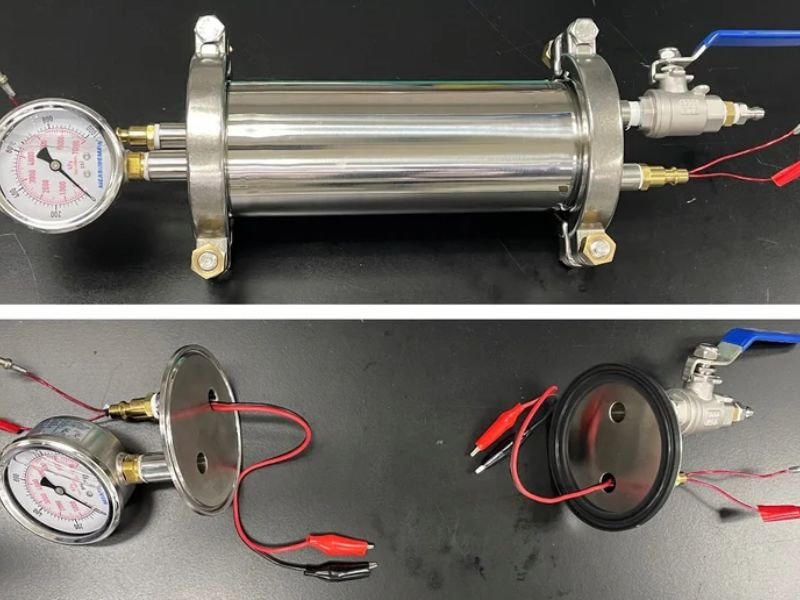
Battery research often depends on more than the active materials inside a cell. Pressure, temperature, electrode contact, and test configuration can all influence results. For teams developing solid state batteries, controlled pressure testing is especially important because solid materials need reliable physical contact to perform consistently. Ampcera supports battery researchers with materials, equipment, and engineering services designed around next generation energy storage. One useful laboratory tool is the Isostatic Pouch Cell Testing Vessel, which can provide a controlled environment for evaluating pouch cell designs under isostatic pressure. Understanding how this type of vessel works and why pressure matters can help researchers design better experiments and compare results more confidently.
What Is an Isostatic Pouch Cell Testing Vessel?
An Isostatic Pouch Cell Testing Vessel is a pressure testing tool designed to help researchers evaluate pouch cells while applying controlled pressure around the cell. In conventional battery testing, pressure may be applied through fixtures or plates. Isostatic testing takes a different approach by applying pressure more uniformly around the pouch cell.
This can be useful for solid state battery development. Solid electrolytes and composite electrodes can have different mechanical characteristics from conventional liquid electrolyte systems. Maintaining contact between the different layers may influence resistance, cycling behavior, and overall cell stability.
The vessel therefore becomes part of the testing setup rather than simply being a container. Researchers can use controlled mechanical conditions alongside electrical measurements to better understand how a cell behaves.
Why Is Pressure Important in Battery Testing?
Pressure can influence the interfaces between electrodes and solid electrolytes. If contact is poor, gaps or high resistance regions may develop. Appropriate pressure can help maintain physical contact and create more consistent interfaces.
The ideal pressure is not identical for every cell. It can depend on electrolyte chemistry, electrode structure, cell dimensions, material properties, temperature, and the research objective. This is why a controllable testing environment is valuable.
When researchers can keep pressure conditions consistent, they can make more meaningful comparisons between different materials and cell designs. Instead of treating pressure as an uncontrolled variable, they can include it as a deliberate part of the experiment.
How Does Isostatic Testing Support Solid State Batteries?
Solid state batteries replace the liquid electrolyte used in many conventional cells with a solid electrolyte. This approach has attracted interest because solid electrolytes may enable new cell architectures and potentially higher energy density.
However, solid state systems introduce their own development challenges. The interfaces between solid layers need to remain stable, and mechanical contact can be important during cycling. Changes in volume, pressure, temperature, and material properties can all affect the behavior of a test cell.
An Isostatic Pouch Cell Testing Vessel can help researchers study these conditions in a controlled way. By applying pressure around the pouch cell, researchers can investigate how the cell responds while keeping the mechanical environment more consistent.
This can be particularly useful during early development, when teams are comparing electrolyte formulations, electrode compositions, or processing methods.
What Can Researchers Learn From Controlled Pressure Tests?
A controlled pressure experiment can provide useful information about several aspects of cell performance. Researchers may compare capacity retention, voltage behavior, impedance, cycling stability, and other measurements under different mechanical conditions.
For example, a team may test the same pouch cell at several pressure levels. If performance changes significantly, that result can indicate that mechanical contact is an important factor in the cell design.
Pressure testing can also help separate material problems from assembly problems. A cell that performs poorly under one condition but improves with better contact may require an engineering adjustment rather than a completely different chemistry.
Important factors to monitor include:
- Applied pressure and pressure consistency
- Cell temperature during testing
- Electrode and electrolyte composition
- Cell dimensions and construction
- Cycling current and voltage range
- Capacity retention over repeated cycles
- Impedance or resistance changes
- Mechanical behavior during cycling
Keeping these variables documented makes experimental results easier to reproduce and interpret.
Why Are Pouch Cells Useful for Battery Development?
Pouch cells provide a practical format for moving beyond small laboratory structures. They can accommodate larger electrode areas and more representative cell configurations than some small test formats.
For solid state battery researchers, pouch cells can also help bridge the gap between material level experiments and larger prototype development. However, scaling a cell can introduce new challenges related to pressure distribution, layer alignment, electrode loading, and manufacturing consistency.
An Isostatic Pouch Cell Testing Vessel can be useful in this stage because it gives researchers a way to study pouch cells while controlling an important mechanical variable.
The value of such equipment is not limited to one chemistry. Depending on the design and research program, controlled pressure testing may support investigations involving different solid electrolyte systems and electrode combinations.
What Makes Isostatic Pressure Different?
The term isostatic refers to pressure being applied in a relatively uniform manner from multiple directions. This differs from a simple clamping setup where force may be concentrated through particular surfaces or points.
Uniform pressure can help reduce some of the uncertainty associated with uneven mechanical loading. For researchers studying solid state cells, this can make experimental conditions easier to define.
It is still important to characterize the actual pressure conditions and understand how the vessel interacts with the pouch cell. Equipment specifications, cell geometry, temperature, and test protocol should all be considered when interpreting results.
How Does Ampcera Support Battery Research?
Ampcera develops materials and engineering solutions for next generation energy storage. Its portfolio includes sulfide solid electrolytes, coated cathode materials, dry processing services, electrolyte film services, and battery research equipment.
The company’s approach connects materials development with practical battery engineering. This can be valuable for researchers who need to evaluate materials under realistic experimental conditions rather than studying each component in isolation.
An Isostatic Pouch Cell Testing Vessel can complement this broader research workflow by providing a controlled platform for pouch cell evaluation. Researchers can investigate how material selection and processing choices translate into complete cell behavior.
This type of equipment is especially relevant when teams move from powder and electrode experiments toward prototype pouch cells.
Designing a Better Battery Testing Workflow
Good battery testing starts with a clearly defined experimental question. Before using a pressure vessel, researchers should determine what they want to learn from the test.
A useful workflow may include:
- Define the cell chemistry and research objective.
- Prepare electrodes and solid electrolyte layers consistently.
- Assemble pouch cells using a repeatable process.
- Establish the target pressure and temperature conditions.
- Record electrical and mechanical test parameters.
- Cycle cells under controlled conditions.
- Compare results across pressure levels or material formulations.
- Review performance together with impedance and physical observations.
This approach helps researchers avoid drawing conclusions from a single measurement. Battery performance is usually the result of several interacting factors, so controlled experiments are important.
Can Pressure Testing Improve Experimental Repeatability?
It can help by making pressure a measurable and controlled variable rather than an uncertain part of cell assembly. Repeatability still depends on many other factors, including material quality, electrode preparation, pouch construction, temperature control, and testing procedures.
Researchers should therefore use consistent protocols and document the conditions of every test. Repeated measurements can provide a stronger basis for identifying real trends.
What Should Researchers Consider Before Choosing Equipment?
Before selecting a pressure testing system, teams should consider the type and size of cells they plan to evaluate. They should also review the required pressure range, temperature conditions, safety requirements, measurement setup, and compatibility with their research workflow.
Other useful questions include:
- What pouch cell dimensions can the equipment accommodate?
- How is pressure applied and controlled?
- How easily can cells be installed and removed?
- What temperature conditions are supported?
- Can the setup work with the planned cycling equipment?
- What measurements need to be collected during testing?
- Is the equipment appropriate for the intended development stage?
Answering these questions early can help researchers choose equipment that fits their actual testing needs.
Frequently Asked Questions
What is the purpose of this testing vessel?
An Isostatic Pouch Cell Testing Vessel is used to evaluate pouch cells under controlled isostatic pressure. It can be useful for studying how mechanical conditions affect cell performance, particularly in solid state battery research.
Why is controlled pressure useful for solid state cells?
Controlled pressure can help maintain contact between solid layers and allows researchers to study pressure as an experimental variable. The appropriate pressure depends on the materials and cell design.
Is this equipment only for solid state batteries?
The primary research value is particularly relevant to systems where pressure and solid interfaces matter. However, the suitability of any pressure vessel depends on its specifications and the intended cell configuration.
What results can researchers evaluate?
Teams can examine electrical performance, cycling behavior, impedance, capacity retention, and changes associated with different pressure conditions. The exact measurements depend on the test protocol.
Conclusion
Reliable battery development requires careful control of both materials and testing conditions. Pressure is an especially important variable when researchers work with solid electrolytes and solid interfaces. An Isostatic Pouch Cell Testing Vessel can provide a controlled way to investigate pouch cells under defined mechanical conditions, helping teams understand the relationship between pressure, interfaces, and electrochemical performance. Ampcera’s combination of advanced materials, processing services, and battery research equipment supports a practical development path from material investigation to prototype testing. By using repeatable cell preparation, controlled pressure, and well documented test procedures, researchers can generate clearer results and make better informed decisions as they develop next generation solid state battery technologies.