The UAE isn’t just adopting IoT — it’s building an economy around it. From Dubai’s smart buildings to Abu Dhabi’s connected ports, sensors and real-time data are quietly becoming the backbone of how the country runs. For any enterprise operating here, the question isn’t whether to invest in connected technology anymore. It’s who to build it with.
That’s where an IoT development company UAE businesses can actually rely on becomes the deciding factor between a pilot project that stalls and a system that scales across an entire operation.
UAE’s IoT integration market generated close to USD 79 million in 2024 and is projected to grow to USD 445 million by 2030, expanding at a compound annual growth rate of roughly 32%. Add in IoT devices — sensors, actuators, edge hardware — and that figure climbs into the billions. The push comes from a mix of national digital strategy, a tech-hungry population, and a business environment where operational efficiency isn’t optional; it’s expected.
Enterprises across healthcare, logistics, real estate, manufacturing, and government are investing in IoT solutions in UAE because the alternative — running on legacy, disconnected systems — is a competitive disadvantage. Predictive maintenance cuts downtime. Smart building sensors cut energy bills. Real-time fleet tracking cuts fuel waste. The ROI case has moved from theoretical to proven.
This guide walks through where the UAE’s IoT market stands today, what a development partner actually does, which industries are leading adoption, the trends shaping 2026, and how to choose the right IoT development company in UAE for a project that needs to work the first time — not the third. Whether you’re evaluating your first pilot or scaling a system that’s already proven itself at one site, the decisions covered here — architecture, cloud platform, security model, and vendor fit — tend to matter far more to the outcome than the specific sensor brand on the label.
UAE IoT Market Overview
Current Market Size
The numbers tell a consistent story: UAE IoT spending is accelerating faster than most of the region. Industry research puts the UAE’s IoT integration market at roughly USD 79.1 million in 2024, with projections placing it at USD 445.2 million by 2030 — a CAGR near 32.3% for the back half of this decade. On the hardware side, the picture is even bigger: the UAE IoT devices market generated close to USD 976.7 million in 2024 and is expected to reach USD 3,022.5 million by 2030, growing at roughly 20.4% annually, with sensors leading today’s spend and edge devices posting the fastest growth of any hardware category.
Put plainly, that means device and integration spend in the UAE is on track to roughly quadruple within six years. For a business still running on manual inspections or paper-based maintenance logs, that gap only widens the longer a decision gets delayed.
The UAE’s IoT integration market is projected to grow from roughly USD 79 million in 2024 to USD 445 million by 2030 — a 32.3% CAGR — while the broader IoT devices market is set to nearly triple to over USD 3 billion in the same period.
Future Growth Forecast
Growth isn’t slowing down after 2026 — it’s compounding. The UAE IoT sensors segment alone is projected to grow above 26.5% annually between 2026 and 2031, pushed forward by smart city initiatives, energy efficiency mandates, and tighter digital governance frameworks. That’s a market where waiting two or three years to invest means competing against businesses that already have a two-year head start on the data those systems produce.
It also means the vendor landscape itself is shifting. Providers that were purely hardware resellers a few years ago are being pushed toward full-stack development — because clients don’t want a box of sensors, they want a working system. That consolidation is worth factoring into any long-term partner decision, since a vendor built only around one narrow slice of the stack may not be around, or may not be enough, three years from now.
Government Initiatives Driving IoT
Public sector strategy has done more to accelerate UAE IoT adoption than any single private-sector trend.
Smart Dubai set the template early, pushing city services, transport, and utilities toward connected infrastructure — and normalizing IoT as standard practice rather than an innovation experiment.
Abu Dhabi Digital Strategy followed with its own push toward smart government services, connected transport, and data-driven public administration, giving enterprises operating in the capital a clear regulatory direction to build around.
UAE Digital Economy Strategy ties it together at the federal level, targeting a larger share of GDP from digital sectors and pushing both public agencies and private companies to modernize. Businesses working with government contracts increasingly need IoT-ready systems just to stay compliant with procurement expectations — a trend closely tied to the broader shift toward Government IT Solutions Dubai.
Taken together, these three strategies do more than set direction — they create demand on a schedule. When a government entity commits to a smart-infrastructure milestone, every vendor and contractor feeding into that project needs systems built to match, on that timeline. That’s part of why IoT development in Dubai and across the wider Emirates tends to move in coordinated waves rather than the scattered, company-by-company pace seen in less centrally planned markets.
Impact of 5G Expansion
5G is the multiplier behind nearly every IoT trend on this list. The UAE’s 5G-powered IoT segment generated around USD 156.5 million in 2024 and is on track to reach USD 1,712.3 million by 2030 — a CAGR near 49%, making it by far the fastest-growing IoT category in the country. Lower latency and higher device density mean applications that were previously impractical — real-time video analytics, autonomous vehicle coordination, dense industrial robotics — are now commercially viable rather than lab experiments.
For enterprises, that shift changes the planning conversation. A project that got shelved two years ago because the network couldn’t support it may well be feasible today, on the same budget, simply because the underlying connectivity has caught up.
What Does an IoT Development Company Do?
An IoT development company UAE businesses hire doesn’t just write code. It builds the entire chain that turns a physical sensor reading into a business decision — the same full-stack scope covered by any established IoT Software Development Company in Dubai. Here’s what that actually involves:
- IoT Consulting — assessing where connected devices create real ROI before a single line of code gets written, so budget doesn’t get burned on the wrong use case.
- Hardware Integration — selecting and connecting sensors, gateways, and controllers so they talk to each other reliably, even in harsh industrial or outdoor environments.
- Firmware Development — writing the low-level code that runs directly on devices, controlling how they collect, process, and transmit data.
- Edge Computing — processing data on or near the device itself instead of sending everything to the cloud, cutting latency and bandwidth costs.
- IoT Cloud Development — building the backend infrastructure that ingests, stores, and processes device data at scale.
- Mobile Apps — giving operations teams and customers a way to monitor and control connected assets from anywhere.
- Dashboard Development — turning raw telemetry into visual, actionable reporting for decision-makers.
- Device Management — remotely monitoring, updating, and troubleshooting thousands of deployed devices without physically touching each one.
- Security — encrypting device communication, managing authentication, and patching vulnerabilities before they become breaches.
- Maintenance — the ongoing work of keeping firmware current, hardware calibrated, and systems running after launch.
A partner that only handles one or two of these ends up forcing the client to coordinate three or four vendors — which is exactly where most IoT projects fall apart. Somebody has to own the handoff between the hardware team and the cloud team, and if that somebody is an internal project manager without deep IoT background, gaps get missed until they show up as production incidents.
That’s the practical argument for a single accountable partner over a patchwork of specialists: not that any one vendor is bad at their piece, but that IoT projects fail most often at the seams between pieces, not inside them.
Industries Driving IoT Adoption in UAE
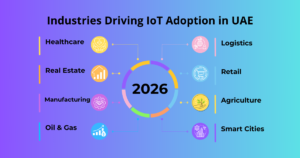
No single sector is carrying UAE IoT adoption on its own — it’s happening in parallel across at least eight industries, each with a different reason for investing and a different definition of “success.” A hospital measures IoT ROI in fewer missed alerts; a logistics fleet measures it in fuel saved. Here’s how that plays out sector by sector.
Healthcare
Use cases: remote patient monitoring, connected medical equipment, hospital asset tracking, cold-chain monitoring for vaccines and medication. Business benefits: fewer readmissions, better equipment utilization, faster emergency response. Typical devices: wearable vital-sign monitors, smart infusion pumps, RFID asset tags.
UAE hospitals adopting connected monitoring are seeing measurable drops in missed critical alerts, which is pushing more providers toward a dedicated healthcare software development company Dubai rather than generic IT vendors.
Real Estate
Use cases: smart access control, predictive HVAC maintenance, occupancy-based energy management. Business benefits: lower utility costs, higher tenant satisfaction, reduced maintenance callouts. Typical devices: smart locks, occupancy sensors, connected thermostats.
Developers building premium residential and commercial towers increasingly treat IoT as a baseline expectation, not a luxury add-on — a shift covered in more depth by any established real estate software development company Dubai.
Manufacturing
Use cases: predictive maintenance, production line monitoring, quality control automation. Business benefits: reduced unplanned downtime, lower defect rates, better throughput visibility. Typical devices: vibration and temperature sensors, industrial PLCs, machine vision cameras.
Oil & Gas
Use cases: pipeline leak detection, remote well monitoring, equipment health tracking in hazardous zones. Business benefits: fewer safety incidents, lower inspection costs, faster fault detection. Typical devices: pressure sensors, gas detectors, ruggedized IoT gateways.
Logistics
Use cases: real-time fleet tracking, cold-chain monitoring, warehouse automation. Business benefits: reduced fuel costs, fewer spoiled shipments, faster delivery cycle times. Typical devices: GPS trackers, RFID readers, temperature loggers.
Fleet-heavy operators across the UAE are increasingly turning to specialized logistics software development Dubai teams to connect tracking hardware with dispatch and inventory systems in one platform.
Retail
Use cases: smart shelving, foot-traffic analytics, automated inventory tracking. Business benefits: reduced stockouts, better store layout decisions, lower shrinkage. Typical devices: RFID tags, smart shelf sensors, people-counting cameras.
Agriculture
Use cases: soil moisture monitoring, greenhouse climate control, automated irrigation. Business benefits: lower water usage, higher crop yield consistency, reduced labor dependency. Typical devices: soil sensors, weather stations, automated irrigation valves.
With the UAE pushing food security as a national priority, demand for smart agriculture solutions Dubai has grown well beyond pilot farms into commercial-scale greenhouse operations.
Smart Cities
Use cases: connected streetlights, traffic flow management, smart waste collection. Business benefits: lower municipal operating costs, better urban planning data, improved resident quality of life. Typical devices: smart streetlight controllers, traffic sensors, fill-level waste sensors.
Across all eight sectors, the pattern repeats: the businesses seeing the clearest returns aren’t the ones with the most sensors — they’re the ones that picked one high-value use case, proved it worked, then expanded deliberately rather than trying to connect everything at once.
Latest IoT Trends in UAE (2026)
AI + IoT (AIoT)
Pairing machine learning with connected devices is where most of the 2026 value creation is happening.
- Predictive Maintenance — models trained on sensor data flag equipment failures days or weeks before they happen, instead of after a breakdown.
- Computer Vision — cameras paired with AI now handle quality inspection, security monitoring, and occupancy counting without a human watching a feed.
- Machine Learning — continuously improving models mean IoT systems get more accurate the longer they run, not just at deployment.
AIoT combines artificial intelligence with connected sensors so systems don’t just collect data — they interpret it and act on it, turning predictive maintenance, automated quality checks, and real-time anomaly detection into standard business tools rather than experimental features.
Edge Computing
Benefits: lower latency, reduced cloud bandwidth costs, continued operation even during connectivity drops. Industries: manufacturing, oil & gas, and retail are the fastest adopters, largely because they can’t afford the round-trip delay of sending every data point to a distant server.
5G Powered IoT
- Ultra-low latency enables applications where even a half-second delay is unacceptable.
- Real-time analytics on high volumes of sensor data becomes practical rather than theoretical.
- Connected vehicles benefit most directly, with 5G enabling vehicle-to-infrastructure communication that older networks simply couldn’t support.
Digital Twins
Virtual replicas of physical assets are moving from concept to production use in the UAE, particularly for industrial monitoring — simulating equipment behavior before committing to a costly physical change — and facility management, where a digital twin of a building lets operators test HVAC or lighting adjustments virtually first.
Sustainability IoT
Given the UAE’s net-zero targets, sustainability-linked IoT is no longer a side project:
- Smart Energy — automated load balancing and demand response systems.
- Carbon Monitoring — sensor networks tracking emissions in real time for compliance reporting.
- Water Management — leak detection and usage monitoring across large properties and municipal networks.
Smart Buildings
- HVAC systems that adjust automatically based on occupancy and weather, not fixed schedules.
- Lighting that responds to natural light levels and room usage.
- Access Control integrated with identity systems rather than standalone key-card readers.
- Occupancy Analytics feeding space-planning decisions for commercial landlords.
None of these six trends operate in isolation — a modern smart building project typically combines edge computing, 5G connectivity, and AIoT-driven predictive maintenance in the same deployment. Treating them as separate initiatives usually means paying for the same infrastructure three times instead of once.
Top IoT Development Companies in UAE
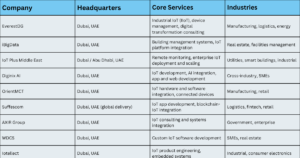
The UAE’s vendor landscape is crowded, but not all IoT companies in Dubai operate at the same depth. Some specialize in a narrow niche like building management; others cover the full stack from hardware to cloud, working essentially as a system integrator Dubai enterprises can hand an entire project to instead of managing five separate contracts. Here’s a snapshot of active players worth knowing about before you shortlist a partner.
How to Choose the Right IoT Development Company in UAE
Not every vendor on that list fits every project. Here’s what actually separates a good fit from a bad one:
Experience — has the team shipped IoT systems that survived contact with real-world conditions, not just demo environments?
Security — device authentication, data encryption in transit and at rest, and a clear patching process are non-negotiable, not nice-to-haves.
Scalability — a system built for 50 devices needs to work just as reliably at 5,000. Ask how the architecture handles that jump before signing anything.
Industry Expertise — a team that’s built cold-chain logistics systems understands constraints a generalist won’t catch until it’s too late.
Cloud Platforms — most serious IoT builds run on one of three ecosystems: AWS IoT, Azure IoT, or Google Cloud IoT. Ask which the vendor defaults to and why — the answer should be tied to your specific scale and budget, not a blanket preference.
Support — what happens when a device fails at 2 a.m. on a production line? Get a straight answer on response times before you need one.
Cost — cheap upfront often means expensive later, once you’re locked into a platform that can’t scale or a codebase nobody else can maintain.
Deployment Speed — a phased rollout that proves value on a pilot before scaling company-wide beats a big-bang launch that fails in week one.
Compliance — data residency rules and sector-specific regulations (particularly in healthcare and government work) need to be built in from day one, not retrofitted after an audit flags a gap.
None of these criteria work well in isolation — a vendor with strong security but no scalability plan just fails later instead of sooner. The strongest sign of a good fit is usually a partner who asks harder questions about your operation than you asked them about their portfolio.
Location matters too, more than most shortlists account for. A team based in Dubai but genuinely able to support a site visit or on-call hardware fix for an IoT development company in UAE near Sharjah, Ajman, or Abu Dhabi saves real time once a system is live and something needs a hands-on look.
Biggest Challenges Businesses Face
IoT adoption in the UAE isn’t friction-free, and pretending otherwise is how projects end up over budget and behind schedule. The most common obstacles enterprises run into:
- Integration — connecting new IoT systems with existing ERPs, CRMs, and legacy databases is often harder than building the IoT layer itself.
- Legacy Systems — older industrial equipment wasn’t designed to be connected, and retrofitting it takes specialized expertise.
- Cybersecurity — every connected device is a potential entry point; more endpoints mean a larger attack surface to defend.
- High Cost — hardware, integration, and ongoing management add up fast, especially for enterprises trying to deploy across multiple sites at once.
- Skills Gap — IoT sits at the intersection of hardware, firmware, cloud, and data science, and few in-house teams cover all four.
- Connectivity — remote sites, industrial facilities, and underground infrastructure often have patchy network coverage that standard Wi-Fi can’t solve.
- Vendor Lock-in — proprietary platforms can trap a business into one vendor’s ecosystem, making future migrations expensive and slow.
Most of these aren’t reasons to delay an IoT investment — they’re reasons to scope the first phase carefully. A well-run pilot surfaces integration and connectivity issues on a small, controlled scale, where fixing them costs a fraction of what the same discovery costs mid-rollout.
Market Gaps Creating Business Opportunities
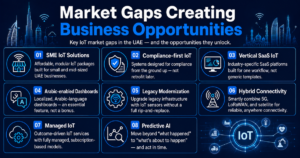
The UAE’s IoT market is growing fast, but growth hasn’t reached every corner evenly — and that unevenness is where the real opportunity sits.
SME IoT Solutions
Most enterprise-grade IoT platforms are priced and architected for large corporations. Small and mid-sized UAE businesses are underserved by affordable, modular IoT packages sized for their actual operations.
Compliance-first IoT
As UAE data protection and sector-specific regulations tighten, systems designed around compliance from the ground up — rather than retrofitted for it — are becoming a genuine differentiator, not just a checkbox.
Vertical SaaS IoT
Generic IoT platforms are giving ground to vertical-specific SaaS tools built for one industry’s exact workflow — a cold-chain logistics platform, for instance, built only for that use case rather than adapted from a general-purpose template.
Arabic-enabled Dashboards
A surprising number of IoT dashboards still ship English-only. Localized, Arabic-language interfaces remain an underserved gap in a market where that’s a basic expectation, not a bonus feature.
Legacy Modernization
Retrofitting older industrial and building infrastructure with IoT sensors — without a full rip-and-replace — is a growing services category on its own, distinct from greenfield IoT builds.
Hybrid Connectivity
Businesses operating across dense urban sites and remote facilities need systems that blend 5G, LoRaWAN, and satellite connectivity intelligently, rather than betting everything on one network type.
Managed IoT
Many enterprises want the outcomes of IoT without building and running the infrastructure themselves — creating steady demand for fully managed, subscription-based IoT services.
Predictive AI
Basic dashboards showing “what happened” are table stakes now. The market gap is in predictive layers that tell operators what’s about to happen, with enough lead time to act on it.
Each of these eight gaps points to the same underlying opportunity: the businesses that move first on an underserved niche — rather than competing head-on in the crowded enterprise IoT space — tend to capture disproportionate share before larger players notice the segment exists.
IoT Development Process
A serious IoT build follows a defined sequence — skipping steps is usually where projects go sideways.
Step 1: Discovery — defining the business problem and success metrics before touching any hardware. ↓ Step 2: Architecture — designing how devices, edge nodes, and cloud systems will communicate. ↓ Step 3: Hardware Selection — choosing sensors, gateways, and controllers matched to the environment and budget. ↓ Step 4: Firmware Development — writing the code that runs directly on the connected devices. ↓ Step 5: Cloud Integration — building the backend that ingests and processes device data at scale. ↓ Step 6: Dashboard — turning raw data into a usable interface for operators and decision-makers. ↓ Step 7: Testing — validating the system under real-world conditions, not just controlled lab environments. ↓ Step 8: Deployment — rolling out in phases, usually starting with a pilot site before scaling. ↓ Step 9: Support — ongoing monitoring, patching, and maintenance once the system is live.
Technology Stack
Connectivity: MQTT, Zigbee, LoRaWAN, BLE, NB-IoT, Wi-Fi, 5G
Cloud: AWS IoT Core, Azure IoT, Google Cloud, ThingsBoard
Hardware: ESP32, Raspberry Pi, Arduino, STM32
Backend: Node.js, Python, Java
Frontend: React, Flutter, Angular
Database: PostgreSQL, MongoDB, InfluxDB
Analytics: TensorFlow, Power BI, Grafana
The right combination depends entirely on the use case — a smart building system and an industrial predictive-maintenance platform rarely share the same stack, even if both fall under the same “IoT” label. At real scale, this analytics layer is really where big data and IoT solutions UAE enterprises rely on start paying off — thousands of devices generating continuous telemetry are only useful once that volume gets turned into patterns a human can act on.
Why UAE Businesses Need Custom IoT Solutions Instead of Off-the-Shelf Platforms
Off-the-shelf IoT platforms look attractive on price until the limitations show up mid-deployment. They’re built to serve the broadest possible customer base, which means the features that matter most to a UAE enterprise — Arabic-language interfaces, local compliance, integration with regional cloud infrastructure — are usually the first things missing.
Localization — off-the-shelf tools are rarely built with UAE-specific operating conditions, regulations, or infrastructure in mind.
Arabic Support — most generic platforms treat Arabic as an afterthought rather than a first-class interface language.
Compliance — packaged platforms often can’t be reconfigured to meet UAE data residency and sector-specific rules without significant rework.
Customization — every business has different sensors, workflows, and legacy systems; a rigid template forces the business to adapt to the software instead of the other way around.
Scalability — generic platforms often hit hard limits once device counts climb past what the template was designed for.
Integration — custom builds are designed from day one to plug into existing ERPs and CRMs; off-the-shelf tools frequently aren’t.
ROI — a system built around the actual business process tends to deliver a faster, clearer return than a generic tool retrofitted to fit.
Why Businesses Choose SISGAIN TECHNOLOGIES for IoT Development
SISGAIN TECHNOLOGIES approaches IoT as a full lifecycle service, not a one-off build. What that looks like in practice:
End-to-end IoT Development — from initial hardware selection through firmware, cloud architecture, and dashboards, handled by one team instead of coordinated across separate vendors.
AI + IoT Integration — predictive maintenance and anomaly detection built into the platform from the start, not bolted on after launch.
Enterprise-grade Security — device authentication, encrypted data pipelines, and a defined patching process built into every deployment.
Cloud-native Architecture — systems built on AWS IoT, Azure IoT, or Google Cloud IoT, chosen based on the client’s scale and existing infrastructure rather than a fixed default.
Industry-specific Solutions — healthcare, logistics, real estate, and agriculture builds each shaped around that sector’s actual regulatory and operational constraints.
UAE-focused Expertise — direct experience with local compliance requirements, connectivity conditions, and Arabic-language interface needs.
Scalable Infrastructure — architecture designed to handle growth from a pilot of a few dozen devices to enterprise-wide rollouts without a redesign.
Ongoing Support & Maintenance — continued monitoring, firmware updates, and troubleshooting after go-live, not just a handoff at launch.

Conclusion
The UAE’s IoT market isn’t a future bet anymore — it’s a present-tense growth story, with integration spend on track to grow roughly fivefold by 2030 and 5G-powered IoT expanding even faster. The opportunities are just as real on the supply side: underserved SMEs, compliance-first builds, Arabic-language dashboards, and managed IoT services all represent gaps the current market hasn’t fully filled.
What separates the businesses that capture this growth from the ones that don’t usually comes down to one decision — who they choose to build with. A generic vendor can get a pilot running. A genuine IoT development company UAE enterprises trust for the long haul builds something that still works, and still scales, three years and ten thousand devices later.
SISGAIN Technologies works with UAE businesses across healthcare, logistics, real estate, and manufacturing to design, build, and maintain IoT systems built for exactly that kind of longevity. If you’re evaluating an IoT project — whether it’s a first pilot or a company-wide rollout — talk to the SISGAIN team about your requirements and get a clear, scoped path forward.
Frequently Asked Questions
What does an IoT development company do? It designs and builds the full connected system — hardware integration, firmware, cloud backend, dashboards, and ongoing device management — rather than just one isolated piece of it.
How much does IoT development cost in UAE? Cost varies widely based on device count, sensor complexity, and cloud infrastructure needs — a small pilot can start in the low tens of thousands of dirhams, while enterprise-wide rollouts run considerably higher. Get a scoped estimate rather than relying on a generic industry average.
Which industries use IoT the most? In the UAE, healthcare, logistics, real estate, manufacturing, and government-linked smart city projects currently show the heaviest IoT adoption.
What is AIoT? AIoT is the combination of artificial intelligence with IoT devices, allowing systems to analyze sensor data and act on it — through predictive maintenance or automated alerts — instead of just displaying it.
How long does IoT development take? A focused pilot can be built and deployed in 8–12 weeks; a full enterprise rollout across multiple sites typically takes several months, depending on hardware lead times and integration complexity.
Which cloud platforms are best for IoT? AWS IoT, Azure IoT, and Google Cloud IoT are the three most widely used platforms for enterprise IoT in the UAE — the right one depends on your existing infrastructure and scale, not a universal best answer.
Is IoT secure? IoT can be secure, but only when security is built in from the architecture stage — encrypted communication, device authentication, and a defined patching process are what separate a secure deployment from a vulnerable one.
What are the benefits of Industrial IoT? Industrial IoT reduces unplanned downtime through predictive maintenance, improves production visibility, and cuts inspection and safety-related costs across manufacturing and energy operations.
Can legacy systems be integrated with IoT? Yes — legacy modernization is one of the fastest-growing IoT services categories, using retrofit sensors and middleware to connect older equipment without a full system replacement.
How do I choose an IoT development partner? Prioritize proven experience in your specific industry, a clear security approach, cloud platform flexibility, and a support model that covers what happens after launch — not just the initial build.