Hydraulic systems often need to deliver high pressure quickly, absorb sudden pressure changes, or maintain consistent force when pump output varies. A hydraulic accumulator helps solve these challenges by storing hydraulic energy and releasing it when the system needs it.
Unlike a hydraulic pump, an accumulator does not continuously generate flow. Instead, it stores pressurized fluid and makes that stored energy available on demand. This makes accumulators useful in industrial machinery, mobile equipment, manufacturing systems, presses, and emergency hydraulic circuits.
Understanding how accumulators work is important when designing or maintaining hydraulic equipment. The wrong accumulator size, pressure setting, or installation method can reduce performance and create serious safety risks.
What Is a Hydraulic Accumulator?
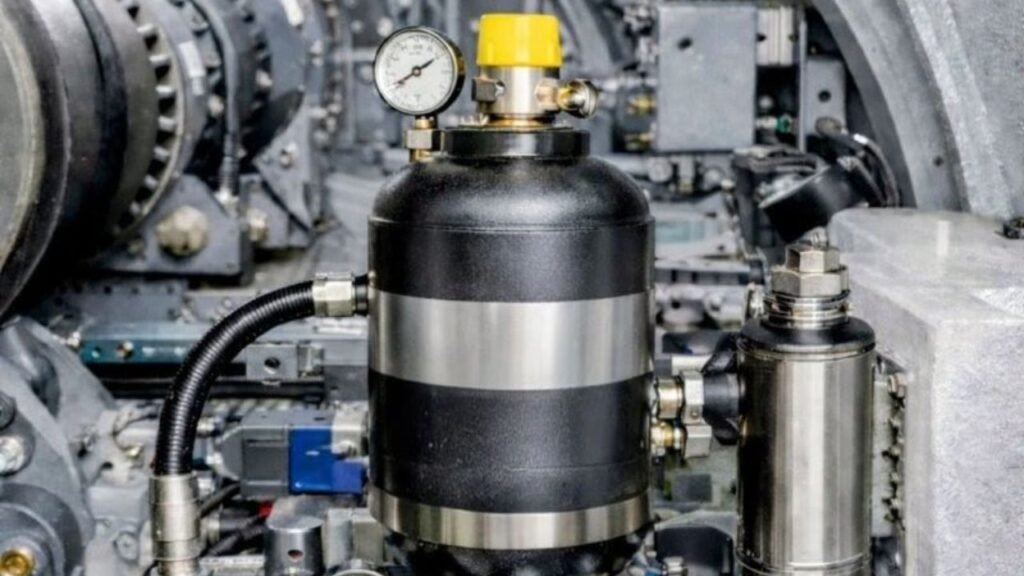
A hydraulic accumulator is a pressure storage device that stores hydraulic fluid under pressure. Most designs use compressed gas, usually nitrogen, to store energy.
The basic operating principle is straightforward. Hydraulic fluid enters the accumulator and compresses the gas inside it. As the gas becomes compressed, it stores potential energy. When system pressure drops, the compressed gas expands and pushes hydraulic fluid back into the circuit.
This process allows an accumulator to supplement pump flow without requiring the pump itself to handle every temporary demand.
For example, imagine a hydraulic press that normally requires moderate flow but occasionally needs a large amount of fluid for a rapid movement. Instead of installing a much larger pump solely for that short demand, an accumulator can store energy during lower-demand periods and release it when required.
How Does a Hydraulic Accumulator Work?
Although accumulator designs differ, their operation generally follows three stages.
1. Precharging
Before hydraulic fluid enters the accumulator, the gas chamber is charged with nitrogen to a specified pressure. This pressure is called the precharge pressure.
Proper precharge is critical because it determines how the accumulator responds to changes in system pressure.
2. Charging
When hydraulic pressure becomes higher than the gas pressure, hydraulic fluid enters the accumulator. The incoming fluid compresses the nitrogen gas.
The accumulator therefore stores energy while the hydraulic system has available capacity.
3. Discharging
When the hydraulic circuit requires additional flow, system pressure decreases. The compressed nitrogen expands and pushes stored hydraulic fluid out of the accumulator.
This can provide temporary additional flow, stabilize pressure, or maintain actuator movement.
Types of Hydraulic Accumulators
Different applications require different accumulator designs.
Bladder Accumulators
Bladder accumulators use a flexible bladder to separate hydraulic fluid from nitrogen. They respond quickly and are widely used for energy storage, shock absorption, and pulsation control.
Their relatively fast response makes them suitable for systems experiencing rapid pressure changes.
Piston Accumulators
Piston accumulators use a movable piston to separate gas and hydraulic fluid. They can accommodate larger fluid volumes and are commonly selected for heavy-duty applications.
They are particularly useful where significant energy storage is required.
Diaphragm Accumulators
Diaphragm accumulators use an elastic diaphragm as the separation element. They are generally compact and work well in applications requiring smaller stored volumes.
Their simple construction can make them practical for certain pressure stabilization applications.
Step-by-Step Guide to Selecting an Accumulator
Choosing an accumulator should involve more than simply matching the connection size.
Step 1: Determine the Purpose
First identify what the accumulator needs to accomplish.
Is it intended to:
- Store energy?
- Provide emergency flow?
- Reduce pressure pulsations?
- Absorb hydraulic shocks?
- Maintain system pressure?
- Compensate for leakage?
Each application can require different accumulator characteristics.
Step 2: Identify Operating Pressures
Determine the minimum and maximum operating pressures. These values influence the usable fluid volume and gas precharge.
For example, an accumulator operating between a relatively narrow pressure range may provide less usable fluid volume than one operating across a wider pressure range.
Step 3: Calculate Required Volume
Accumulator volume depends on the amount of hydraulic fluid that must be stored and the pressure range over which it will operate.
Gas behavior is not perfectly linear, so accumulator sizing calculations normally account for gas compression and expansion. For critical systems, use manufacturer sizing software or engineering calculations rather than relying on a simple volume estimate.
Step 4: Consider Temperature
Gas pressure changes with temperature. A precharge that appears correct when equipment is cold may behave differently after the hydraulic system reaches operating temperature.
Always consider the expected operating temperature when selecting and setting an accumulator.
Step 5: Select the Correct Construction
Choose bladder, piston, or diaphragm construction based on pressure, volume, response time, temperature, contamination levels, and maintenance requirements.
Common Applications
Hydraulic accumulators perform several useful functions across industrial systems.
In hydraulic presses, they can provide supplemental flow during rapid actuator movement. In mobile machinery, they can help absorb shocks caused by sudden load changes.
They can also reduce pump pulsations. A pump may produce pressure fluctuations as its displacement elements cycle. An accumulator can absorb some of these fluctuations, helping create smoother hydraulic operation.
Another important application is emergency operation. If a hydraulic pump stops unexpectedly, stored accumulator energy can sometimes move an actuator to a safe position or complete a critical operation.
Accumulators can also reduce the frequency with which a pump must respond to small, temporary flow demands. This can improve system efficiency when properly engineered.
Common Mistakes or Challenges
One of the most common mistakes is using the wrong precharge pressure. Too much or too little gas pressure can reduce usable capacity and negatively affect system behavior.
Another problem is selecting an accumulator based only on its nominal volume. A 10-gallon accumulator does not necessarily provide 10 gallons of usable hydraulic fluid. Usable volume depends on operating pressures and gas compression characteristics.
Ignoring temperature is another frequent oversight. Pressure changes as temperature changes, which can affect performance.
Maintenance errors can also create problems. Accumulators should not be treated like ordinary hydraulic components because they contain stored energy. Before servicing one, technicians must follow the manufacturer’s pressure-release and isolation procedures.
Contamination presents another challenge. Damaged seals, dirty hydraulic fluid, or improper installation can shorten accumulator life.
Practical Tips for Reliable Operation
Start by documenting the accumulator’s specifications, including model information, rated pressure, precharge requirements, and installation orientation. This makes future maintenance much easier.
Check for external leakage, damaged connections, corrosion, and unusual operating behavior during routine inspections. A sudden change in accumulator performance can indicate a bladder, seal, piston, or precharge problem.
Use dry nitrogen for gas charging. Oxygen and other gases should not be substituted because of serious safety concerns.
Keep accurate maintenance records. Recording precharge measurements, inspection dates, operating conditions, and replaced components can help identify gradual performance changes.
Most importantly, never assume an accumulator is depressurized simply because the hydraulic pump is turned off. Stored hydraulic and gas energy can remain present after the system stops.
For example, if a maintenance technician needs to replace a valve connected to an accumulator circuit, the correct procedure should include isolating the relevant energy sources and confirming pressure has been safely released according to the equipment manufacturer’s instructions.
Conclusion
A hydraulic accumulator is much more than a pressure storage tank. It can provide supplemental flow, absorb shocks, stabilize pressure, reduce pulsations, compensate for temporary demand, and provide limited emergency hydraulic power.
Reliable performance depends on correct sizing, suitable accumulator construction, accurate precharge, proper temperature considerations, and disciplined maintenance. By understanding the relationship between gas pressure, hydraulic pressure, and stored fluid volume, engineers and technicians can use accumulators more effectively.
The key takeaway is simple: select the accumulator according to the actual hydraulic requirement, not just the physical size of the equipment. Proper engineering and safe maintenance can significantly improve hydraulic system performance and reliability.