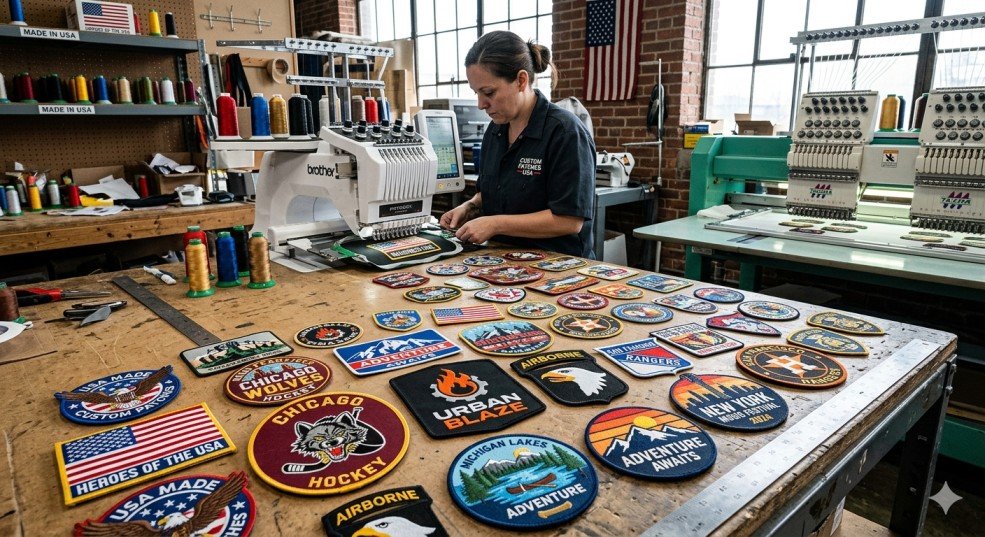
Custom embroidered patches are a simple yet effective way to display a logo, name, message, symbol, or creative design on clothing and accessories. They are widely used by businesses, sports teams, clubs, schools, organizations, fashion brands, and individuals who want something distinctive and professionally made.
Ordering patches online has also made customization much more accessible. However, getting a great finished product requires more than uploading an image and choosing a quantity. From artwork quality and thread colors to backing options and border styles, several details can influence the final appearance. Choosing a reliable Custom Embroidered Patches Maker Online and understanding the ordering process can help you receive patches that closely match your expectations.
Start With a Clear Purpose for Your Patches
Before contacting a patch maker, determine exactly how you plan to use the patches. This decision can influence almost every other specification.
For example, patches intended for employee uniforms may require a professional appearance and durable attachment method. Fashion patches may focus more heavily on creative shapes, bold colors, and decorative details. Patches designed for bags, jackets, caps, or promotional merchandise may need different sizes and backing options.
Knowing the purpose also makes it easier to explain your requirements to the manufacturer. The clearer your initial brief is, the easier it becomes to create a suitable design.
Prepare a High-Quality Design
The quality of your artwork has a major impact on the finished embroidered patch. A clear logo or illustration allows the design team to understand important details such as shapes, lettering, colors, and spacing.
Vector artwork is often useful because it can be resized without losing clarity. If you do not have a vector file, a high-resolution PNG, PDF, or another clear image may still provide a useful reference, depending on the manufacturer’s requirements.
Keep in mind that embroidery is different from digital printing. Extremely small text, thin lines, complicated gradients, and tiny details may not translate perfectly into thread. An experienced patch maker can suggest adjustments that preserve the character of your design while making it suitable for embroidery.
Select the Right Size and Shape
Patch size should be chosen according to both the design and where the patch will be placed.
A small chest patch, for instance, may need a simpler design than a larger back patch. Trying to fit too many details into a very small area can make text difficult to read and reduce the clarity of individual design elements.
You should also consider the shape. Traditional circles, squares, rectangles, shields, and ovals remain popular, but custom shapes can give patches a more distinctive appearance.
A professional Custom Embroidered Patches Maker Online should be able to recommend dimensions based on your artwork and intended application.
Choose Colors Carefully
Thread colors play an important role in the overall appearance of embroidered patches. The colors should complement the design while maintaining enough contrast for important details to remain visible.
If you are ordering patches for a company, school, organization, or established brand, provide accurate brand color references whenever possible. This can help the manufacturer choose thread colors that closely represent your visual identity.
It is also important to remember that colors displayed on a computer or phone screen can appear slightly different when produced using physical embroidery thread. Reviewing a digital proof before production can help reduce misunderstandings.
Understand Different Backing Options
The backing determines how your patch will be attached to a garment or accessory. Different applications require different solutions.
Iron-on backing is convenient for fabrics that can safely handle heat. Sew-on patches provide a traditional and secure attachment, especially for items that will be used or washed frequently. Hook-and-loop backing is useful when patches need to be removed or changed regularly.
Other options may also be available depending on the manufacturer.
Instead of automatically selecting one backing type, consider the material of the item, how often it will be used, and whether the patch needs to be permanent or removable.
Pay Attention to Border Style
Borders provide a clean finish and help define the shape of an embroidered patch.
Merrowed borders are commonly used for standard shapes such as circles, rectangles, squares, and ovals. They create a raised stitched edge around the patch.
For complicated or highly customized shapes, a heat-cut or laser-cut edge may be more suitable because it can follow detailed outlines more accurately.
Your patch maker can recommend the appropriate border based on the shape and design.
Always Review the Digital Proof
One of the most important stages of ordering custom patches is reviewing the proof before approving production.
A digital proof usually provides a representation of how the design will be converted into an embroidered patch. Check the spelling, dimensions, shape, border, colors, text placement, and overall layout carefully.
Do not approve a proof simply because it looks generally correct. Small errors are much easier to fix before manufacturing begins.
If something does not match your original requirements, request the necessary changes and review the revised proof.
Consider Ordering a Sample
For large orders, asking about a physical sample can be worthwhile. A sample allows you to evaluate the embroidery quality, thread appearance, size, border, backing, and overall finish before committing to full production.
This can be particularly useful for businesses and organizations placing bulk orders.
While samples may involve additional time or cost, they can reduce the risk of receiving a large quantity of patches that do not meet expectations.
Compare Quality, Not Just Price
Low prices can be attractive, especially when ordering hundreds of patches. However, the cheapest quotation is not necessarily the best value.
Poor embroidery, loose threads, inaccurate colors, weak backing, or unclear details can make inexpensive patches costly in the long run.
When evaluating a Custom Embroidered Patches Maker Online, consider product quality, customization capabilities, communication, proofing procedures, turnaround times, shipping information, revision policies, and customer support alongside price.
For bulk orders, ask whether quantity-based pricing is available. Larger quantities often have a lower cost per patch, making bulk purchasing more economical for organizations that regularly need patches.
Check the Final Order Details
Before making payment or approving production, review your complete order one final time.
Confirm the patch dimensions, quantity, artwork, colors, backing, border, production timeline, shipping method, delivery information, and total price. If the patches are required for an event or specific deadline, allow additional time for production and delivery instead of ordering at the last moment.
Keeping your order details and approved proof can also be helpful if you need to reorder the same design later.
Conclusion
Ordering custom embroidered patches online can be straightforward when you understand the important decisions involved. A clear design, suitable size, accurate colors, appropriate backing, professional border, and carefully reviewed proof all contribute to a better finished product.
Choosing a dependable Custom Embroidered Patches Maker Online is equally important. Instead of making a decision based solely on price, look for a provider that offers good workmanship, clear communication, customization options, and a transparent ordering process.
Taking a little extra time during the design and approval stages can prevent avoidable mistakes and help ensure that your finished embroidered patches look professional, durable, and suitable for their intended purpose.