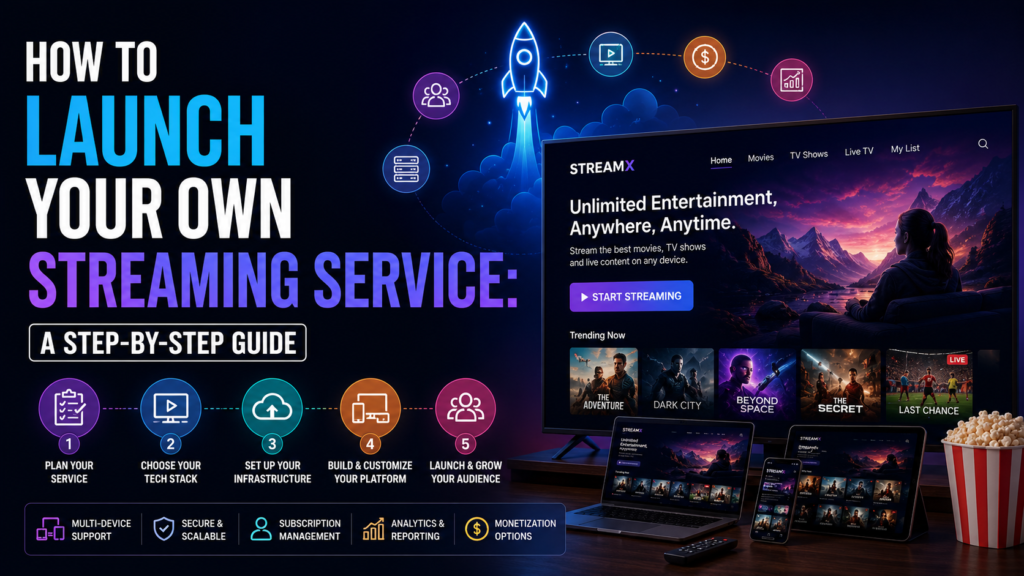
The rise of digital video consumption has created new opportunities for creators, media companies, sports organizations, educators, and businesses to build their own streaming platforms. With the right technology and business strategy, organizations can deliver live and on-demand content directly to their audiences while maintaining control over branding, customer relationships, and monetization.
If you are planning to launch a streaming service, understanding the required technology, content strategy, monetization options, and audience acquisition methods is essential. This guide explains how to start a streaming business from the ground up and build a scalable foundation for long-term growth.
What Is a Streaming Service?
A streaming service is a digital platform that allows users to watch video content through an internet connection without downloading the entire video file before playback.
A modern streaming service can offer:
- Live video streaming
- Video-on-demand (VOD)
- Movies and TV shows
- Educational courses
- Sports events
- Fitness videos
- Religious content
- Corporate training
- Creator content
- Premium exclusive content
Businesses can use an OTT platform to manage and distribute their video content across websites, mobile applications, Smart TVs, tablets, and other connected devices.
Why Start a Streaming Business?
The streaming industry offers businesses an opportunity to build direct relationships with their audiences and create multiple revenue streams.
Some major reasons to start a streaming business include:
Direct Audience Access
Instead of relying completely on third-party platforms, businesses can create their own branded environment and communicate directly with viewers.
Multiple Monetization Options
A streaming service can generate revenue through:
- Subscriptions
- Advertising
- Pay-per-view
- Content rentals
- One-time purchases
- Sponsorships
- Hybrid monetization
Global Reach
Internet-based video platforms can potentially reach audiences across different countries and regions.
Better Audience Insights
A dedicated platform can provide information about viewer behavior, content engagement, subscriptions, watch time, and customer preferences.
Step-by-Step Guide to Launch a Streaming Service
Step 1: Define Your Streaming Niche
The first step in your streaming service setup is identifying what type of content you want to provide.
Potential niches include:
- Entertainment
- Sports
- Fitness
- Education
- News
- Music
- Religious content
- Kids’ programming
- Corporate training
- Independent creators
A clearly defined niche makes it easier to identify your target audience, select content, determine pricing, and develop an effective marketing strategy.
For example, an educational streaming business could offer professional courses, tutorials, certifications, and live classes, while a sports-focused platform could provide live matches, highlights, interviews, and on-demand content.
Step 2: Identify Your Target Audience
Understanding your audience is essential before investing in technology.
Define characteristics such as:
- Age
- Location
- Interests
- Viewing habits
- Preferred devices
- Content preferences
- Spending behavior
You should also understand what problem your streaming service solves.
For example:
Fitness Platform: Users want convenient access to workout programs.
Education Platform: Students want flexible access to specialized courses.
Sports Platform: Fans want live and on-demand sports content.
A clear audience definition helps shape your entire video streaming business strategy.
Step 3: Develop Your Content Strategy
Content is one of the most important components of a streaming service.
Decide what type of content you will offer and how frequently new content will be published.
You may use:
Original Content
Content produced specifically for your platform.
Licensed Content
Content acquired from third-party content owners.
User-Generated Content
Videos created and uploaded by platform users.
Live Content
Real-time events such as sports, conferences, webinars, concerts, and other events.
On-Demand Content
Pre-recorded content users can watch whenever they want.
A strong content strategy should provide enough value to attract new users and encourage existing subscribers to remain active.
Step 4: Choose Your Monetization Model
Before completing your streaming service setup, decide how your platform will generate revenue.
Subscription Video on Demand
Users pay a recurring monthly or annual fee to access premium content.
Advertising Video on Demand
Users can access content for free while the platform generates revenue through advertising.
Transactional Video on Demand
Users pay for individual videos, movies, courses, or events.
Hybrid Model
A platform can combine subscriptions, advertising, and transactional payments.
For example, you could offer free ad-supported content while providing premium content through a monthly subscription.
Step 5: Choose the Right OTT Platform
Technology is the foundation of your streaming service.
An OTT platform can provide the infrastructure needed to manage, distribute, monetize, and analyze video content.
Depending on your business requirements, your OTT platform may include:
- Video content management
- Video-on-demand
- Live streaming
- Custom video player
- Subscriber management
- Payment integration
- Content monetization
- Analytics
- Recommendation engine
- User authentication
- Multi-device support
- Content security
Choosing a scalable OTT platform from the beginning can make it easier to expand your service as your audience grows.
Step 6: Build Your Streaming Website and Apps
Your viewers should be able to access content conveniently from their preferred devices.
A complete streaming ecosystem may include:
- Responsive web application
- Android application
- iOS application
- Smart TV application
- Tablet application
- Web-based video player
A consistent user experience across devices can improve engagement and retention.
Your platform should also provide simple navigation, fast content discovery, personalized recommendations, and reliable video playback.
Step 7: Set Up Video Hosting and Delivery
A streaming platform needs reliable infrastructure to deliver video content efficiently.
The basic process looks like:
Video Content → Encoding → Storage → CDN → Video Player → Viewer
Video Encoding
Video files are encoded into streaming-friendly formats and different resolutions.
Cloud Storage
Content can be securely stored in scalable cloud infrastructure.
Content Delivery Network
A CDN distributes content through geographically distributed servers, helping improve video delivery performance.
Adaptive Bitrate Streaming
Multiple video qualities allow the player to adjust streaming quality based on the viewer’s internet connection.
These components are important when building a scalable video streaming business.
Step 8: Implement Streaming Security
If your platform contains premium or copyrighted content, security should be part of the initial development strategy.
Common security measures include:
- User authentication
- Access control
- Encryption
- Digital Rights Management
- Secure video URLs
- Token-based access
- Device management
- Payment security
The appropriate security strategy depends on your content, audience, and business model.
Step 9: Add Subscriber and Payment Management
If your streaming service uses paid access, you need a reliable subscription and payment system.
Important features may include:
- User registration
- Login
- Subscription plans
- Free trials
- Recurring billing
- Payment processing
- Subscription upgrades
- Subscription cancellation
- Coupon management
- Invoices
- Payment history
A well-designed subscription system makes it easier to manage customers throughout their lifecycle.
Step 10: Add Analytics and Recommendations
Analytics help you understand how users interact with your content.
Important metrics include:
- Total views
- Watch time
- Active users
- Subscriber growth
- Churn rate
- Content engagement
- Average viewing duration
- Conversion rate
- Revenue per user
You can also add an AI-powered recommendation engine to suggest relevant content based on user behavior.
For example:
User Watches Sports Content → System Analyzes Behavior → Recommends Similar Sports Videos
Personalized recommendations can help increase content discovery and engagement.
Step 11: Test Your Streaming Platform
Before launching your platform, conduct comprehensive testing.
Test:
- Video playback
- Streaming quality
- Login and registration
- Subscription management
- Payments
- Content search
- Mobile responsiveness
- Smart TV compatibility
- Video security
- Application performance
- Network performance
Testing across different devices and internet conditions is particularly important for a streaming service.
Step 12: Launch Your Streaming Service
Once the platform is tested, you can prepare for the official launch.
Your launch strategy may include:
- SEO
- Social media marketing
- Paid advertising
- Email campaigns
- Influencer partnerships
- Content marketing
- Referral programs
- Promotional offers
Create a clear value proposition that tells potential customers why they should choose your streaming platform instead of competing services.
Step 13: Monitor and Optimize Performance
Launching your platform is only the beginning.
After launch, continuously monitor:
- Viewer engagement
- Subscriber retention
- Churn
- Content performance
- Revenue
- Streaming quality
- Customer feedback
- Application performance
Use these insights to improve your content strategy, pricing, user experience, and technology.
How Much Does It Cost to Start a Streaming Business?
The cost of launching a streaming service varies significantly depending on the scope and technology requirements.
Factors that influence the cost include:
- Number of platforms
- Customization
- Content volume
- Live streaming requirements
- Cloud infrastructure
- Video quality
- Security requirements
- Payment integrations
- Monetization model
- Mobile and Smart TV applications
- Third-party integrations
A basic streaming service may require less investment than an enterprise-level platform designed to support a large audience across multiple countries.
The best approach is to define your minimum viable product first and then scale the platform as your audience and revenue grow.
How an OTT Platform Helps Your Streaming Business
Building every component of a streaming service from scratch can require significant technical resources.
An OTT platform can simplify the process by providing ready-to-use or customizable capabilities for:
- Content management
- Video delivery
- Subscriber management
- Monetization
- Analytics
- Multi-platform distribution
- Video playback
- User management
For businesses with unique requirements, a customized OTT solution can provide greater control over branding, functionality, integrations, and scalability.
Common Mistakes to Avoid When Launching a Streaming Service
1. Focusing Only on Technology
Technology is important, but content and audience strategy are equally important.
2. Ignoring Mobile Users
A significant portion of viewers may access content through smartphones and tablets, so mobile optimization should be a priority.
3. Choosing the Wrong Monetization Model
Your revenue strategy should match your content and audience.
4. Underestimating Content Costs
Content creation, licensing, and management can represent a significant part of your overall business expenses.
5. Ignoring Scalability
Choose infrastructure that can handle increasing traffic and content consumption.
6. Neglecting Security
Premium video content requires appropriate access controls and security measures.
7. Launching Without Analytics
Without analytics, it becomes difficult to understand what content and features are driving engagement.
Future of the Video Streaming Business
The future of the video streaming business is moving toward more personalized, interactive, and intelligent viewing experiences.
Emerging technologies include:
- AI-powered recommendations
- AI content tagging
- Personalized content feeds
- AI customer support
- Interactive video
- Low-latency streaming
- Cloud-based streaming infrastructure
- Multi-platform applications
- Advanced viewer analytics
AI can also automate several backend operations, including content classification, metadata generation, customer support, and recommendation workflows.
Final Thoughts
If you want to launch a streaming service, success requires more than simply uploading videos to a website. You need a clear niche, high-quality content, a suitable monetization strategy, reliable streaming infrastructure, strong security, and a user-friendly experience.
A scalable OTT platform can provide the technology foundation needed to manage content, subscribers, payments, video delivery, analytics, and multi-device streaming.
Start by defining your audience and content strategy, choose the right technology, launch with a focused set of features, and continuously improve the platform using customer feedback and analytics.
With the right combination of content, technology, and marketing, your streaming service setup can evolve into a scalable video streaming business with long-term growth potential.
Frequently Asked Questions
How much does it cost to launch a streaming service?
The cost depends on the platform’s features, number of applications, content requirements, cloud infrastructure, security, monetization model, and expected audience size.
What do I need to start a streaming business?
You need quality video content, a streaming platform, video hosting and delivery infrastructure, a monetization strategy, applications or a website, payment integration, security, analytics, and a marketing plan.
What is an OTT platform?
An OTT platform is a technology solution that allows businesses to manage, distribute, and monetize video content over the internet across devices such as smartphones, websites, and Smart TVs.
Can I build my own OTT platform?
Yes. Businesses can use an existing OTT solution or develop a customized OTT platform based on their branding, features, integrations, content, and scalability requirements.
Which monetization model is best for a streaming service?
The right model depends on your audience and content. Common options include subscription-based, advertising-supported, transactional, and hybrid monetization.
Can an OTT platform support live and on-demand video?
Yes. Depending on the solution, an OTT platform can support both live streaming and video-on-demand content.
How can I make my streaming service scalable?
Use scalable cloud infrastructure, CDN-based video delivery, adaptive bitrate streaming, efficient content management, performance monitoring, and an OTT platform designed to support growing audiences.