Modern eCommerce businesses need storefronts that load quickly, adapt to changing customer expectations, and support unique shopping experiences. Traditional storefront architectures can limit customization and make it difficult to introduce new features as business requirements evolve.
Headless BigCommerce offers a more flexible approach by separating the frontend presentation layer from backend commerce functionality. This allows businesses to build customized storefronts while continuing to use BigCommerce for product management, inventory, orders, and other essential operations.
Why Are Businesses Adopting Headless BigCommerce?
As online competition increases, businesses need more control over storefront performance, design, and customer interactions. With headless BigCommerce development, businesses can separate frontend and backend systems while connecting them through APIs. This makes it easier to create customized storefronts without changing essential commerce operations.
Here are some reasons businesses are considering this architecture:
-
Greater design flexibility: Businesses can create custom storefront layouts, navigation, and product pages without depending entirely on predefined themes.
-
Better customer experiences: Modern frontend technologies help development teams create responsive interfaces that support smoother shopping journeys.
-
Omnichannel capabilities: Businesses can deliver consistent commerce experiences across websites, mobile applications, and other digital touchpoints.
-
Easier frontend updates: Development teams can introduce design improvements and new features without restructuring the entire backend system.
-
Support for business growth: Flexible architecture makes it easier to accommodate changing storefront requirements, integrations, and customer expectations.
This approach is particularly useful for growing businesses that need more control over their digital commerce experiences.
How Does Headless BigCommerce Architecture Work?
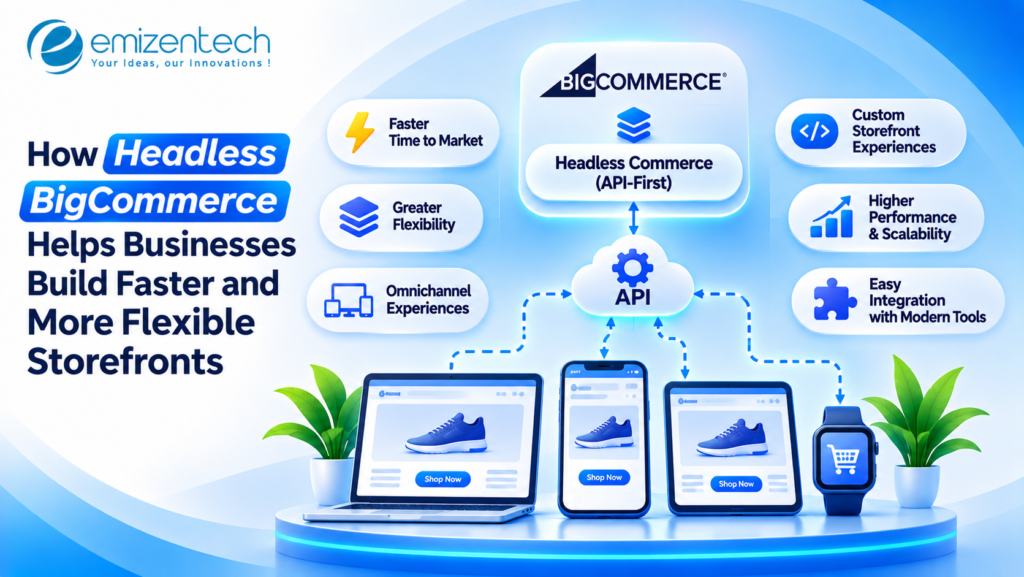
Headless architecture separates the frontend, where customers interact with the store, from the backend, which manages commerce operations. Both layers communicate through APIs, allowing developers to customize the storefront without changing the underlying commerce infrastructure.
The architecture generally includes four important components:
1. Frontend presentation layer
The frontend controls how customers interact with the online store. Developers can use technologies such as React, Next.js, and Vue.js to build customized interfaces, product pages, navigation, and shopping experiences.
2. BigCommerce backend
BigCommerce manages essential commerce operations, including product catalogs, inventory, pricing, customer accounts, and order processing. Businesses can continue using these capabilities while developing a separate frontend experience.
3. API communication
APIs connect the frontend with BigCommerce backend functionality. They allow the storefront to retrieve product information, display pricing, manage customer data, and support commerce operations.
4. Third-party integrations
Businesses can connect additional tools, including ERP, CRM, payment gateways, search platforms, and marketing automation systems, to support their operational requirements.
This separation allows frontend developers to work on customer-facing experiences while backend operations continue independently.
How Does Headless BigCommerce Help Build Faster Storefronts?
Storefront speed directly influences customer engagement, product discovery, and purchasing decisions. Slow-loading pages, delayed images, and unresponsive elements can frustrate visitors and increase shopping cart abandonment.
Headless architecture provides opportunities to improve performance through several frontend optimization techniques.
-
Optimized frontend rendering: Frameworks such as Next.js support server-side rendering and static site generation, helping deliver page content efficiently.
-
Content caching: Caching frequently requested product information and page content can reduce repeated requests and improve response times.
-
Lightweight frontend components: Developers can remove unnecessary scripts and dependencies to create more efficient storefront interfaces.
-
Improved Core Web Vitals: Optimizing image delivery, page rendering, and interaction responsiveness helps improve LCP, INP, and CLS performance.
-
Mobile performance optimization: Responsive layouts, optimized assets, and efficient loading techniques help deliver smoother experiences across mobile devices.
However, headless architecture does not automatically guarantee faster performance. Results depend on frontend implementation, hosting infrastructure, API response times, and caching strategies.
How Does Headless Architecture Improve Storefront Flexibility?
Beyond loading speed, headless architecture gives businesses greater control over how their storefront looks, functions, and responds to customer needs.
Some important flexibility advantages include:
Custom storefront design: Businesses can create unique shopping interfaces that reflect their brand identity, product categories, and customer preferences.
Frontend technology freedom: Development teams can select suitable frameworks and tools based on project requirements instead of depending entirely on platform-specific themes.
Faster feature development: New features, navigation improvements, and interface updates can be introduced independently of backend commerce operations.
Personalized shopping experiences: Businesses can implement dynamic content, personalized product recommendations, and customized shopping journeys based on customer behavior.
Consistent customer experiences: The same commerce backend can support multiple digital touchpoints, helping businesses maintain consistent product information and shopping functionality.
These capabilities make headless architecture useful for businesses with complex customization and omnichannel requirements.
What Should Businesses Consider Before Adopting Headless BigCommerce?
Although headless architecture offers several advantages, it also introduces technical and operational considerations. Businesses should evaluate the following factors before investing in this approach.
-
Development complexity: Separate frontend and backend systems require experienced developers who understand APIs, frontend frameworks, and integration workflows.
-
Implementation costs: Custom storefront development, hosting, testing, and ongoing maintenance can increase the overall project budget.
-
Integration requirements: Existing ERP, CRM, inventory, payment, and marketing systems must work reliably with the new architecture.
-
SEO considerations: Server-side rendering, metadata management, structured data, canonical URLs, and crawlability must be handled correctly.
-
Maintenance requirements: Frontend updates, API changes, security patches, and performance monitoring require continuous attention.
Businesses should also compare headless development with traditional BigCommerce storefronts to determine whether the additional flexibility justifies the investment.
How to Implement Headless BigCommerce for Your Online Store
A successful implementation requires more than selecting a frontend framework. Businesses need a structured development approach that connects technical decisions with storefront goals.
1. Evaluate existing storefront requirements
Identify current performance issues, design limitations, integration requirements, and customer experience challenges. This helps establish whether a headless approach is necessary.
2. Select the frontend technology
Choose a suitable framework, such as React or Next.js, based on project complexity, performance requirements, and available development expertise.
3. Plan API integrations
Determine how the frontend will communicate with BigCommerce APIs for product information, inventory, customer accounts, and checkout functionality.
4. Develop the custom storefront
Build responsive layouts, product listing pages, product detail pages, navigation, and other essential shopping features.
5. Test and optimize the implementation
Test API communication, checkout workflows, mobile responsiveness, SEO elements, and Core Web Vitals before launching the storefront.
Continuous monitoring after launch helps identify performance issues and maintain a consistent shopping experience.
Is Headless BigCommerce the Right Choice for Your Business?
Headless architecture is particularly suitable for businesses that require advanced storefront customization, multiple digital touchpoints, and greater control over frontend performance. It can be a practical approach for businesses investing in commerce web development to create more flexible shopping experiences and support evolving digital requirements.
It can benefit growing eCommerce brands, businesses managing multiple storefronts, and retailers with complex integration requirements.
However, smaller stores with straightforward design and functionality needs may find a traditional BigCommerce storefront more cost-effective. The decision should depend on business objectives, technical resources, customization requirements, and long-term development costs.
Conclusion
Headless BigCommerce gives businesses greater control over storefront performance, design flexibility, and digital shopping experiences. However, achieving these benefits requires the right architecture, frontend technology, and integration strategy. With 12+ years of development experience, EmizenTech helps businesses build customized eCommerce solutions through its BigCommerce development expertise, aligning storefront capabilities with performance requirements and long-term business goals.