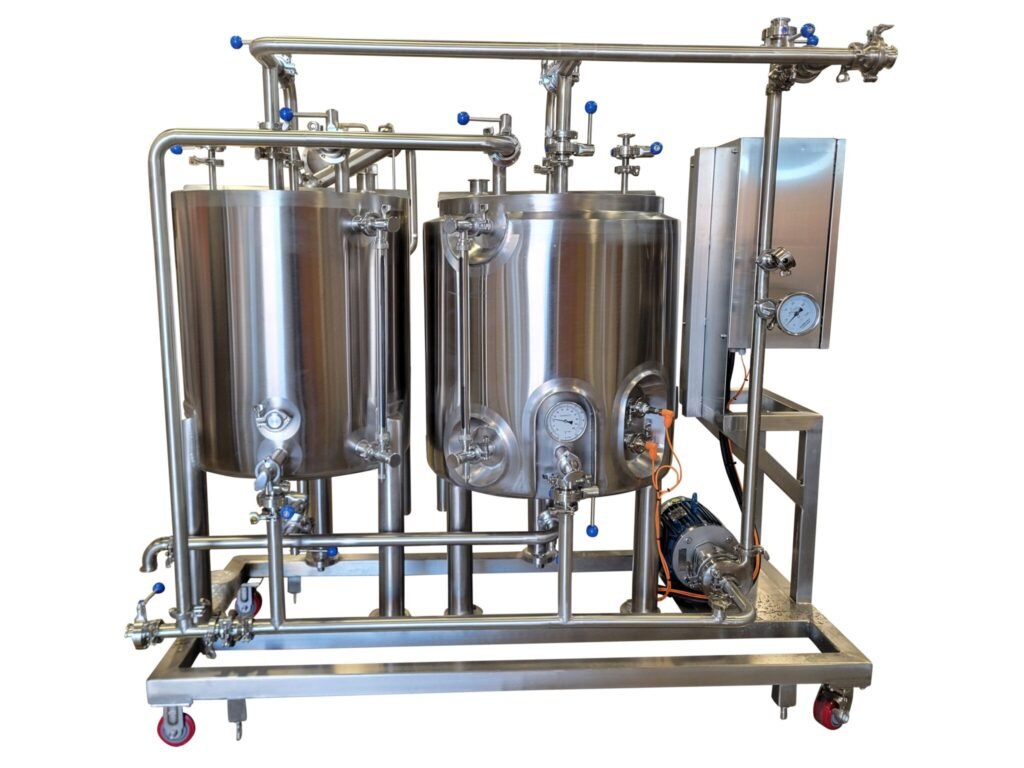
A reliable Clean-in-place system must do more than circulate cleaning chemicals through process equipment. It needs to deliver the right flow, temperature, chemical concentration, and cleaning time in a controlled sequence. PLC-based automation helps achieve that consistency by replacing many manual decisions with programmed process logic. When properly engineered, a PLC can coordinate pumps, valves, heaters, sensors, and chemical dosing equipment so each CIP cycle follows defined operating conditions. The result is greater repeatability, better process visibility, and more consistent sanitation.
What Does the PLC Control in a CIP Process?
A programmable logic controller, or PLC, acts as the control center for the CIP sequence. It receives signals from field instruments and sends commands to equipment based on programmed logic.
Depending on the system design, the PLC can control:
- CIP supply and return pumps
- Automated valves
- Heating systems
- Chemical dosing
- Flow monitoring
- Temperature control
- Conductivity measurement
- Tank levels
- Cycle timers
- Alarms and interlocks
This allows the complete cleaning sequence to operate according to predefined conditions rather than relying on an operator to manually coordinate every step.
Repeatability Starts With a Defined Recipe
One of the biggest advantages of PLC automation is recipe-based operation. A cleaning recipe can define the required sequence and operating parameters for a particular process circuit. For example, the PLC may initiate a pre-rinse, transition to a caustic wash, complete an intermediate rinse, perform an acid cycle when required, and finish with a final rinse.
Each stage can have defined values for temperature, flow, conductivity, and duration.
That matters because a cleaning cycle should not depend on someone remembering exactly when to open a valve or move from one stage to another. Once the recipe has been properly established, the PLC can execute the same logic repeatedly.
Maintaining the Required Flow
Mechanical action is a critical part of effective CIP. Cleaning solution must move through piping and equipment at an appropriate velocity to remove soil from internal surfaces. For sanitary process piping, turbulent flow is commonly targeted, with approximately 5 ft/sec often used as a practical reference. The actual requirement should be established according to pipe diameter, circuit design, product residue, and cleaning conditions.
A PLC can monitor flow instrumentation and control pump operation to maintain the required conditions. If flow drops below the programmed limit, the system can generate an alarm or prevent the cycle from progressing.
This is far more controlled than simply running a pump for a fixed period and assuming adequate flow has been achieved.
Temperature Control Improves Consistency
Temperature has a direct effect on cleaning chemistry and soil removal. A PLC can receive signals from temperature transmitters and regulate steam, hot-water valves, electric heaters, or other heating equipment to reach the required setpoint.
More importantly, the PLC can use temperature as a process condition rather than simply treating it as a display value. A cleaning stage can be programmed to begin its timing only after the required temperature has been reached.
If a caustic wash requires a specific temperature before the effective cleaning period begins, the PLC can hold the sequence until that condition is satisfied. This prevents the system from counting ineffective time toward the cleaning cycle.
Conductivity Helps Control Chemical Strength
Chemical concentration is another important variable in CIP performance. Conductivity sensors can provide an indication of cleaning-solution concentration for many commonly used CIP chemicals.
A PLC can monitor conductivity and control chemical dosing or valve positioning based on programmed limits. During a caustic wash, the system can circulate the solution until the conductivity reaches the required range. If the value falls below the defined limit, additional chemical can be introduced where the system is designed for automatic dosing.
This helps reduce both under-dosing and unnecessary chemical use.
Interlocks Prevent Incorrect Sequences
CIP systems involve multiple pumps, valves, tanks, and process connections. Opening the wrong valve or starting the wrong pump can cause serious process problems.
PLC-based interlocks provide a layer of protection. The control logic can prevent a pump from starting unless the correct valve path is established. It can also prevent two incompatible flow paths from opening simultaneously or stop a heating stage when an appropriate flow condition is not present.
These safeguards are particularly valuable in larger systems with multiple cleaning circuits.
A CIP Skid Can Become a Controlled System
A modern CIP skid can combine tanks, pumps, valves, heat exchangers, instrumentation, chemical management, and controls into one integrated cleaning platform. The PLC coordinates these components as a single process rather than treating each component independently.
This integration makes it easier to establish repeatable cleaning recipes and monitor system performance. It also simplifies the operator interface because key information can be presented through a central HMI.
Instead of manually checking several pieces of equipment, an operator can see the active cleaning stage, temperatures, flow values, conductivity, alarms, and remaining cycle time in one location.
Alarm Logic Adds Another Layer of Control
Automation becomes much more useful when it can recognize abnormal conditions.
A PLC can generate alarms for issues such as:
- Low cleaning-solution flow
- Temperature below the required setpoint
- Incorrect conductivity
- Low CIP tank level
- Pump faults
- Valve-position errors
- Excessive cycle time
The response can also be programmed. Depending on the process, the PLC may pause the cycle, stop a pump, close a valve, or require operator intervention.
This prevents a system from quietly continuing through a cleaning sequence when critical conditions have not been met.
Data Logging Helps Verify Performance
PLC-based CIP automation can also create a record of what happened during each cycle. Temperature, conductivity, flow, cycle duration, alarms, and other process values can be logged when the control system is configured for data collection.
This information is useful for troubleshooting and process improvement. If a cleaning problem occurs, engineers can compare the affected cycle with previous successful cycles and determine whether a process variable changed.
Over time, this data can also reveal recurring equipment issues or opportunities to optimize cleaning duration and resource consumption.
Designing Automation Around the Cleaning Process
PLC automation does not automatically make a CIP system effective. The underlying equipment and process still need to be engineered correctly. Pump capacity, pipe diameter, spray-device coverage, valve configuration, drainage, heating capacity, sensor placement, and chemical compatibility all influence cleaning performance.
The PLC should then be programmed around those engineering requirements.
When these elements are properly integrated, PLC-based automation can turn CIP from a largely manual procedure into a controlled and repeatable process. Each cycle follows defined conditions, deviations are easier to detect, and historical data provides greater visibility into system performance. That combination supports more consistent sanitation while reducing unnecessary operator variation and improving overall process control.