There was a time when building enterprise software meant months of planning, sprawling development teams, and a release cycle that felt longer than a Netflix series. That era is not exactly over, but it is changing faster than most organizations expected.
In 2026, artificial intelligence is no longer a buzzword sitting in the “future initiatives” column of a roadmap. It is embedded inside the tools developers use every day, influencing how code gets written, tested, reviewed, and deployed.
For enterprises, this shift is not just a productivity story. It is a fundamental rethinking of what software development looks like at scale.
If you are leading an engineering team, making technology decisions for your organization, or simply trying to understand where the industry is heading, this piece is for you.
The Real Shift Happening Inside Enterprise Dev Teams
A lot of the public conversation around AI in software development focuses on individual developers using copilot-style tools to write code faster. That is real, but it barely scratches the surface of what is happening inside large enterprises.
The deeper shift is organizational. AI is compressing the distance between an idea and a working product. Traditionally, enterprise software development involves a long chain of handoffs from business stakeholders to architects, from architects to developers, from developers to QA teams, and eventually to operations. Each handoff was a friction point.
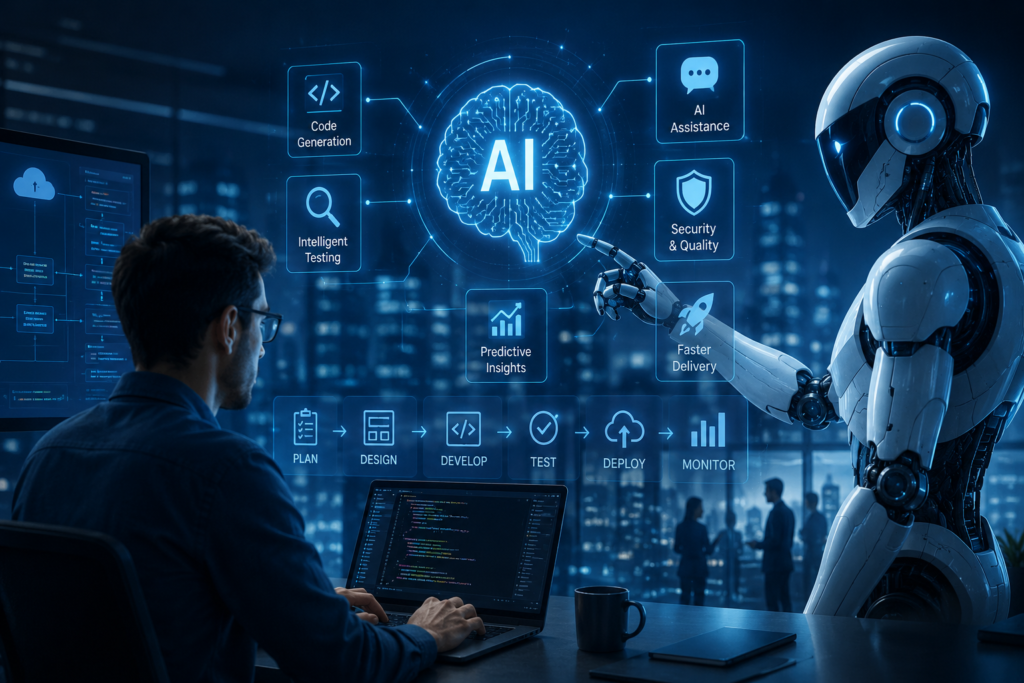
AI is shortening that chain. Natural language interfaces are allowing non-technical stakeholders to describe requirements in plain English and get functional prototypes back. Automated code generation tools are handling boilerplate and repetitive logic. AI-assisted testing is catching regressions before humans even look at the output.
For enterprises that rely on software development services to build and maintain complex systems, this changes the economics significantly. You can do more with smaller teams, move faster without sacrificing quality, and redirect senior engineering talent toward genuinely hard problems rather than routine implementation work.
How AI Is Being Used Across the Software Development Lifecycle
AI-Powered Code Generation and Completion
This is the most visible use case, and in 2026 it has matured well beyond autocomplete. Tools like GitHub Copilot, Amazon CodeWhisperer, and several enterprise-grade alternatives can now generate entire functions, suggest architectural patterns, and even flag potential security vulnerabilities in real time.
What makes this genuinely valuable in an enterprise context is that these tools are increasingly trainable on proprietary codebases. An AI that understands your internal APIs, your naming conventions, and your preferred frameworks is dramatically more useful than a generic code assistant. Several large enterprises are now fine-tuning models on their own repositories to create development tools that feel like they were built specifically for their teams.
Automated Testing and Quality Assurance
Manual QA has always been a bottleneck in enterprise software delivery. AI is changing this by generating test cases automatically based on code changes, predicting which areas of a codebase are most likely to break after a given update, and running intelligent regression tests without human configuration.
Some organizations are reporting significant reductions in testing cycles without any drop in coverage. The reason is not that AI is cutting corners it is that AI can analyze code paths and edge cases faster and more comprehensively than any manual process.
AI-Assisted Code Review
Code review has traditionally been a time-consuming process that slows down developer velocity, particularly in larger teams. AI-powered review tools can now analyze pull requests for correctness, performance issues, security risks, and adherence to coding standards before a human reviewer ever opens the diff.
This does not eliminate human review it makes human review more meaningful. Reviewers spend less time catching basic issues and more time thinking about design, scalability, and business logic.
Intelligent DevOps and Incident Management
In 2026, AI is playing an increasing role in the operations side of software development. AI-driven monitoring tools do not just alert you when something breaks they analyze patterns, predict potential failures before they happen, and in some cases automatically roll back problematic deployments.
For enterprises running complex distributed systems, this kind of intelligent observability is becoming essential. The alternative having humans manually parse through telemetry data at scale simply does not work anymore.
Real-World Examples Worth Paying Attention To
Goldman Sachs has been openly building internal AI tools to assist developers with code generation and review, with early results showing measurable improvements in developer productivity. Google has integrated AI deeply into its internal development tools, and the results have influenced the products they are building for enterprise customers.
Microsoft’s integration of AI into the entire Azure DevOps ecosystem is perhaps the clearest example of how AI is becoming infrastructure rather than a feature. You do not opt into AI assistance it is woven into the workflow by default.
For mid-market and growing enterprises, the more instructive examples are companies that have used AI to significantly accelerate custom enterprise application development without proportionally growing their headcount. Organizations that previously needed six to twelve months to build a complex internal tool are doing it in a fraction of that time.
The Challenges Enterprises Are Still Working Through
It would be dishonest to write about AI in enterprise software development without addressing the friction. Because there is plenty of it.
Data Security and Code Privacy
When developers use AI tools to write code, that code often contains sensitive business logic, proprietary algorithms, or references to internal systems. Enterprises have legitimate concerns about where that data goes and how it is handled.
Most serious enterprise AI development tools now offer on-premises deployment or private cloud options specifically to address this. But it requires deliberate procurement decisions, not just downloading a tool and hoping for the best.
Accuracy and Hallucination Risk
AI code generation tools are impressive, but they are not infallible. They can generate code that looks correct and compiles cleanly but contains subtle logical errors or security flaws. Enterprises that treat AI-generated code as inherently trustworthy without appropriate review processes are taking on real risk.
The solution is not to distrust AI it is to build review workflows that account for AI’s particular failure modes. That means training developers to critically evaluate AI suggestions rather than accepting them uncritically.
Skill Gaps and Change Management
Introducing AI into software development workflows requires more than installing new tools. It requires changing how teams work, which is always harder than it sounds.
Some developers embrace these changes enthusiastically. Others are skeptical, or concerned about the implications for their roles.
Enterprises that handle this well invest in proper onboarding, create internal communities of practice around AI tools, and involve development teams in evaluating and selecting the tools they will use. The organizations that handle it poorly treat AI adoption as a top-down mandate and wonder why adoption is slow.
What This Means for Enterprise Software Strategy Going Forward
The organizations winning with AI in software development are not the ones that adopted the most tools. They are the ones that thought carefully about where AI adds genuine value in their specific context and built workflows around that.
A few principles seem to hold across industries and organization sizes.
Start with the friction. Look at where your software development process slows down or breaks down. Automated testing, documentation, repetitive code generation, incident response these are often the highest-value targets for AI assistance because the ROI is immediate and measurable.
Invest in the human side as much as the technical side. The technology is increasingly accessible. The harder work is building a team culture and set of practices that uses that technology well. Developers who understand how to work effectively with AI tools are becoming significantly more valuable than those who do not.
Think about build versus buy differently. AI is changing the economics of custom software in ways that make it worth revisiting old build-versus-buy decisions.
Things that were previously too expensive to build internally are becoming more feasible. This is relevant for any enterprise evaluating whether off-the-shelf software meets their needs or whether a custom solution has become practical.
For enterprises ready to move beyond experimentation and build AI capabilities into their core development infrastructure, working with an experienced AI development service partner can significantly accelerate that journey particularly for organizations that do not yet have deep internal AI expertise.
The Bigger Picture
Enterprise software development in 2026 looks meaningfully different from three years ago, and the pace of change is not slowing. The enterprises that will be best positioned in the next three years are the ones treating AI adoption in software development not as a cost-cutting exercise but as a capability-building one.
Faster development cycles, smarter testing, more reliable systems, and smaller gaps between business intent and technical execution these are the real promises of AI in this space. Most of them are achievable today, with the right approach.
The question is not whether AI will reshape enterprise software development. It already is. The question is whether your organization is shaping that change or reacting to it.