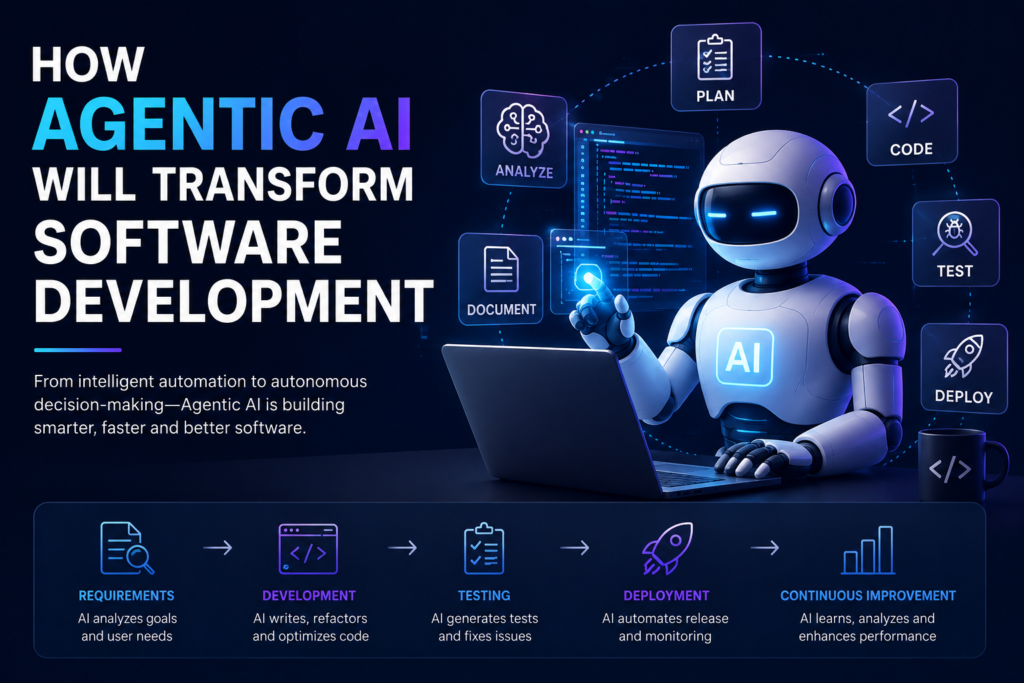
Artificial intelligence is already changing how developers write code, test applications, and automate repetitive tasks. But the next evolution isn’t just about generating code, it’s about AI systems that can plan, reason, make decisions, and execute complex workflows with minimal human intervention.
This is where Agentic AI comes in.
Instead of acting as a coding assistant, Agentic AI functions more like a collaborative software engineer. It can understand objectives, break them into tasks, coordinate multiple actions, learn from outcomes, and adapt its approach as projects evolve.
For businesses, this means faster development cycles, improved software quality, and more efficient engineering teams.
What Is Agentic AI?
Agentic AI refers to AI systems that can independently pursue goals by planning, making decisions, using external tools, and adapting based on feedback.
Unlike traditional AI assistants that respond to individual prompts, Agentic AI can manage entire workflows while keeping the original objective in focus.
For example, instead of simply generating code for a login page, an Agentic AI system could:
- Analyze project requirements
- Create implementation tasks
- Generate backend and frontend code
- Write automated tests
- Identify security issues
- Fix detected bugs
- Document the completed feature
The developer remains in control while the AI handles much of the execution.
How Agentic AI Is Transforming Software Development
Agentic AI is reshaping software development by moving beyond code generation to autonomously planning, executing, testing, and optimizing development workflows. As a result, teams can accelerate delivery, improve software quality, and focus more on solving complex business challenges.
Faster Requirement Analysis
Understanding business requirements often consumes a significant portion of software projects.
Agentic AI can analyze documentation, user stories, product specifications, and previous project data to identify missing requirements, inconsistencies, and potential risks before development begins.
This helps teams reduce costly changes later in the project.
Smarter Code Generation
Code generation is becoming more context-aware.
Rather than producing isolated code snippets, Agentic AI can generate complete features while considering:
- Existing architecture
- Coding standards
- Dependencies
- Security practices
- Project documentation
The result is code that fits naturally into the application instead of requiring extensive manual adjustments.
Continuous Testing and Bug Resolution
Testing no longer needs to wait until development is complete.
Agentic AI can:
- Generate unit tests
- Create integration tests
- Detect regressions
- Identify root causes
- Suggest fixes
- Re-run failed tests automatically
This shortens feedback loops and improves software reliability.
Better Project Planning
Project managers often spend hours estimating timelines and allocating resources.
Agentic AI can analyze historical project data to:
- Estimate development effort
- Predict delivery risks
- Identify bottlenecks
- Recommend sprint priorities
- Monitor project progress
Teams gain better visibility throughout the software development lifecycle.
Improved Code Reviews
Manual code reviews remain essential, but Agentic AI can reduce review time by detecting:
- Code duplication
- Performance issues
- Security vulnerabilities
- Style inconsistencies
- Architecture violations
Developers can then focus on business logic and complex technical decisions.
Automated Documentation
Keeping documentation updated is a common challenge.
Agentic AI can automatically generate:
- API documentation
- Technical specifications
- Release notes
- Architecture summaries
- Code explanations
Accurate documentation improves collaboration across development teams.
Stronger Security Throughout Development
Rather than treating security as a final step, Agentic AI continuously monitors for:
- Vulnerable dependencies
- Insecure coding patterns
- Authentication issues
- Compliance gaps
- Configuration errors
This supports a more proactive approach to software security.
Benefits of Agentic AI for Businesses
Organizations adopting Agentic AI can expect improvements across multiple areas.
Some of the most significant benefits include:
- Faster software delivery
- Improved development productivity
- Better software quality
- Reduced manual effort
- Earlier detection of project risks
- More consistent documentation
- Enhanced security practices
- Better resource utilization
The biggest advantage isn’t replacing developers, it’s allowing them to spend more time solving complex business problems.
Challenges Businesses Should Consider
Despite its potential, Agentic AI requires thoughtful implementation.
Key considerations include:
- Human oversight for critical decisions
- Protecting sensitive business data
- Validating AI-generated code
- Governance and compliance policies
- Integration with existing development workflows
- Training engineering teams to work effectively with AI
Organizations that treat Agentic AI as a collaborative tool rather than a replacement for developers are more likely to achieve sustainable results.
Best Practices for Adopting Agentic AI
Before introducing Agentic AI into software development, organizations should:
- Define clear business objectives.
- Start with low-risk development tasks.
- Establish AI governance policies.
- Maintain human review for production code.
- Monitor AI performance regularly.
- Continuously improve workflows based on outcomes.
A phased implementation approach helps teams build confidence while minimizing operational risks.
Is Agentic AI Replacing Software Developers?
No. Agentic AI is changing how software is built, but it doesn’t replace the need for experienced developers.
Software engineers remain responsible for:
- Defining architecture
- Solving complex business problems
- Making technical decisions
- Reviewing AI-generated outputs
- Ensuring software quality
- Collaborating with stakeholders
Agentic AI enhances developer productivity rather than replacing engineering expertise.
How Software Development Teams Can Prepare
Businesses should begin by evaluating where AI can create measurable value within their development process.
Areas such as requirement analysis, testing, documentation, code reviews, and project planning often deliver the fastest return on investment.
Partnering with experienced providers of Software development services can also help organizations integrate Agentic AI into existing workflows while maintaining quality, security, and governance standards.
Frequently Asked Questions
What is Agentic AI in software development?
Agentic AI refers to AI systems that can plan, reason, execute tasks, and adapt independently to achieve software development goals while working alongside human developers.
How is Agentic AI different from generative AI?
Generative AI primarily creates content or code based on prompts. Agentic AI goes further by planning workflows, making decisions, coordinating multiple tasks, and using tools to accomplish broader objectives.
Will Agentic AI replace software developers?
No. Agentic AI automates repetitive and time-consuming work, allowing developers to focus on architecture, problem-solving, innovation, and business strategy.
Which software development activities benefit most from Agentic AI?
Requirement analysis, code generation, testing, documentation, code reviews, project planning, security monitoring, and workflow automation are among the areas where Agentic AI can deliver the greatest impact.
Final Thoughts
Agentic AI marks a significant shift in how software is designed, built, and maintained. By combining autonomous decision-making with human expertise, it enables development teams to work more efficiently without compromising quality or governance.
Organizations that adopt Agentic AI strategically supported by clear processes, skilled developers, and responsible oversight will be better positioned to deliver software faster while meeting evolving business and customer expectations.