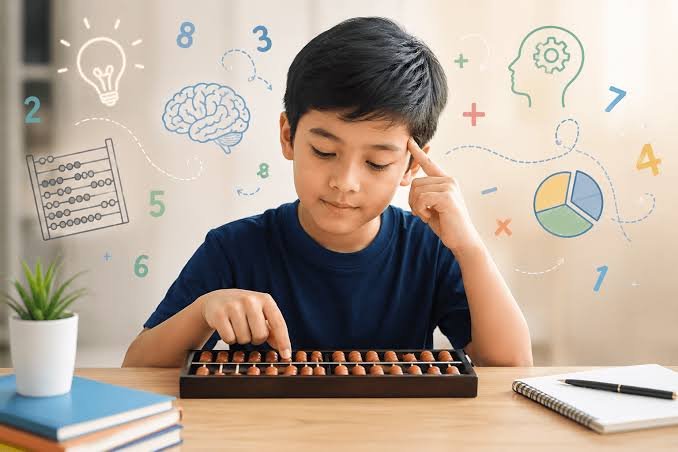
Abacus Mental Math can help children understand numbers in an easy way. An abacus lets children see numbers and work with them by moving beads. Instead of only looking at numbers on paper they can move the beads and see how the numbers change.
With practice children can also learn to picture the abacus in their minds. This can help them work with numbers without using a real abacus every time.
How Does Abacus Mental Math Help Children Understand Numbers?
An abacus gives children a simple way to see numbers. Each bead has a value. Moving the beads changes the number. This can help children understand numbers instead of only trying to remember maths rules.
1. Makes Numbers Easier to See
An abacus turns numbers into something children can see and move. They can use the beads to make a number and then change it by moving more beads.
For example a child can make the number 4 and then add 3 more beads. Seeing the change can make 4 + 3 easier to understand.
2. Makes Addition and Subtraction Easier
A child can easily practice adding and taking away with an abacus. Adding beads moves them forward, and taking beads backward moves them backward.
This helps kids understand each step of the math. These kids can get better at simple math problems if they do them often.
3. Builds Mental Calculation Skills
Children may find it easier to make the transition from using a real abacus to imagining themselves using one if they have the opportunity to practice using an abacus. While they are working through the process of solving a mathematical problem, they are able to imagine moving the beads and visualize them using their imagination.
One of the most important aspects of Abacus Mental Math is this component. Children can begin to solve problems in their heads with practice, and it is not necessary for them to use paper or an abacus exclusively. Children can begin to solve problems in their heads.
4. Makes Number Patterns Easier to Understand
An abacus can help children see how numbers change. They can see what happens when they add or remove beads.
For example adding one bead makes the number one higher. Doing simple activities like this can help children understand how numbers work together.
5. Makes Calculation Practice More Hands-On
Certain children have a better understanding of mathematics when they are able to use their hands. They are provided with something that they can touch and move while they are practicing with an abacus.
As the children move the beads, they can look at the answer that is displayed on the abacus. Maths practice can be made simpler and more enjoyable to follow as a result of this.
6. Helps Children Remember Number Values
The beads on an abacus have different values based on where they are placed. Children use these bead positions again and again while practising numbers.
After some time they may remember where the beads should be for different numbers. They can then picture these bead positions while solving maths problems.
7. Makes Mental Maths Easier With Practice
Mental maths can become easier when children practise often. An Abacus Math Program can give children simple lessons that help them build their skills step by step.
Children can start with easy calculations and then move to harder ones. This gives them time to understand each skill before trying something new.
How Can Parents Make Abacus Learning Easier for Children?
Parents can give children a quiet place to practise and let them work at their own speed. Children should first focus on understanding how the abacus works instead of trying to solve problems very quickly.
Short practice sessions can also help. As children use the abacus more often they can slowly start doing calculations in their heads.
Final Thoughts
Abacus mental math gives children an easy way to see and use numbers. It can help them understand simple calculations and build a picture of numbers in their minds. Abacus Math Lessons can give children regular practice and help them build these skills step by step.
Smart Math Tutoring offers abacus learning for children to help them practise numbers and mental maths. With regular lessons children can become more comfortable with numbers and improve their calculation skills over time.