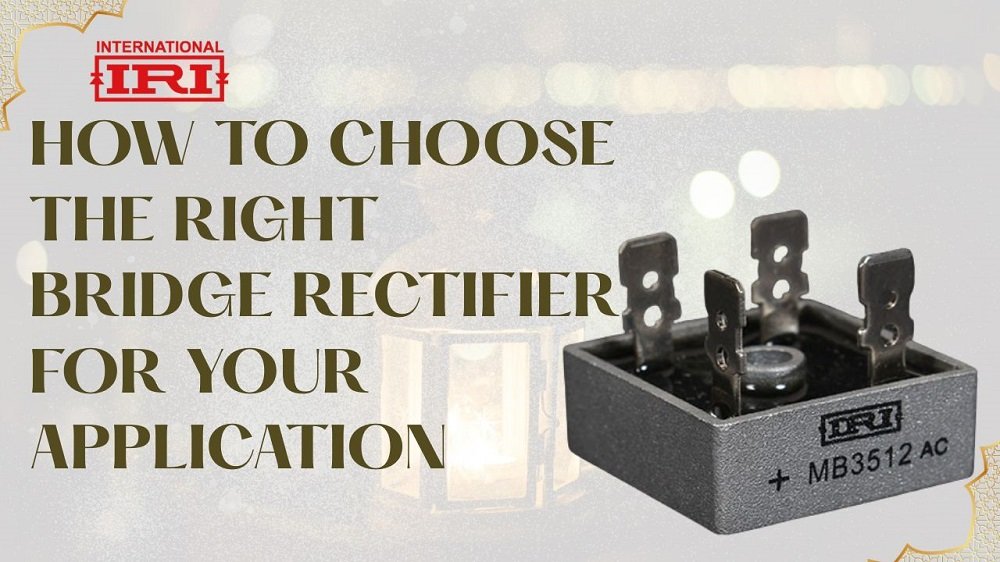
A procurement engineer ordered a “bridge rectifier” off a spec sheet last quarter without checking whether it meant half-wave or full-wave, assuming the word “bridge” settled the question on its own. It doesn’t, not reliably. Somewhere in that confusion between half-wave and full-wave terminology is where most buyers end up ordering the wrong part entirely, then wondering why the ripple filtering downstream doesn’t behave the way the datasheet promised.
Half-wave vs full-wave isn’t really a choice anymore
A half-wave bridge rectifier technically uses only one diode, and the “bridge” label gets applied loosely here since there’s no real bridge configuration involved. Half of the AC waveform gets thrown away entirely, wasted as unused potential, and the output ends up choppy with long gaps between pulses.
Nobody designs new equipment around half-wave rectification anymore, not for anything drawing real current. A full-wave bridge rectifier uses four diodes arranged to catch both halves of the AC cycle, doubling output frequency and cutting ripple in half compared to the half-wave approach. The efficiency gap is large enough that half-wave designs mostly survive in legacy equipment nobody’s gotten around to replacing yet.
Some catalogs still list half-wave options for cost reasons, single-diode setups priced lower than a proper bridge. Worth it only for genuinely low-power applications where ripple barely matters, like a simple indicator LED circuit.
What a bridge rectifier manufacturer actually controls
Diode matching matters more than people realize when comparing suppliers. A bridge rectifier manufacturer running matched forward voltage drops across all four diodes in a bridge keeps thermal load balanced. Mismatched diodes concentrate heat unevenly, and that imbalance shortens the part’s working life well before its rated current would otherwise suggest.
Insel Rectifiers tests each bridge assembly for forward voltage consistency across the full set before it ships, not just at final QC on a sample basis. That kind of batch-level consistency rarely shows up on a spec sheet, but it shows up fast in field failure rates once a product actually deployed at scale.
Package rating tolerance is the other detail buyers skip. A bridge rectifier manufacturer rating a part at exactly its breaking point, with zero margin, is setting up a field failure the moment ambient temperature climbs a few degrees above whatever the test bench assumed.
Picking the right bridge wave rectifier for the application
Current rating needs headroom above the actual load, not a number that exactly matches peak draw on paper. A bridge wave rectifier running at 90% of its rated current continuously ages faster than one running comfortably under that ceiling, even if both technically meet spec on day one.
Reverse voltage rating matters just as much, especially in applications with voltage spikes from nearby switching loads. Under sizing that margin is how a bridge rectifier survives bench testing fine and then fails within weeks of real-world installation, once actual transients start hitting it.
FAQs
Is a half-wave bridge rectifier ever a reasonable choice for new designs?
Rarely. Only for genuinely low-power, low-cost applications where ripple and efficiency don’t matter much.
What separates a reliable bridge rectifier manufacturer from a cheaper option?
Diode matching and batch consistency, mainly. Two rectifiers with identical spec sheets can behave very differently under sustained load.
Does a full-wave bridge rectifier always need external filtering?
Almost always, yes. The output is pulsing DC, not flat DC, and filtering capacitors smooth that out for most applications.
How much current headroom should I build in when sizing a bridge wave rectifier?
Use a reasonable margin above the expected peak load, rather than sizing exactly to it. Running near the rated ceiling constantly shortens lifespan.
Can a bridge rectifier fail without any obvious visible signs?
Yes. A single degraded diode can still pass current with worse ripple and lower efficiency, easy to miss without actually testing output quality.