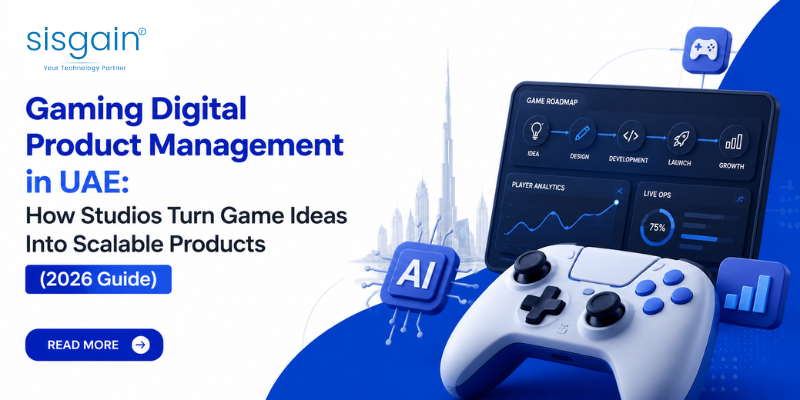
A game idea is cheap. A game that survives launch, holds its players past week one, and actually makes money is not — and that gap is exactly where most UAE gaming businesses lose momentum. The UAE’s gaming market crossed the billion-dollar mark faster than almost anywhere else in the region, yet a large share of studios here still run their roadmap out of a WhatsApp group and a spreadsheet. That’s not a technology problem. It’s a gaming digital product management problem, and it’s the single biggest reason promising games in Dubai and Abu Dhabi stall out after a strong soft launch.
This guide breaks down what gaming digital product management in UAE actually looks like in practice, why the region’s specific mix of regulation, culture, and rapid growth makes it non-negotiable, and how studios — from three-person mobile teams to enterprise gaming divisions — are structuring product decisions to compete in 2026. If you’re building, funding, or advising a gaming business anywhere in the Emirates, this is the operational layer that decides whether your next release becomes a case study or a write-off.
Most founders searching for a game development company in Dubai start the conversation with tech stack and timeline. That’s the wrong starting point. The studios pulling ahead in this market start with the product question — who plays this, why do they keep coming back, and how does it make money — and only then bring in engineering. This article walks through that sequence in full, with real market numbers, a working framework, and the mistakes that quietly sink otherwise well-funded gaming products.
Key Takeaways
- The UAE gaming market has grown from roughly USD 484 million in 2023 to well over USD 1 billion today, and it’s on track to approach USD 1.6–2.5 billion by the early 2030s.
- Gaming digital product management covers the full lifecycle — strategy, monetization design, compliance, UX, and post-launch iteration — not just development or design in isolation.
- Mobile gaming already accounts for more than half of UAE gaming revenue, which changes how product roadmaps, monetization, and testing priorities should be set.
- Studios that treat product management as a formal function ship faster, retain more players, and avoid the compliance rework that derails real-money and fantasy sports launches.
- Choosing the right game development company in Dubai or product management partner early avoids the most expensive mistake in gaming: building the wrong product well.
- AI-driven personalization, cloud-native backends, and AR/VR are moving from “nice to have” to baseline expectations for any 2026 gaming launch in the region.
What Is Gaming Digital Product Management?
Gaming digital product management is the discipline of planning, prioritizing, building, and continuously improving a game as a business asset — not just a creative or technical project. It sits between the studio’s vision, the engineering team’s execution, and the player’s actual behavior, and it’s the function responsible for answering one question at every stage: does this decision move the game closer to sustainable revenue and retention, or does it just add scope?
In practice, that means a product manager (or a small product team) owns the roadmap, defines what “success” looks like before a feature is built, sets monetization and pricing strategy, coordinates compliance requirements specific to the UAE market, and reads player data closely enough to know which features are worth a second sprint and which ones should be cut. It’s a different skill set from game design and a different skill set from software engineering, and treating it as an afterthought is exactly why so many otherwise well-built games underperform.
Studios that want this handled end-to-end, rather than assembled internally feature by feature, typically bring in specialized digital product management services in Dubai to own the roadmap, monetization model, and release strategy from day one — rather than retrofitting a product function after launch problems already show up in the data.
Why the UAE Gaming Market Needs This Now
Three things are happening in the UAE gaming sector at the same time, and each one raises the cost of skipping proper product management.
First, the market itself is growing fast enough that “figure it out as you go” no longer works. Second, regulatory scrutiny — particularly around real-money gaming, age verification, and data handling — has tightened, and a product built without compliance baked in from the start usually needs expensive rework. Third, player expectations in the UAE are shaped by a highly connected, mobile-first, premium-spending audience that has little patience for a rough launch.
| Metric | Figure | Source Context |
| UAE gaming market size (2023) | ~USD 484 million | MarkNtel Advisors |
| UAE gaming market size (2024) | USD 891.9M – 1.16B (varies by source) | IMARC / Grand View Research |
| Projected UAE market size by 2030 | USD 1.6–1.65 billion | Grand View Research |
| Active gamers in UAE population | ~75% of residents | Industry market reports |
| Mobile share of UAE gaming revenue | 54%+ | Grand View Research |
| UAE government esports investment commitment | ~USD 1 billion announced | UAE government initiatives |
According to IMARC Group’s market analysis, the UAE gaming market reached USD 1,260.4 million in 2025 and is projected to grow to approximately USD 2,503.4 million by 2034 — a compound annual growth rate of 7.69% between 2026 and 2034. That kind of growth curve rewards studios that can move quickly and punishes ones that can’t, and the difference between the two is almost always whether product decisions are being made deliberately or reactively. With roughly 75% of UAE residents actively gaming and smartphone penetration exceeding 95%, the Emirates has become one of the region’s most lucrative per-player gaming markets, which means a mobile-first product strategy isn’t optional for anyone building here.
Is the UAE a good market to launch a mobile game in?
Yes — high disposable income, near-universal smartphone penetration, and government backing make it one of the strongest per-player markets in the Middle East, though local compliance and Arabic localization matter more here than in most regions.
The 5 Pillars of Gaming Digital Product Management
Every gaming product function in the UAE, regardless of studio size, ends up covering the same five areas. Skipping any one of them is usually where the trouble starts.
| Pillar | What It Covers | Why It Matters in UAE |
| Strategy & Roadmapping | Prioritizing features against business goals, not just player requests | Fast-moving market means wrong bets are costly |
| Monetization Design | In-app purchases, subscriptions, wallets, ads, tournament fees | Revenue model must match regional spending habits and payment rails |
| Compliance & Trust | Age verification, KYC, data privacy, content sensitivity | UAE has specific cultural and regulatory content rules |
| UX & Retention | Onboarding, progression, rewards, personalization | 75%+ gamer penetration means retention beats acquisition |
| Data & Iteration | Analytics, A/B testing, post-launch feature cuts | Separates games that improve from games that stagnate |
A product manager working on a fantasy sports or real-money gaming platform, for instance, has to weigh monetization decisions against KYC and responsible-gaming controls simultaneously — a tournament entry fee feature isn’t just a revenue line, it’s also a compliance surface. That’s a very different job than managing a casual puzzle game’s roadmap, even though both fall under the same “gaming product manager” title.
How Team Structure Looks for Digital Product Management in UAE Studios
There’s no single correct org chart for this, but a few patterns repeat across the UAE gaming sector.
Solo founder, outsourced product function. Common for early-stage mobile studios. The founder owns vision and business relationships, while a specialized digital product management partner in the UAE runs roadmap discipline, monetization modeling, and release planning. This keeps overhead low while still giving the product real ownership instead of ad-hoc decisions.
In-house PM, outsourced engineering. A studio hires one dedicated product manager who works directly with an external development team — often the same game development company in Dubai handling the technical build — to keep product decisions close to the business while engineering scales up or down with project needs.
Full in-house product and engineering team. Typically appears once a studio has a live game generating consistent revenue and needs daily, hands-on iteration — live-ops events, seasonal content, and rapid A/B testing move too fast for an external cadence to keep up with.
None of these is inherently “better.” The right structure depends on how much of the studio’s value is in the game’s IP and creative direction versus in the underlying technical platform, and how fast the team needs to move once a game is live. What all three have in common is that someone — a named person, not a committee — owns the roadmap and is accountable for the metrics tied to it.
Localization, Culture, and Compliance: The UAE-Specific Layer
Product management in gaming looks different in the UAE than in most Western markets, and this is where generic playbooks fall short fastest.
Content review matters more here than in most regions the studio’s founders may have worked in before. Games are expected to align with local cultural values, and product roadmaps that don’t budget review time for this end up shipping content that has to be pulled or reworked post-launch — an expensive and reputation-damaging way to learn the lesson. Arabic localization is not a translation checkbox; it affects UI layout (right-to-left considerations for supporting text), voice and text tone, and even reward and event naming conventions that resonate with the local player base.
Payment and monetization design also has to reflect regional habits — wallet-based payments, carrier billing, and region-specific gateways often convert better than assumptions carried over from a US or European launch playbook. And for any product touching real-money mechanics, product managers need to build KYC, age verification, and responsible-gaming controls into the roadmap from the discovery phase, not as a compliance patch applied right before launch. Studios serious about gaming software development UAE projects treat this as core scope, not an add-on line item.
From Idea to Launch: The Product Lifecycle UAE Studios Actually Follow
Most successful gaming launches in the region follow a version of the same sequence, even when the studio never formally names it.
- Discovery and market validation. Before a single screen gets designed, the product team should be able to answer who the player is, what they’re currently doing instead of playing this game, and what would make them switch. Skipping this step is the single most common reason UAE studios build a technically solid game nobody asked for.
- Product definition and scope. This is where monetization model, core loop, platform choice (mobile, web, Unity, AR/VR), and MVP scope get locked. Immersive formats are a growing part of this conversation — studios exploring AR/VR game development in UAE need this decision made early, since AR/VR architecture affects almost every downstream technical choice.
- Design and prototyping. Wireframes, game economy modeling, and a clickable prototype get tested with a small player group before full development spend begins.
- Development and QA. Backend systems, wallet and payment integration, multiplayer infrastructure, and anti-cheat and anti-fraud layers get built in parallel with core gameplay — not bolted on afterward.
- Launch and post-launch iteration. Soft launch in a limited market segment, live monitoring of retention and monetization metrics, then a phased full rollout. The product manager’s job doesn’t end at launch — arguably it starts there, since this is where real player data finally replaces assumptions.
Studios building anything beyond a simple casual title — fantasy sports, multiplayer, real-money gaming — increasingly outsource this entire lifecycle to a specialized custom game development services in Dubai provider that can run product strategy, engineering, and compliance under one roof, rather than coordinating three separate vendors across the same timeline.
Monetization and Cost Realities
Budget conversations in gaming almost always start in the wrong place — with a total number instead of a breakdown of what’s actually driving it. Product management exists partly to keep that conversation honest.
| Cost Driver | Low Complexity | High Complexity |
| Platform scope | Single platform (mobile only) | Cross-platform (mobile + web + console) |
| Game engine | 2D casual engine | Unity/Unreal 3D, AR/VR |
| Backend | Simple leaderboard/API | Real-time multiplayer, wallet, KYC |
| Monetization | Single IAP model | Wallets, subscriptions, tournament fees, ads |
| Compliance | Basic data privacy | Real-money, age verification, fraud monitoring |
| Post-launch support | Bug fixes only | Continuous live-ops and feature releases |
Real-money and fantasy sports products carry the widest cost range in the UAE market because compliance requirements — KYC workflows, wallet controls, responsible-gaming features — scale non-linearly with complexity. Studios evaluating this should look closely at the actual breakdown behind the iGaming software development cost in UAE before committing to a build, since the difference between a compliant architecture from day one and a retrofit later can run into six figures.
A Realistic Product Scenario
Picture a mid-size entertainment brand running a mobile game development Dubai project — a casual game tied to a loyalty program, with points, levels, and redeemable rewards for existing customers. Without a product owner, the natural instinct is to hand engineering a feature list and start building. With proper digital product management, the sequence looks different: a two-week discovery phase validates which reward mechanics actually drive repeat visits, a lightweight prototype gets tested with 50–100 real customers before full development starts, and the monetization model (in this case, brand-funded rather than player-funded) gets locked before a single screen is finalized. The build might take the same number of engineering weeks either way — the difference is that one version is validated before the spend, and the other is validated after, when changes cost far more.
Build In-House vs. Outsource vs. Hybrid
| Approach | Best For | Trade-off |
| Fully in-house | Studios with existing tech talent and a live, revenue-generating game | Slower to start; highest fixed cost |
| Fully outsourced | Startups and first-time gaming launches | Faster start; requires a partner with genuine product ownership, not just delivery |
| Hybrid (in-house PM, outsourced build) | Studios that want direct control over product decisions without full engineering overhead | Needs strong communication discipline between the PM and the external team |
How much does it cost to build a mobile game in the UAE?
A simple mobile game MVP can start in the low tens of thousands of AED, while a full multiplayer or real-money platform with compliance features typically runs well into six figures — scope, not platform, is what drives the range.
The Metrics That Actually Matter Post-Launch
A gaming product manager’s job doesn’t get easier after launch — it gets more data-driven. The metrics worth tracking weekly are narrower than most first-time studios expect, and it’s worth naming them plainly instead of drowning a dashboard in vanity numbers.
Retention (Day 1, Day 7, Day 30) tells you whether the core loop is actually fun, independent of how well marketing drove installs. ARPU and ARPPU (average revenue per user and per paying user) separate a healthy monetization model from one that’s leaking revenue through poor pricing or weak conversion. Session length and frequency reveal whether players are engaging the way the game economy assumes they will — a mismatch here usually means the reward pacing needs rework. And churn triggers — the specific point where players drop off, whether that’s a difficulty spike, a paywall, or a tutorial that runs too long — are usually more actionable than any aggregate retention number on its own.
Studios that skip formal digital product management UAE practices tend to track installs and revenue only, which tells them that something is wrong without ever showing where. That’s the gap a dedicated product function closes.
Mistakes UAE Gaming Businesses Make Without Product Management
A handful of patterns show up again and again in gaming projects that stall after launch, and almost none of them are technology failures.
Studios build the full feature list before validating the core loop with real players, which means months of engineering time gets spent before anyone confirms the game is fun. Monetization gets bolted on after launch instead of designed alongside the game economy, which usually damages retention right when it should be improving. Compliance — age verification, KYC, responsible-gaming controls — gets treated as a legal afterthought instead of a product requirement, which means a working game sits unlaunched for weeks while workflows get retrofitted. And perhaps most common: nobody owns the post-launch roadmap, so the game ships and then quietly stops improving, which is a slower and less visible way of losing to competitors who kept iterating.
Each of these is fixable with the same intervention — a product owner accountable for the decision, not just the delivery.
What to Look For in a Gaming Product Management Partner
Not every software vendor that says “we build games” actually runs product management as a discipline. A few questions separate the two.
Does the partner ask about your monetization model and target retention metrics before discussing tech stack? Do they have a documented process for compliance-aware architecture, or is that something they figure out mid-project? Can they show a realistic development timeline broken into discovery, MVP, and post-launch phases, rather than one lump estimate? And do they have experience specific to the UAE’s regulatory and cultural context — Arabic localization, GCGRA-aligned compliance thinking, region-specific payment rails — rather than a generic global playbook.
Studios and platforms already active in the region, including operators referenced across the broader gaming software hub in UAE ecosystem, consistently point to the same lesson: the technical build was rarely the bottleneck. The product decisions around it were.
Where Gaming Digital Product Management in UAE Is Heading (2026–2030)
A few shifts are already visible enough to plan around rather than guess at.
AI personalization is moving from a differentiator to table stakes — recommendation engines, dynamic difficulty, and fraud detection are becoming standard product requirements rather than premium add-ons. Cloud-native backends are replacing single-server architectures as multiplayer and live-ops features become the norm rather than the exception, which puts more weight on product managers who understand infrastructure trade-offs, not just feature prioritization. Regulatory sophistication is increasing alongside market size, with the UAE’s evolving gaming regulations opening new opportunities even as they raise the bar for compliance-ready product design. Regional competition is intensifying too — Mordor Intelligence estimates the broader Middle East gaming market will grow from roughly USD 4.56 billion in 2025 to USD 9.32 billion by 2031 — with sovereign investment from neighboring markets pushing every UAE studio to differentiate on quality and product execution rather than scale alone.
Esports and live-events infrastructure are also becoming a product management concern rather than purely a marketing one — tournament features, spectator modes, and streaming integrations now need to be scoped and prioritized alongside core gameplay, not bolted on once a game already has an audience. Cloud gaming and cross-platform play are pushing more studios toward backend-first architecture decisions early in the roadmap, since retrofitting cross-device play into a mobile-only codebase is one of the more expensive rebuilds a product team can face. And as more entertainment and retail brands enter gaming through gamification and loyalty products rather than standalone titles, the demand for gaming software development UAE teams that understand both game mechanics and enterprise product requirements is growing faster than the local talent pool can fill on its own — which is exactly why more businesses are partnering with established studios rather than hiring from scratch.
For studios and enterprises building gaming products in this environment, digital product management stops being a “nice to have” layer on top of development and becomes the actual competitive strategy.
Final Thoughts
The UAE gaming market isn’t short on ambition, funding, or technical talent — it’s short on the discipline that turns a good game idea into a product that keeps growing after launch day. That discipline is gaming digital product management, and it’s the difference between a studio that ships once and a studio that compounds. Whether you’re validating your first mobile title or scaling a multiplayer platform across the GCC, the product decisions you make before a single line of code gets written will matter more than almost anything you build afterward.
The pattern across every successful launch covered in this guide is the same: product decisions came before technical ones, not after. Studios that validate the core loop before scaling engineering spend, that design monetization alongside the game economy instead of retrofitting it, and that treat compliance as a product requirement rather than a legal afterthought are the ones still growing a year after launch — not just the ones with the biggest opening week.
If you’re planning a gaming product launch in the UAE and want a team that treats product strategy, compliance, and engineering as one connected process rather than three separate vendors, SISGAIN’s gaming and digital product management teams work across mobile, Unity, AR/VR, and real-money gaming platforms for studios and enterprises across Dubai and the wider UAE. Whether you’re validating your first prototype or planning a multiplayer platform’s next roadmap cycle, get a scoped plan before your next sprint starts — it’s a far cheaper conversation to have now than after a feature ships to the wrong audience.
Turn your game idea into a scalable, player-focused product with the right strategy from day one. Talk to SISGAIN’s gaming product experts to plan your roadmap, validate your concept, and build a gaming platform designed for long-term growth in the UAE.