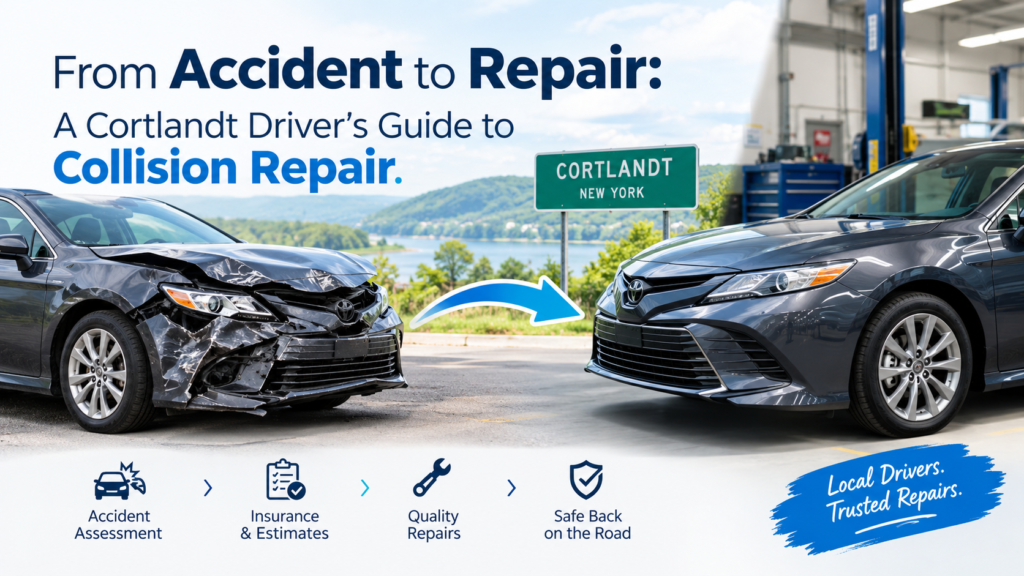
Nobody plans for a fender bender on Route 6. But it happens. A deer darts out near the Croton reservoir. Someone taps your bumper at a Cortlandt Manor intersection. A hailstorm leaves your hood looking like a golf ball overnight. The moment right after a crash is never calm, and you’re suddenly supposed to make smart calls about towing, insurance, and repair shops all at once, usually while your hands are still shaking a little. This guide walks through what actually happens between the accident and the finished repair.
Right After the Crash
Safety first. Move to the shoulder if you can, flip on the hazards, check on everyone involved. If there’s an injury or real damage, call the police. Cortlandt PD will file a report, and honestly, you’ll want that report later when the claims process starts.
Once everyone’s okay, grab your phone and take photos. A lot of them. Wide shots of the area close-ups of the parts, pictures of the license plates signs, on the street anything that shows where the accident took place and how it happened. Adjusters look at what they can see in the photos not what you say over the phone so having a good group of pictures helps the claim go quicker.
One thing a lot of people don’t realize: your insurer’s “preferred” shop is not your only option. You get to pick where your car goes. That’s your legal right, and it’s worth knowing before someone on the phone makes it sound like a formality.
Picking the Right Shop
Here’s where it gets a bit overwhelming. Search for an autobody repair shop in Cortlandt and you’ll pull up a dozen names, every one of them claiming to be the best in town. So how do you actually sort through that?
Start with certifications. I-CAR Gold Class and OEM-specific training sound like marketing buzzwords, but they’re not. They mean the technicians have actually been tested on manufacturer-specific repair procedures. That matters more today than it did fifteen years ago, because cars are built differently now. High-strength steel, sensors built into bumpers, safety systems that need exact calibration after even a minor hit. A shop without that training can make your car look fine on the outside. There could still be a structural issue hiding underneath, and you’d never know from looking at it.
Parts matter too. Genuine OEM parts cost more than the aftermarket stuff, but they’re built to the exact specs your manufacturer intended. Fit, strength, how it performs in a crash. For anything near your car’s frame or safety systems, that’s not a small detail.
A few things worth asking before you commit to a shop:
- Do they work directly with your insurance company, or are you stuck relaying messages between the two?
- What kind of warranty comes with the work?
- Can they give you a timeline that’s actually realistic, not just hopeful?
- Do they have experience with your specific vehicle brand, especially if you’re driving a Tesla or another EV?
Most drivers looking for the best collision center in the area land on the same conclusion once they actually read reviews and ask around. A shop with decades behind it, real customer feedback, and insurance relationships already in place just saves you a lot of hassle. Spectrum Auto Inc. has built that kind of name across Westchester and Rockland counties, with over 30 years in business and more than a thousand five-star reviews behind it.
What Actually Happens During the Repair
Once your car’s at the shop, there’s a general order to things. Damage analysis comes first, and a good shop won’t just eyeball it. They’ll run diagnostics to catch anything hidden, not just what’s visible on the surface. From there it moves into structural repair if the frame or unibody needs work, then refinishing for paint and color matching, reassembly, detailing, and a final quality check before you get the car back.
That sounds clean on paper. In reality, timelines move around. A small bumper job might take a few days. Frame damage, a part stuck on backorder, or insurance dragging its feet can turn that into a week or more. What matters most is whether the shop actually calls you with updates instead of leaving you to chase them down. That kind of communication is worth more than saving fifty bucks somewhere else.
When the Trouble Shows Up Later
Collision damage doesn’t always stop at dents and scratched paint. Sometimes a crash jars a hose loose, cracks a radiator, or knocks a sensor out of place without anyone noticing right away. Weeks later you’re sitting in traffic and the gauge starts climbing, and you’re left wondering why is my engine overheating when the accident seemed minor. It happens more often than people expect.
Usually it comes down to one of a few things: a coolant leak from the impact, a damaged radiator fan, a thermostat that’s stuck, or a water pump that took a hit and has been slowly failing ever since. If that needle creeps toward the red, pull over. Don’t push it. Driving even a few more miles on an overheating engine can warp a head gasket or crack the block, and suddenly a simple fix turns into a very expensive one.
So if you’re asking why is my engine overheating not long after a collision, don’t write it off as unrelated. Bring it up when you drop the car off. A shop that actually knows what it’s doing will check the cooling system as part of the post-collision inspection, not just patch up the bodywork and call it done.
Getting Through the Insurance Side
Insurance paperwork is its own headache. The adjuster wants photos, a police report if one exists, and usually their own look at the car before approving anything. This is where it helps a lot to have a shop that already works directly with the big insurers, State Farm, Geico, Allstate, Travelers, and the rest. They can talk to the adjuster themselves, submit supplements if more damage turns up mid-repair, and keep things moving without you stuck in the middle relaying messages back and forth.
Spectrum Auto Inc.: Three Decades in Cortlandt and Beyond
Spectrum Auto Inc. has spent over 30 years working on cars across West Nyack, Cortlandt, Montrose, and the surrounding New York area. The reputation wasn’t built on shortcuts. Every technician on staff is I-CAR Platinum certified, and the shop itself carries I-CAR Gold Class status. It’s an OEM-certified collision center, and that includes Tesla-approved repair work done with genuine parts and backed by a lifetime warranty. With direct insurance partnerships, online estimate tools, and towing available around the clock, Spectrum Auto covers the whole process from the accident scene to the finished repair, so you’re not figuring it out alone.
Frequently Asked Questions
1. How long does collision repair usually take?
Really depends on the damage. A minor fix might take a few days, while structural work or backordered parts can push things past a week. A good shop will give you a real number once they’ve actually looked at the car.
2. Can I pick my own repair shop instead of the one my insurer suggests?
Yes. In New York, that choice is yours, no matter what your insurance company recommends.
3. Should I be concerned if my engine runs hot after an accident, even minor damage?
Yes, get it checked. Impact can damage cooling components you’d never spot just by looking at the car, and ignoring a rising gauge usually leads to a bigger, costlier problem.
4. Why does it matter if a shop uses genuine OEM parts?
Because they match your car’s original specs exactly, fit, safety performance, durability. That matters a lot more for anything structural or safety-related than it does for, say, a scratched panel.