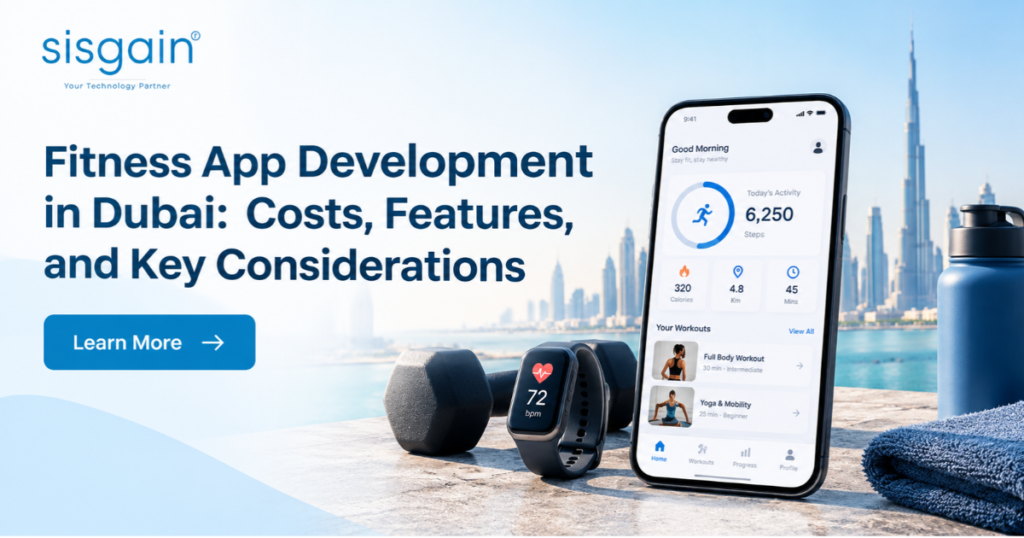
The fitness industry is becoming increasingly digital, and mobile applications are changing how people exercise, manage memberships, communicate with trainers, and track their progress. In Dubai, gyms, wellness brands, personal trainers, and fitness startups are increasingly exploring mobile solutions to create more convenient and personalized experiences for their customers.
A well-designed fitness application can bring workouts, bookings, payments, progress tracking, and personalized recommendations into a single platform. However, developing such an application requires careful planning around functionality, technology, security, and long-term scalability. Working with the right fitness app development company in Dubai can help businesses turn an idea into a reliable digital product while keeping development goals aligned with business requirements.
Key Takeaways
- Fitness apps can improve customer engagement, convenience, and operational efficiency.
- Development costs depend heavily on features, platforms, integrations, and technical complexity.
- AI, wearable connectivity, live classes, and personalized recommendations can increase development scope.
- Security and scalable cloud infrastructure should be considered from the beginning.
- A capable development partner can help businesses prioritize features and avoid unnecessary costs.
Why Fitness Businesses in Dubai Are Investing in Mobile Apps
Customer expectations have changed significantly. Fitness users increasingly want access to services without being restricted by gym opening hours or physical locations. A mobile app allows businesses to maintain a continuous digital connection with their customers.
Fitness applications can support several areas of a fitness business, including:
- Membership registration and management
- Personal training bookings
- Workout and exercise programs
- Class scheduling
- Progress monitoring
- Digital payments
- Notifications and reminders
Beyond convenience, an application can create additional revenue opportunities. Fitness businesses can introduce premium workout plans, online coaching, subscription packages, nutrition programs, or paid digital content.
For business owners, applications can also simplify daily operations. Instead of managing different systems for bookings, member information, communication, and payments, many processes can be connected through one digital platform.
Essential Features of a Fitness App

The features included in a fitness application should reflect its target audience and business model. A basic gym membership app will have different requirements from an advanced platform combining trainers, nutritionists, wearable devices, and AI-powered recommendations.
User Registration and Profiles
Users should be able to create accounts and maintain personal profiles. Depending on the application, profiles may include fitness goals, activity levels, workout preferences, and membership information.
Simple registration, social login, secure authentication, and easy profile management can reduce friction during onboarding.
Workout and Exercise Management
A comprehensive exercise section can allow users to access workout routines, exercise demonstrations, training schedules, and customized plans. Video instructions can make exercises easier to understand, particularly for users exercising independently.
Gym and Class Booking
For gyms and fitness centers, booking functionality can be particularly valuable. Users can browse available classes, check trainer schedules, reserve sessions, and cancel bookings when necessary.
This functionality can also help businesses manage capacity and reduce manual administrative work.
Progress and Performance Tracking
Progress tracking gives users a reason to continue interacting with an application. Depending on the product, the app can record workout history, calories burned, completed sessions, measurements, and personal goals.
Visual dashboards can make progress easier to understand and encourage users to remain consistent.
Payments and Subscriptions
Fitness businesses can use applications to manage memberships, subscriptions, digital programs, and other paid services. Secure payment integration can support different pricing models while making the purchasing process more convenient.
Notifications and Engagement
Push notifications can remind users about upcoming classes, scheduled workouts, membership renewals, or new programs. Personalized notifications can be more effective than sending generic messages to every user.
Advanced Features That Can Increase Development Costs
Advanced functionality can transform a basic fitness application into a more sophisticated digital platform, but it also increases development time and technical requirements.
AI-Powered Personalization
Artificial intelligence can analyze user activity and preferences to generate more personalized experiences. For example, an application could recommend workouts based on fitness goals, previous performance, or available training time.
AI can also support adaptive plans that change as users progress.
Wearable Device Integration
Fitness applications can connect with smartwatches and other wearable devices to collect information such as activity levels, heart rate, steps, and workout data.
Such integrations require additional APIs, synchronization mechanisms, testing, and data-management capabilities.
Nutrition and Diet Management
Nutrition features can include calorie tracking, meal recommendations, dietary goals, and meal planning. Fitness businesses that operate alongside food and wellness services may also benefit from connecting digital fitness experiences with operational systems.
For businesses managing broader food-related operations, food ERP software in UAE can provide a useful example of how specialized digital systems can support data and process management across interconnected business functions.
Live Classes and Video Streaming
Live training sessions and on-demand workout libraries can expand a fitness business beyond its physical location. However, video streaming requires reliable infrastructure, content management, bandwidth planning, and performance optimization.
How Much Does Fitness App Development Cost in Dubai?
There is no single fixed price for developing a fitness application. The final investment depends on the application’s functionality, platforms, design complexity, integrations, backend architecture, and ongoing support requirements.
As a general estimate:
| App Type | Approximate Development Cost |
| Basic Fitness App | AED 50,000–90,000 |
| Mid-Level Fitness App | AED 90,000–180,000 |
| Advanced Fitness Platform | AED 180,000–350,000+ |
A basic application may include user profiles, workout plans, progress tracking, notifications, and an administrative dashboard.
A mid-level solution may add payment gateways, class bookings, trainer management, analytics, and third-party integrations.
An advanced platform could include AI-powered personalization, wearable connectivity, live streaming, multiple user roles, sophisticated analytics, and a highly scalable backend.
These figures are indicative rather than fixed quotations. A detailed project assessment is necessary to determine the actual cost.
Key Factors That Affect Fitness App Development Costs
Several technical and business decisions can significantly influence the development budget.
Number of Platforms
Building for iOS, Android, and the web can increase development and testing requirements. Businesses must decide whether native development or cross-platform development is more appropriate for their goals.
UI/UX Complexity
A simple interface generally requires less design and development effort than an application containing interactive dashboards, animations, personalized journeys, and advanced visualizations.
Third-Party Integrations
Payment gateways, wearable devices, health APIs, maps, video services, analytics platforms, and external business systems can all add development complexity.
Backend and Infrastructure
A fitness application must have infrastructure capable of handling user accounts, workout data, transactions, analytics, and API requests. Planning for scalability early can prevent expensive architectural changes later.
Security and Compliance
Fitness applications can process personal information and potentially sensitive health or activity-related data. Strong authentication, encryption, secure APIs, access controls, and regular security testing are therefore important.
Businesses can also consider managed cloud security services when they need ongoing protection, monitoring, and security management for cloud-based application infrastructure.
Technology Considerations for a Scalable Fitness App
Technology choices should support both current requirements and future growth.
Native vs. Cross-Platform Development
Native development can provide strong platform-specific performance and access to device capabilities. Cross-platform development can reduce duplicated development work and may be suitable when businesses want to launch on multiple platforms efficiently.
The right approach depends on application complexity, budget, performance requirements, and long-term plans.
Cloud-Based Architecture
Cloud infrastructure can provide the flexibility needed as the number of users increases. A properly designed cloud environment can support application availability, data storage, APIs, analytics, and scalable processing.
API and System Integrations
APIs allow fitness applications to communicate with payment systems, wearable devices, analytics platforms, CRM systems, and other digital services.
Reliable communication infrastructure is particularly important for applications that depend on real-time data exchange. Similar principles are relevant when working with a telecom software development company, where scalable APIs, connected systems, and reliable data transmission are essential.
How to Choose a Fitness App Development Company in Dubai
Selecting a development partner is an important decision because the quality of development can affect performance, security, scalability, and future maintenance.
Before choosing a partner, consider the following:
- Relevant experience: Review previous mobile applications and projects involving fitness, wellness, healthcare, or subscription-based platforms.
- Technical capabilities: Check experience with mobile development, backend systems, APIs, cloud technologies, and security.
- Development methodology: Understand how the company handles discovery, UI/UX design, development, testing, deployment, and maintenance.
- Communication: Clear communication helps prevent misunderstandings about functionality, timelines, and project priorities.
- Post-launch support: Ask how the team handles bug fixes, updates, performance improvements, security patches, and future feature development.
A suitable fitness app development company in Dubai should be able to understand the business objective rather than simply build a list of requested features.
Common Mistakes to Avoid When Developing a Fitness App
Many fitness app projects become unnecessarily expensive because businesses try to include every possible feature in the first release.
Common mistakes include:
- Building too many features before validating the core concept
- Ignoring user experience during development
- Treating security as an afterthought
- Choosing technology without considering future scalability
- Underestimating device and platform testing
- Failing to plan post-launch maintenance
- Focusing only on initial development cost
Starting with a well-defined minimum viable product can allow businesses to test the concept, collect user feedback, and prioritize future improvements based on actual usage.
Final Considerations Before Starting Your Fitness App Project
Before development begins, business owners should clearly define their target audience, revenue model, essential features, budget, and expected outcomes.
It is also important to determine which features are necessary for the initial launch and which can be introduced later. Planning integrations, security, analytics, and scalability from the beginning can reduce technical complications as the application grows.
A realistic development plan should include:
- Business and technical requirements
- UI/UX design
- Development and integration
- Quality assurance and testing
- Deployment
- Performance monitoring
- Ongoing maintenance
This structured approach can make development more predictable and help businesses make better use of their investment.

Conclusion
Fitness app development in Dubai presents an opportunity for gyms, wellness companies, personal trainers, and fitness startups to create stronger digital experiences and develop new revenue channels. However, building a successful application requires more than an attractive interface. Features, infrastructure, security, integrations, scalability, and ongoing support all influence the final product and its cost.
Businesses should define their objectives before development begins and prioritize functionality based on genuine user needs. Choosing an experienced fitness app development company in Dubai can further support the process, from planning and design through development, testing, deployment, and future improvements. With the right strategy, a fitness application can become a long-term digital asset rather than simply another mobile product.
How much does it cost to develop a fitness app in Dubai?
Fitness app development in Dubai can cost approximately AED 50,000 to AED 350,000+, depending on features, platforms, integrations, design complexity, and backend requirements.
What features should a fitness app include?
Essential features can include user profiles, workout plans, exercise libraries, class booking, progress tracking, subscriptions, payment integration, notifications, and an admin dashboard.
How long does it take to develop a fitness app?
Development time depends on the application’s complexity. A basic fitness app may take a few months, while an advanced platform with AI, wearable integrations, and live streaming can require considerably more time.
How can I choose the right fitness app development company in Dubai?
Review the company’s relevant experience, technical capabilities, previous projects, development methodology, security practices, communication process, and post-launch support.
Can a fitness app integrate with wearable devices?
Yes. Fitness apps can integrate with smartwatches and fitness trackers to collect data such as steps, heart rate, calories, activity levels, and workout performance.