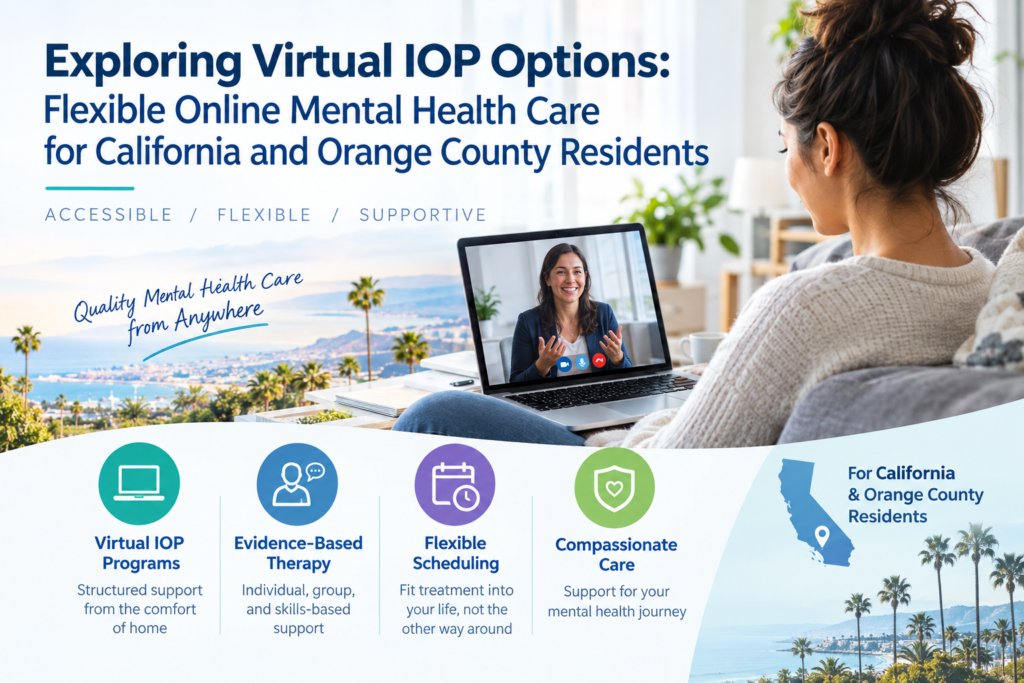
Exploring Virtual IOP Options: Flexible Online Mental Health Care for California and Orange County Residents
Access to mental health care has changed significantly in recent years. For people managing anxiety, depression, trauma-related concerns, mood disorders, or other behavioral health challenges, traditional in-person appointments are no longer the only option. Virtual intensive outpatient programs (IOPs) can provide a flexible alternative for individuals who need structured mental health support while continuing to manage work, school, family, and everyday responsibilities.
For California and Orange County residents, virtual IOP services can make ongoing behavioral health treatment more accessible. Understanding how virtual intensive outpatient care works, how it differs from other treatment options, and what to consider when choosing a program can help individuals make informed decisions about their mental health care.
What Is a Virtual Intensive Outpatient Program?
An intensive outpatient program provides a structured level of behavioral health care without requiring participants to live at a residential treatment facility. Depending on the provider and individual treatment plan, an IOP may include individual therapy, group sessions, psychoeducation, coping-skills development, and other forms of behavioral health support.
A virtual IOP delivers eligible services through secure online technology rather than requiring participants to attend every session at a physical treatment center. This approach can reduce travel requirements while allowing participants to engage with scheduled treatment from an appropriate private setting.
Virtual treatment may be particularly useful for people who need more support than occasional outpatient therapy but do not require residential care based on a professional assessment.
Understanding the Kaiser IOP Program and Virtual Alternatives
People researching intensive outpatient care may encounter information about the Kaiser iop program while comparing available treatment pathways in California.
Insurance coverage, provider networks, eligibility requirements, and available services can vary considerably. Individuals who receive healthcare through an insurance provider may want to determine which behavioral health services are included in their specific plan and whether particular providers are considered in-network.
At the same time, some individuals may explore virtual IOP alternatives when looking for additional scheduling flexibility or different treatment arrangements. Comparing program structures, clinical services, scheduling requirements, and accessibility can help someone identify options that align with their circumstances.
It is important to remember that insurance coverage and clinical appropriateness are separate considerations. A person should discuss their treatment needs with qualified professionals and verify insurance benefits directly with their plan or provider.
Benefits of Virtual IOP Treatment in California
One of the most significant advantages of virtual treatment is convenience. California is a large and geographically diverse state, and traveling regularly to a treatment facility may be difficult for some residents.
A Virtual iop mental health program in california can allow eligible participants to attend scheduled sessions remotely. Depending on the program, virtual care may include group therapy, individual counseling, educational sessions, and other structured services.
Virtual IOP treatment may also help reduce some common logistical barriers. Participants may spend less time commuting, avoid arranging transportation for every appointment, and potentially fit treatment more easily around existing responsibilities.
For someone balancing employment or education with mental health treatment, this flexibility can be an important practical consideration. However, virtual care still requires consistent participation and a suitable environment for attending sessions.
Online Mental Health Treatment in Orange County
Orange County residents have access to a range of behavioral health services, including options that incorporate remote care. For individuals who prefer receiving treatment from home or another private location, Mental health treatment online orange county services may provide an alternative to frequent in-person visits.
Online treatment can be especially convenient for individuals who have demanding schedules or transportation limitations. It can also allow participants to remain connected to their everyday environment while working on therapeutic goals.
Privacy is an important consideration when receiving mental health care online. Participants should have access to a private, quiet space where they can engage comfortably in sessions without unnecessary interruptions. A reliable internet connection and compatible device may also be necessary.
How Virtual IOP Differs From Traditional Therapy
A common question is how an online IOP differs from a standard virtual therapy appointment. The primary distinction is often the level and frequency of structured support.
Traditional outpatient therapy may involve an individual meeting with a therapist periodically according to a personalized schedule. An IOP generally involves a more structured treatment schedule and may incorporate multiple types of services.
For individuals who require more frequent behavioral health support, an IOP can offer a framework that goes beyond occasional therapy appointments. Group sessions can also provide opportunities to develop communication and coping skills while learning alongside others with similar treatment goals.
The appropriate level of care depends on each person’s needs. A mental health professional can help determine whether standard outpatient therapy, an IOP, or another level of care is appropriate.
What to Consider Before Choosing a Virtual IOP
Before enrolling in a virtual intensive outpatient program, prospective participants can consider several practical and clinical factors.
Treatment needs: The program should offer services appropriate to the individual’s mental health concerns and treatment goals.
Schedule: Review session frequency and timing to determine whether the program can realistically fit around work, school, caregiving, or other responsibilities.
Technology: Participants should have a suitable device, stable internet access, and a private environment for attending sessions.
Privacy: Ask how virtual sessions are conducted and what measures are used to protect participant privacy.
Professional support: Consider the qualifications of the clinicians providing treatment and whether the program offers appropriate coordination of care when necessary.
Insurance and cost: Verify coverage, out-of-pocket expenses, eligibility requirements, and payment arrangements before beginning treatment.
Making Mental Health Care More Accessible
Virtual intensive outpatient treatment is one example of how behavioral healthcare continues to adapt to the needs of modern patients. By combining structured treatment with remote access, virtual IOP programs can offer an option for people who need consistent support but face challenges with attending traditional in-person programs.
For California residents, and particularly those in Orange County, online treatment may provide greater scheduling and transportation flexibility while maintaining a structured approach to mental health care.
Ultimately, choosing a treatment format should be based on individual clinical needs, safety, availability, and practical circumstances. Speaking with a qualified mental health professional can help determine whether a virtual IOP or another form of care is an appropriate next step.
As technology continues to expand access to behavioral health services, virtual treatment can give eligible individuals another pathway for seeking structured support without requiring every appointment to take place at a physical facility.