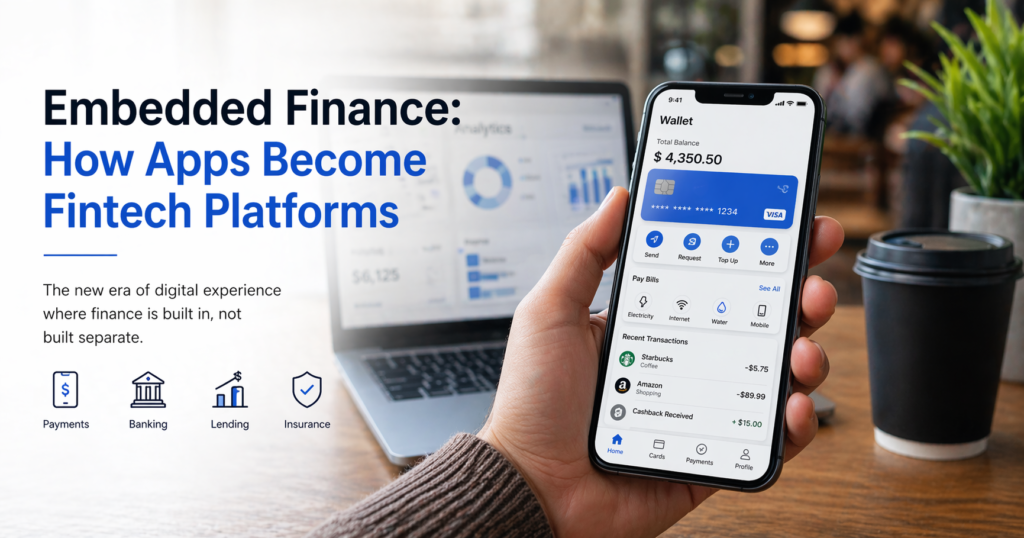
Open your favorite shopping app, book a cab, or subscribe to a SaaS tool. Something powerful is happening behind the scenes. Payments are completed instantly, credit is offered at checkout, and financial decisions are made without ever leaving the platform.
You are not “going to a bank” anymore. Banking is coming to you.
This shift is driven by embedded finance, which is rapidly transforming how digital products are built and experienced. In fact, industry estimates suggest that embedded finance could contribute trillions of dollars in transaction value over the next few years, making it one of the fastest-growing segments in fintech.
What started as a niche innovation used by fintech startups is now being adopted across industries. From eCommerce and healthcare to logistics and SaaS, every digital platform is evolving into a financial ecosystem designed to keep users engaged and transacting within a single environment.
In 2026, embedded finance is no longer optional. It is a competitive necessity. Platforms that fail to integrate financial services risk losing users to those that offer faster, smarter, and more seamless experiences.
What Is Embedded Finance (And Why It Matters Now)
Embedded finance refers to the integration of financial services such as payments, lending, insurance, and banking directly into non-financial applications.
Instead of redirecting users to third-party financial institutions, businesses now deliver these services within their own platforms. But the real shift is not technical. It is behavioral.
Users expect:
- Instant payments
- One-click transactions
- Flexible credit options
- Personalized financial insights
If your platform does not provide this, users will move to one that does. This is why embedded finance is not just a feature. It is a user experience evolution.
Why Embedded Finance Is Growing Rapidly in 2026
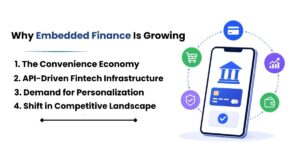
1. The Convenience Economy
Modern users prioritize speed and simplicity. Every additional step in a process increases drop-off rates. Embedded finance removes friction by keeping users within a single ecosystem.
For example, instead of switching to a banking app, users can complete transactions instantly within the same interface.
2. API-Driven Fintech Infrastructure
The rise of APIs and modular fintech solutions has made integration easier than ever. Businesses no longer need to build financial systems from scratch.
With banking as a service (BaaS) and fintech APIs, companies can:
- Launch financial features faster
- Reduce development costs
- Ensure regulatory compliance through partners
3. Demand for Personalization
Users expect tailored experiences. Embedded finance enables platforms to offer:
- Personalized credit limits
- Smart spending insights
- Contextual insurance options
This level of customization drives engagement and trust.
4. Shift in Competitive Landscape
Today, companies are not just competing on product features. They are competing on experience ecosystems. Apps that integrate financial services create deeper user engagement and stronger retention loops.
The biggest mistake many businesses make is treating embedded finance as an add-on feature rather than a core product strategy. In reality, the platforms winning in 2026 are those that design their entire user experience around financial integration from day one.
The Business Case: Why Companies Are Investing in Embedded Finance
Embedded finance is not just about improving UX. It is a powerful business growth engine.
New Revenue Streams
Embedded finance allows companies to monetize financial interactions that were previously handled by third parties.
- Transaction fees: Platforms earn a small percentage on every payment processed within the app.
Example: An eCommerce platform charges a 1–2% fee on each in-app payment instead of relying entirely on external gateways. - Lending interest: Businesses can offer credit or BNPL options and earn interest or service fees.
Example: A B2B marketplace provides short-term working capital loans to vendors and earns interest on repayments. - Insurance commissions: Platforms partner with insurers and earn commissions for every policy sold.
Example: A travel app offers travel insurance at checkout and receives a commission per purchase. - Payment processing margins: Companies integrate payment infrastructure and keep a share of processing fees.
Example: A SaaS platform handling subscriptions earns a margin on every recurring payment processed internally.
This transforms platforms from service providers into revenue-generating financial ecosystems.

Higher Customer Lifetime Value (LTV)
When financial services are embedded, users don’t just interact occasionally, they become part of a continuous ecosystem.
Example: A freelancer using a SaaS platform for project management starts accepting payments, managing invoices, and even accessing credit within the same tool. Over time, their dependency increases, leading to higher spending and longer retention.
The more services a user relies on, the higher their lifetime value.
Improved Retention
Embedded finance creates a form of “functional lock-in.” Users are less likely to switch because their financial activities are deeply integrated into the platform.
Example:
A ride-hailing driver using an app that provides instant payouts, earnings analytics, and a wallet system is far less likely to move to a competitor that only offers basic ride bookings.
Switching platforms would mean disrupting their financial workflow, which most users avoid.
Competitive Differentiation
In crowded markets, features alone are not enough. Embedded finance helps platforms stand out by offering a more complete and seamless experience.
Example:
Two eCommerce apps sell similar products, but one offers BNPL, instant refunds, and in-app wallets. Users naturally prefer the platform that simplifies their financial decisions.
This positions the platform not just as a service provider, but as a complete solution, giving it a strong competitive edge.
Core Models of Embedded Finance
Understanding the different models helps businesses identify the right strategy.
Embedded Payments
The most widely adopted use case, allowing users to complete transactions without leaving the platform. It includes seamless experiences like one-click checkout, in-app wallets, and subscription billing that reduce friction and improve conversions.
Embedded Lending
Platforms offer credit directly within the user journey, making financing instant and accessible. Common use cases include Buy Now, Pay Later (BNPL), microloans, and working capital solutions for businesses.
Embedded Insurance
Insurance products are offered contextually at the point of need, increasing relevance and adoption. Examples include travel insurance during bookings and device protection at the time of purchase.
Embedded Banking
Through Banking as a Service (BaaS), companies can provide full-scale financial services within their platform. This includes digital bank accounts, debit or credit cards, and integrated financial dashboards.
Real-World Use Cases Across Industries
Embedded finance is not limited to fintech companies anymore.
E-commerce Platforms
Online stores integrate instant payments, BNPL options, and wallet systems to simplify checkout and reduce friction. For example, Amazon and Flipkart offer “Pay Later” and EMI options at checkout, which can increase conversion rates by 20–30% and boost average order value by up to 40%. This makes purchasing easier for users while driving higher revenue for businesses.
- Faster checkout experience
- Reduced cart abandonment
- Increased average order value
Ride-Hailing & Mobility Apps
Mobility platforms embed financial tools for both drivers and users, creating a seamless ecosystem. For instance, Uber provides instant payouts and real-time earnings tracking for drivers, while users benefit from in-app payments. Instant payout features have been shown to significantly improve driver retention and satisfaction.
- Instant driver payouts
- Real-time earnings insights
- Seamless in-app payments
SaaS Platforms
SaaS platforms are evolving into financial hubs by offering payments, invoicing, and financing in one place. A strong example is Shopify, which enables merchants to accept payments and access funding through Shopify Capital. Businesses using such integrated tools often see over 20% faster growth due to improved cash flow management.
- Integrated payments and billing
- Easy access to business financing
- Improved cash flow management
Marketplaces
Marketplaces provide vendors with embedded financial services like payments, insurance, and credit to support growth. Platforms such as Alibaba and Etsy offer seller financing and secure payment systems, helping vendors scale faster. Sellers using these services often experience up to 30% higher growth rates.
- Access to credit for sellers
- Secure payment processing
- Better liquidity and scalability
How Embedded Finance Works (Simplified Architecture)
Behind every seamless experience lies a structured ecosystem.
Frontend Platform: The user-facing app or platform where all interactions and financial activities take place.
Fintech APIs: These act as connectors that enable integration of services like payments, lending, and banking into the platform.
BaaS Providers: Licensed financial institutions that handle core banking operations, regulatory compliance, and backend infrastructure.
Compliance & Security Layer: Ensures all transactions follow financial regulations while protecting user data through advanced security measures.
Flow Example:
User → App → API → Banking Partner → Transaction Completed
This modular architecture allows businesses to scale efficiently.
Embedded Finance Trends That Will Shape the Future
1. AI-Powered Financial Intelligence
Artificial intelligence is transforming how financial decisions are made within apps. Platforms will offer predictive spending insights, smart budgeting tools, and personalized credit scoring, enabling users to make faster and more informed financial choices.
2. Invisible Payments
Payments are moving towards complete automation, where transactions happen in the background without explicit user actions. The goal is to create a zero-friction experience where users don’t even notice the payment process.
3. Industry-Specific Fintech Solutions
Different industries are adopting tailored financial models based on their unique needs. For example, healthcare platforms offer patient financing, education apps provide fee installment options, and logistics companies enable fleet financing to support operations.
4. Rise of Super Apps
Digital platforms are evolving into super apps that combine commerce, communication, and financial services into a single ecosystem. This all-in-one approach increases user engagement and reduces the need to switch between multiple apps.
5. Global Expansion of Embedded Finance
Embedded finance is expanding beyond local markets, making cross-border payments and international financial services more accessible. This will enable businesses to scale globally while offering seamless financial experiences to users worldwide.
Challenges Businesses Must Address
Despite its potential, embedded finance comes with several complexities that businesses need to handle strategically.
- Regulatory Compliance: Financial services are strictly regulated, requiring businesses to follow KYC (Know Your Customer), AML (Anti-Money Laundering) guidelines, and strong data protection standards to operate legally and safely.
- Security Risks: Handling sensitive financial data demands advanced security measures such as encryption and fraud detection systems to prevent data breaches and cyber threats.
- Integration Complexity: Even with modern APIs, integrating financial services into existing systems and ensuring smooth workflows requires careful technical planning and execution.
- Building User Trust: Users must feel secure and confident while using financial services within non-financial platforms, making transparency and reliability essential.
This is where most embedded finance strategies fail. Companies often underestimate regulatory complexity and overestimate how quickly users will trust financial services within a non-financial app.
How to Build a Successful Embedded Finance Strategy
The gap between successful and failed embedded finance implementations is not technology. It is a strategy. Businesses that focus on real user value outperform those that simply integrate financial features without a clear purpose.
- Identify Real User Needs: Focus on solving actual problems rather than adding features just for innovation.
- Start Small and Scale: Begin with one use case such as payments or lending, then expand gradually.
- Choose the Right Technology Partner: Selecting a reliable BaaS provider ensures scalability and compliance.
- Prioritize User Experience: Financial features must feel seamless, intuitive, and secure.
- Focus on Compliance from Day One: Ignoring regulatory requirements can lead to serious consequences.
Where Mobile Banking Still Fits In
While embedded finance is rising, traditional banking apps are evolving alongside it.
Modern platforms still rely on strong foundations like
mobile banking app features for fintech to deliver secure and efficient financial services.
These features now integrate with broader ecosystems, creating hybrid models that combine standalone banking with embedded capabilities.
The Role of Development in Fintech Innovation
Behind every successful fintech solution is robust engineering.
Businesses looking to enter this space often rely on expert finance mobile app development strategies to build scalable, secure, and user-centric platforms.
From architecture design to API integration, development plays a critical role in delivering seamless financial experiences.
Choosing the Right Development Approach
To succeed in embedded finance, companies must invest in reliable finance app development services that understand both technology and regulatory requirements.
A well-executed development strategy ensures:
- Faster time-to-market
- Secure infrastructure
- Scalable systems
The Future: When Every Platform Becomes a Fintech Platform
The lines between fintech and non-fintech companies are disappearing.
In the near future:
- Every app will offer financial services
- Payments will become invisible
- Credit will be contextual
- Banking will be embedded into daily life
The companies that adapt early will define the next generation of digital experiences.
Conclusion: Embedded Finance Is the New Digital Standard
Embedded finance is no longer just an innovation in fintech, it has become a core part of how modern digital platforms operate. By integrating financial services directly into user experiences, businesses can unlock new growth opportunities and build stronger customer relationships.
As the shift accelerates, companies that adopt embedded finance early will gain a clear competitive advantage. The focus now is not whether to adopt it, but how effectively it can be implemented to stay ahead.
If you are planning to build or scale a digital platform, investing in finance mobile app development is the key to integrating embedded finance effectively. Partnering with an experienced technology provider like SISGAIN can help you create secure, scalable, and user-focused financial experiences that drive long-term growth.