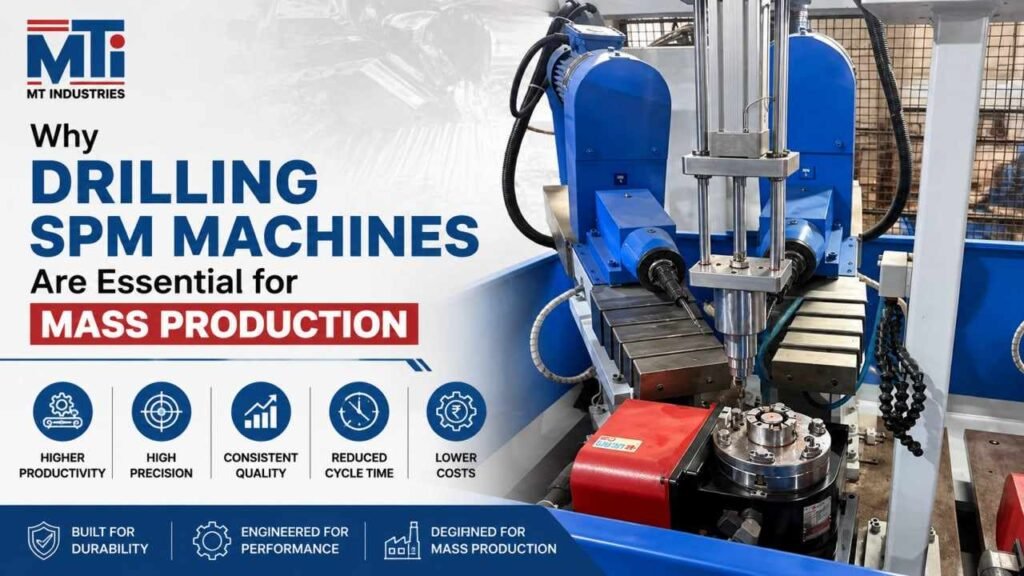
Mass production requires manufacturers to maintain high output without compromising accuracy, consistency, or product quality. Traditional drilling methods can become inefficient when thousands of identical components need to be machined within tight production schedules. This is where a Drilling SPM Machine becomes an important part of modern manufacturing.
A Special Purpose Machine (SPM) is designed around a specific machining requirement. Instead of relying on a general-purpose machine for every operation, manufacturers can use an SPM engineered to perform drilling operations quickly and consistently. Depending on the application, these machines can incorporate multiple drilling heads, automated feeding systems, fixtures, and other mechanisms to reduce cycle time and improve productivity.
For industries handling high-volume production, the right drilling solution can help minimize manual intervention, improve repeatability, and make production planning more predictable. Companies such as MT Industries develop industrial machining solutions around these production requirements, helping manufacturers select configurations that match their component design and output targets.
What Is a Drilling SPM Machine?
A Drilling SPM Machine is a customized or purpose-built industrial machine designed to perform drilling operations on specific components. Unlike standard drilling equipment, an SPM is generally developed around the geometry, dimensions, hole pattern, material, and production requirements of a particular workpiece.
The machine can be configured to perform one or several drilling operations in a controlled sequence. Depending on the design, it may include:
- Multiple drilling spindles
- Dedicated drilling heads
- Hydraulic or pneumatic clamping
- Automatic component loading and unloading
- Customized fixtures
- Servo or mechanical feed systems
- Coolant and chip-management systems
- Sensors and safety interlocks
- Automated sequencing and controls
The objective is simple: perform repetitive machining operations faster, more consistently, and with less dependence on manual handling.
Why Are Drilling SPM Machines Important for Mass Production?
Mass production is highly dependent on cycle time, repeatability, and process stability. Even a small reduction in machining time can create significant productivity gains when multiplied across thousands of components.
Here are the major reasons manufacturers use Drilling SPM Machines for high-volume production.
1. Faster Production Cycles
One of the biggest advantages of an SPM is its ability to perform repetitive drilling operations efficiently.
A conventional setup may require an operator to position a component, drill one hole, reposition it, and repeat the process. A purpose-built machine can automate much of this sequence.
A Multi Spindle Drilling Machine, for example, can perform multiple drilling operations simultaneously or in a predetermined sequence. This reduces unnecessary movement and can significantly shorten the cycle time per component.
For high-volume manufacturers, faster cycle times can translate into greater daily production capacity without necessarily increasing the number of machines on the shop floor.
2. Consistent Drilling Accuracy
Mass production requires every component to meet the same dimensional and positional requirements. Manual operations can introduce variation because of differences in positioning, feeding, or operator technique.
A properly engineered Drilling SPM Machine uses dedicated fixtures, controlled feeds, and repeatable machining sequences to maintain consistency from one component to another.
This is particularly important when hole position, depth, diameter, and spacing are critical to the final assembly.
A Precision Multi Drill Spindle configuration can be particularly useful where several holes need to maintain accurate relationships with one another.
3. Multiple Operations in a Single Setup
Another important advantage is the ability to combine multiple drilling operations into one production setup.
Instead of transferring a component between several machines, a specialized SPM can be configured to complete multiple holes during one clamping cycle.
This can reduce:
- Handling time
- Repositioning errors
- Work-in-process inventory
- Operator involvement
- Overall production cycle time
For manufacturers producing components with several holes or repeated hole patterns, a Multi Drilling Head can provide an efficient solution.
4. Reduced Dependence on Manual Operations
Automation does not necessarily mean eliminating operators. Instead, it allows skilled workers to spend less time performing repetitive positioning and drilling tasks.
Once the component is correctly loaded and the machine is properly configured, automated sequences can handle repetitive machining operations with greater consistency.
This can help manufacturers improve labor utilization while reducing the risk of fatigue-related mistakes during repetitive production.
5. Better Production Repeatability
Repeatability is one of the most important requirements in mass manufacturing.
If the same component is produced today, tomorrow, and several months later, the machining process should deliver consistent results.
A dedicated Drilling SPM Machine is designed around a defined production process. Once the tooling, fixture, spindle arrangement, and machining parameters are properly established, the process can be repeated with predictable results.
This is particularly valuable for industries supplying components to automotive, engineering, electrical, agricultural, and other high-volume sectors.
6. Improved Fixture and Component Positioning
Accurate drilling depends not only on the drill itself but also on how the workpiece is positioned.
SPMs commonly use customized fixtures designed specifically for the component. These fixtures help establish a repeatable reference position before machining begins.
Proper workholding can help control:
- Component alignment
- Hole location
- Workpiece stability
- Drill positioning
- Repeatability between cycles
This makes fixture engineering an important part of designing a successful Drilling SPM Machine.
7. Lower Production Cost Over Time
The initial investment in a specialized machine can be higher than purchasing a basic drilling machine. However, mass-production economics should be evaluated based on the total cost per component rather than machine purchase price alone.
A purpose-built system can potentially reduce the cost per component through:
- Shorter cycle times
- Lower handling requirements
- Reduced rejection rates
- Improved machine utilization
- Less manual intervention
- Higher production output
For a manufacturer producing thousands or millions of components, these improvements can have a substantial effect on long-term production economics.
How Does a Multi Spindle Drilling Machine Improve Productivity?
A Multi Spindle Drilling Machine uses multiple spindles to perform more than one drilling operation. The exact arrangement depends on the component and hole pattern.
For example, if a component requires six holes, a suitable spindle configuration may allow several holes to be drilled during the same machining cycle instead of completing each hole individually.
The productivity improvement depends on several factors, including:
- Number of holes
- Hole diameter
- Material being drilled
- Spindle speed
- Feed rate
- Component geometry
- Tool configuration
- Clamping method
- Required accuracy
Therefore, simply increasing the number of spindles does not automatically guarantee better productivity. The complete machining process must be engineered around the component.
What Is the Role of a Multi Drilling Head?
A Multi Drilling Head is designed to accommodate multiple drilling tools or spindles in a defined arrangement.
Its configuration can be customized according to the required hole pattern. This makes it useful for components that require several holes to be produced repeatedly.
The benefits can include:
- Simultaneous drilling
- Consistent hole positioning
- Reduced machining time
- Fewer component transfers
- Improved process repeatability
The correct head configuration should be selected based on the component drawing, material, hole specifications, production volume, and required cycle time.
How Does a Precision Multi Drill Spindle Support Quality?
A Precision Multi Drill Spindle setup focuses on maintaining the required relationship between multiple drilling positions.
For precision applications, spindle alignment, tooling quality, fixture accuracy, machine rigidity, and feed control all matter. If any of these factors are poorly designed, the final hole pattern may not meet the required tolerance.
Therefore, manufacturers should evaluate the complete machine system rather than focusing only on spindle quantity.
Choosing the Right Drilling SPM Machine
Selecting an SPM should begin with the production requirement rather than the machine specification alone.
Before investing, manufacturers should evaluate:
Component Design
Review the component drawing, hole diameter, hole depth, hole pattern, material, and dimensional tolerances.
Production Volume
Higher production volumes generally make automation and multi-spindle configurations more valuable.
Required Cycle Time
Calculate the target output per hour or shift and determine the maximum acceptable cycle time.
Automation Level
Decide whether manual loading, semi-automatic operation, or fully automated loading and unloading is appropriate.
Tooling and Fixture Requirements
The fixture should securely position the component while allowing quick loading and unloading.
Machine Maintenance
Consider accessibility, spare parts, lubrication requirements, tooling replacement, and technical support before finalizing the machine.
MT Industries emphasizes application-specific machine design because different components require different machining strategies. A machine designed around the actual production process can provide better results than a generic configuration.
Common Applications of Drilling SPM Machines
Drilling SPM Machines are used across many manufacturing environments where repetitive and high-volume drilling is required.
Common applications include:
- Automotive components
- Agricultural machinery parts
- Electrical components
- Pump and valve components
- Engineering components
- Industrial equipment
- Hardware manufacturing
- General precision machining
The exact machine configuration varies according to the component and production objective.
Key Takeaway
For mass production, productivity is not simply about drilling faster. Manufacturers need a machining process that combines speed, accuracy, repeatability, automation, and reliable workholding.
A properly designed Drilling SPM Machine can address these requirements by combining specialized fixtures, multiple spindles, controlled feeds, and automated sequences. A Multi Spindle Drilling Machine can reduce repetitive machining time, while a Multi Drilling Head and Precision Multi Drill Spindle configuration can support consistent hole patterns and production accuracy.
The most effective solution is one designed around the actual component, production volume, tolerances, and cycle-time requirements. With application-focused engineering and proper maintenance, an SPM can become a valuable part of a high-volume manufacturing process.
MT Industries provides specialized industrial machining solutions designed around individual production requirements, making application analysis an important step before selecting an SPM configuration.
Frequently Asked Questions
1. What is a Drilling SPM Machine used for?
A Drilling SPM Machine is primarily used for repetitive drilling operations in manufacturing. It is especially useful for components that require consistent hole patterns, high production volumes, and reduced machining cycle times.
2. What is the difference between an SPM and a conventional drilling machine?
A conventional drilling machine is generally designed for flexible, manually controlled operations, whereas an SPM is engineered for a specific production application. An SPM can integrate customized fixtures, multiple spindles, automated sequences, and dedicated tooling to improve productivity and repeatability.
3. Is a Multi Spindle Drilling Machine suitable for mass production?
Yes. A Multi Spindle Drilling Machine can be highly suitable for mass production because multiple drilling operations can be performed during the same cycle or within a coordinated sequence. The actual productivity benefit depends on the component design and machine configuration.
4. How do I choose the right Drilling SPM Machine?
Start by evaluating the component drawing, material, hole diameter and depth, hole pattern, tolerance, production volume, target cycle time, and desired automation level. These factors help determine the appropriate spindle arrangement, fixture, tooling, and machine configuration.
5. Can MT Industries customize a Drilling SPM Machine?
Yes. MT Industries focuses on application-specific industrial machining solutions. The appropriate SPM configuration can be developed according to factors such as component geometry, drilling requirements, production volume, cycle time, automation needs, and accuracy requirements.
For More Information Click Here:- https://mtindustries.in/service-drilling