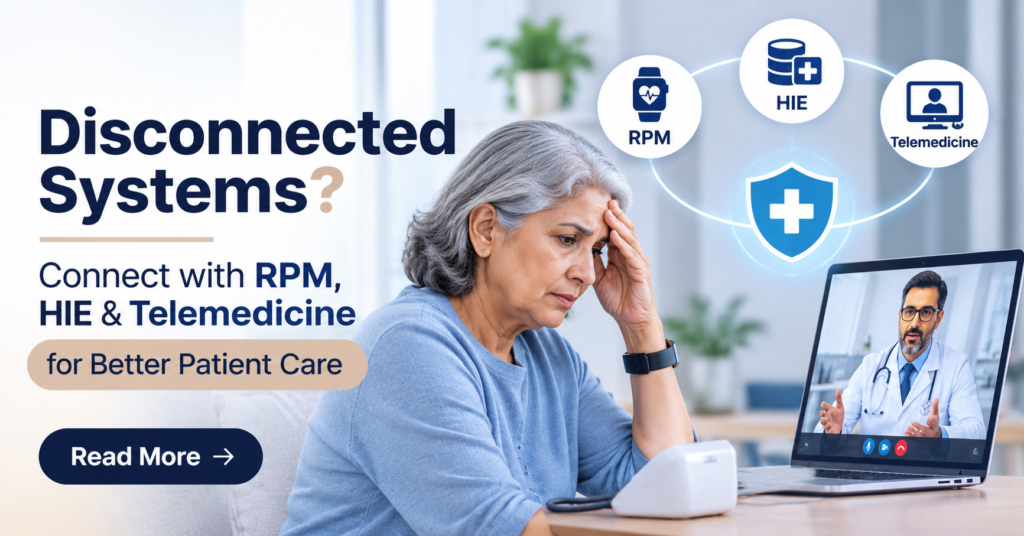
Disconnected healthcare systems put patient care at risk because the information needed for a decision often sits in a system the decision-maker cannot see. A patient’s lab results may be in one hospital’s system, their prescriptions in a pharmacy’s, their home blood pressure readings in a wearable app, and their last specialist note in a clinic’s email inbox. Connecting these sources is what Remote Patient Monitoring (RPM), Health Information Exchange (HIE), and telemedicine each do in a different way. Used together, they form a connected care model.
What Are Disconnected Healthcare Systems?
A disconnected healthcare system is one where patient data, clinical workflows, or communication channels do not share a common structure or connection. Each hospital, clinic, laboratory, and pharmacy may run its own electronic record, and those records often cannot exchange information without manual work such as faxing, printing, or re-entering data.
Fragmentation is growing because patients now receive care in more places than before. A single patient may see a primary care doctor, a specialist at a private hospital, a diagnostic centre, and a home-care provider within the same year. Each touchpoint generates data, but without integration that data stays locked inside the place where it was created.
How Disconnected Systems Put Patient Care at Risk
Delayed Diagnosis and Treatment
When a clinician cannot access a patient’s recent imaging or lab work, they often order it again or wait for it to be sent. Each delay adds time before treatment starts. For conditions where timing matters, such as stroke, sepsis, or a worsening heart condition, that delay can change the outcome.
Incomplete Patient Medical Records
A record built from one provider’s data is only a partial picture. Allergies recorded at one clinic may be missing at another. A medication started by a specialist may not appear in the primary care file. Clinicians then make decisions based on an incomplete history, which increases the chance of drug interactions or missed diagnoses.
Communication Gaps Between Providers
Care handoffs are a known pressure point. When a patient moves from a ward to home, or from a specialist back to a general practitioner, the discharge summary may arrive late, arrive in an unusable format, or not arrive at all. Each gap is a place where instructions get lost.
Repeated Tests and Unnecessary Costs
If results cannot be shared, patients repeat tests. They pay again, wait again, and face additional procedures such as repeat imaging with contrast. For health systems, duplicated work consumes capacity that could serve other patients.
Limited Monitoring and Follow-Up
Many patients, particularly those with chronic conditions such as diabetes, hypertension, or heart failure, need checks between visits. Without a connected way to collect readings and route them to a care team, deterioration can go unnoticed until the patient returns to hospital in a worse state.
What Is the Role of Telemedicine in Connected Healthcare?
Telemedicine delivers clinical care over a video, phone, or messaging connection. Its role in a connected system is to make the clinician reachable, which matters most when a patient cannot easily travel to a facility. Providers looking to offer this capability often start with a telemedicine app development UAE partner who understands local regulatory requirements.
How Telemedicine Improves Access to Healthcare Services
Patients in remote areas, patients with mobility limitations, and patients with work or caregiving commitments often struggle to attend in-person appointments. Telemedicine removes travel from the equation for many routine consultations, follow-ups, and medication reviews.
Virtual Consultations and Remote Patient Follow-Ups
A follow-up visit after surgery or a medication change often needs a conversation, not an examination. Telemedicine lets the clinician review symptoms, check readings, and adjust treatment without requiring the patient to come in. Where an in-person exam is needed, the telemedicine visit can determine that quickly and arrange it.
Secure Communication Between Patients and Providers
For telemedicine to work in a regulated environment, the communication channel must protect patient data. Encrypted video, authenticated logins, and audit trails are baseline requirements. Patients also need a clear way to message their care team between visits, with defined response expectations so that urgent concerns are not left in an inbox.
How Telemedicine Supports Continuity of Care
Telemedicine supports continuity when it is linked to the patient’s wider record. A video consultation that can see the latest lab results and the RPM readings from the past month is far more useful than one that starts from scratch. A telehealth platform UAE connected to the rest of the care system delivers the most value, because clinicians can act on the full picture during the call.
Also Read – Why Remote Patient Monitoring Alone Isn’t Enough: The Missing Link Between HIE & Telemedicine
How Health Information Exchange (HIE) Connects Disconnected Systems
What Is Health Information Exchange?
Health Information Exchange is the secure electronic sharing of patient health information between organisations that provide care. Rather than each provider holding a separate, closed record, an HIE in the UAE allows authorised clinicians to view relevant information from other providers, subject to consent and access rules.
How HIE Enables Seamless Patient Data Sharing
An HIE works by connecting the systems of participating providers through standardised formats and secure interfaces. When a patient is admitted to a hospital, the admitting team can view recent records from other facilities. When a laboratory finalises a result, it can notify the ordering clinician and make the report available to other authorised providers.
Interoperability is the difficult part. Systems use different data structures, terminologies, and message formats. Successful implementations rely on common standards such as HL7 and FHIR, along with mapping work to translate local codes into shared ones.
Improving Coordination Between Hospitals, Clinics, and Laboratories
Coordination improves when every party in a patient’s care can see the same up-to-date information. A laboratory result that reaches the referring clinician within minutes, instead of days, changes the speed of decisions. A discharge summary that appears in the primary care record on the day of discharge makes the follow-up plan actionable.
Benefits of HIE for Patient Safety and Clinical Decision-Making
The clearest safety benefit of HIE is a more complete medication and allergy history at the point of care. Clinicians can see what the patient is already taking, what they have reacted to, and what other specialists have recommended. This reduces the chance of prescribing errors and helps clinicians spot patterns across providers.
The Importance of HIE Integration in Modern Healthcare
As more care moves outside hospitals, the value of an HIE grows with the number of connected sources. Each new clinic, laboratory, or RPM platform that joins adds context to the patient record. Without HIE integration, these new tools add more data silos rather than more insight.
How Remote Patient Monitoring (RPM) Bridges the Gap in Patient Care
What Is Remote Patient Monitoring?
Remote Patient Monitoring uses connected devices to collect a patient’s health data outside a clinical setting and transmit it to a care team. Typical devices include blood pressure cuffs, glucose meters, pulse oximeters, weight scales, and wearable sensors. The data is reviewed against clinical thresholds, and the care team acts when readings fall outside the expected range. Healthcare organisations evaluating remote patient monitoring software UAE options should look for platforms built around these clinical workflows.
How RPM Enables Continuous Patient Health Tracking
Traditional care captures a patient’s condition at discrete moments: a clinic visit, a lab draw, a hospital admission. RPM fills the gaps between those moments. A patient with heart failure who records daily weight and symptoms gives the care team a trend, not a single snapshot. Gradual fluid build-up, which often precedes a hospital admission, becomes visible days earlier.
Real-Time Health Data Collection Through Connected Devices
The value of RPM depends on how reliably data moves from the device to the clinical record. Good RPM platforms pair devices with mobile apps or gateways that transmit readings automatically, flag missing data, and attach timestamps so the clinician can judge when a reading was taken.
Early Detection of Health Risks and Timely Intervention
The clinical benefit of RPM comes from the threshold and escalation logic built into it. A rule that flags a sustained rise in systolic blood pressure, or a drop in oxygen saturation, lets a nurse call the patient the same day. Earlier intervention often means a phone adjustment instead of an emergency admission.
Supporting Chronic Disease Management Through RPM
Chronic conditions account for a large share of ongoing healthcare demand, and they are the natural fit for RPM because they require regular measurement and medication adjustment. Diabetes management, hypertension control, COPD monitoring, and post-discharge heart failure care all benefit from frequent data and timely clinician input. An RPM platform that routes these readings into the clinical workflow turns raw data into action.
ALSO READ – Why Remote Patient Monitoring Systems Struggle with Data Accuracy, Alert Fatigue, and EHR Integration
RPM vs HIE vs Telemedicine: How Do They Work Together?
Understanding the Different Roles of RPM, HIE, and Telemedicine
Each technology addresses a different part of the problem. RPM collects data from the patient’s environment. HIE moves data between providers. Telemedicine lets clinicians and patients communicate directly. None of the three is a complete solution on its own.
How These Technologies Exchange and Utilise Patient Data
RPM readings are most useful when they reach the clinician’s main record, not a separate app. HIE makes it possible for those readings, together with lab results and hospital records, to be viewed by any authorised provider. Telemedicine consultations then use this combined data to make decisions in real time, rather than relying on what the patient remembers to report.
Creating a Unified and Connected Healthcare Ecosystem
A connected ecosystem means a patient’s data follows them across providers and devices, and the right people see the right information at the right time. Achieving this requires agreed data standards, consent management, and clear rules about who acts on which alerts. The technology is the easier part. The operating model, meaning who is responsible for each signal, is harder to design well.
Real-World Example of an Integrated Digital Healthcare Workflow
Consider a patient with type 2 diabetes who was recently discharged after a hospital stay. Their glucose meter sends daily readings to the RPM platform. The platform flags a run of high readings and alerts the diabetes nurse, who reviews the patient’s recent discharge summary and lab results pulled through the HIE. The nurse then schedules a telemedicine consultation with the endocrinologist, who adjusts medication during the video call and updates the shared record. The patient, the nurse, and the specialist each work from the same information, and the patient avoids an unplanned visit.
Key Benefits of Integrating RPM, HIE, and Telemedicine
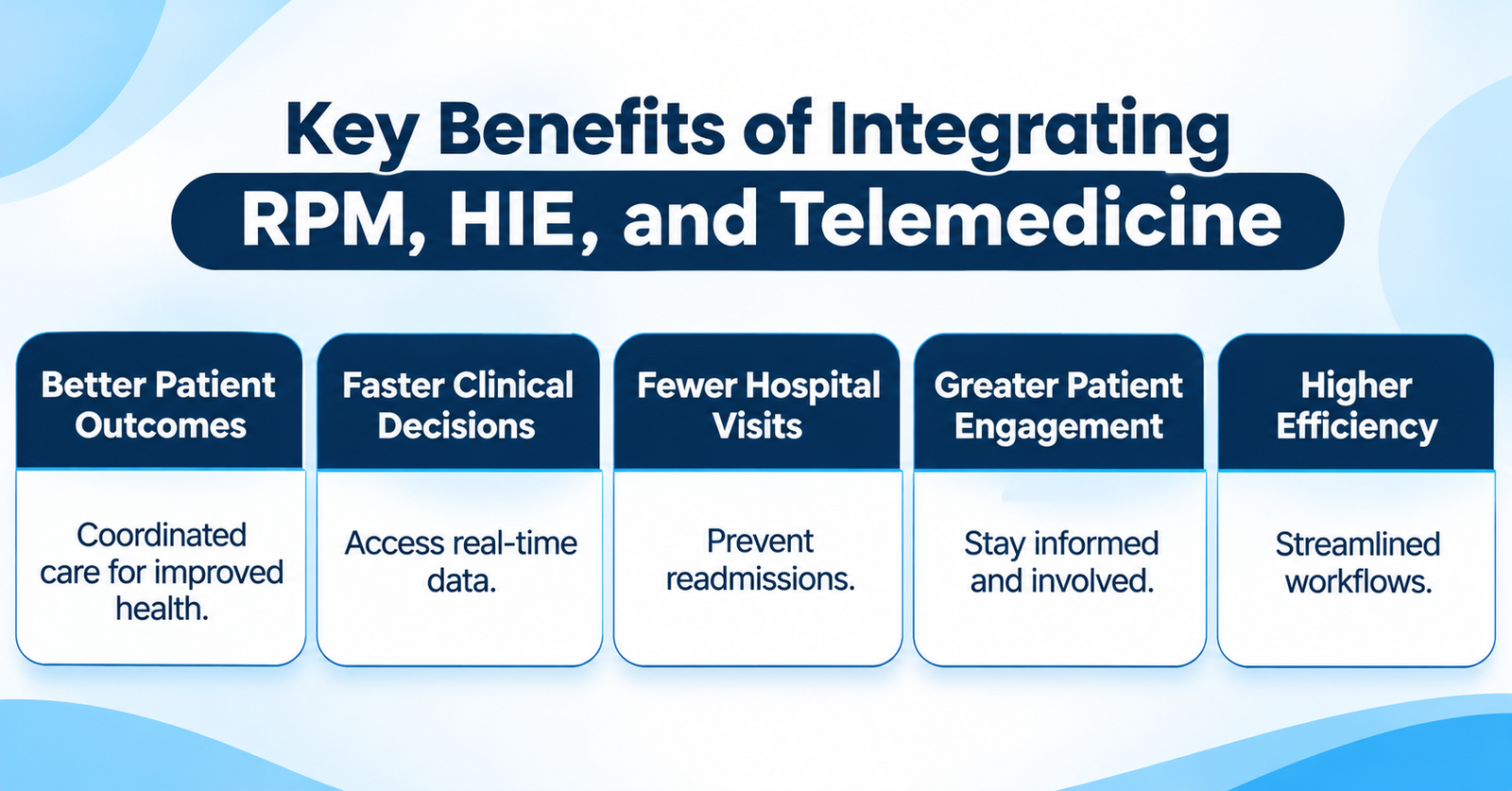
Improved Patient Outcomes and Care Coordination
When the care team sees the full picture, coordination improves. Fewer decisions are made on partial information, and fewer follow-ups fall through the gaps between providers.
Faster Clinical Decision-Making
Clinicians who can review recent data before or during a consultation can decide faster. Telemedicine visits become more focused, and urgent cases can be identified from RPM alerts rather than discovered at the next scheduled appointment.
Reduced Hospital Visits and Readmissions
Early detection through RPM and better post-discharge follow-up through telemedicine both reduce avoidable readmissions. Patients stay at home where it is safe to do so, and hospital beds remain available for those who need them.
Better Patient Engagement and Healthcare Accessibility
Patients who can track their own readings, message their care team, and attend consultations from home are generally more involved in managing their condition. Access improves for those who would otherwise struggle to attend in person.
Improved Operational Efficiency for Healthcare Providers
Providers benefit from fewer duplicated tests, less time spent chasing records, and more efficient use of clinical staff. Connected workflows also make it easier to manage populations of patients with chronic conditions, because the data needed for population-level review is already structured.
Challenges in Connecting Healthcare Systems in the UAE
Connecting healthcare systems in the UAE involves the same technical challenges found elsewhere, along with a regulatory environment that providers must navigate carefully.
Data Interoperability and System Compatibility
Facilities in the UAE use a mix of electronic record systems, some imported and some locally developed. Making them exchange data reliably requires mapping work, testing, and ongoing maintenance. Legacy systems that predate current standards are often the hardest to connect.
Patient Data Privacy and Healthcare Regulations
Health data is among the most sensitive categories of personal information. Providers must comply with the UAE’s federal and emirate-level rules on health information, including requirements on where data may be stored and who may access it. Any integration project should begin with a clear legal and regulatory review rather than treating compliance as a final checkpoint.
Integration With Existing Hospital Management Systems
Most providers already run a hospital information system or electronic medical record, and the new RPM, HIE, or telemedicine tools must work alongside them. Integration decisions affect staff workload, so the best projects involve clinical users early and avoid adding parallel data entry.
Ensuring Secure and Reliable Data Exchange
Security involves encryption in transit and at rest, strong authentication, role-based access, audit logging, and tested incident response. Reliability matters just as much. An alert that fails to reach a nurse because of a connection drop is a patient safety problem, so monitoring of the data pipeline itself is essential.
How to Choose the Right Connected Healthcare Technology Partner in the UAE
Choosing a partner for RPM, HIE, or telemedicine integration is a decision with clinical and regulatory consequences, so it deserves a structured evaluation.
Experience in Telemedicine and RPM Solutions
Ask for evidence of live deployments, not just demonstrations. Find out which clinical conditions the partner has supported, how alert thresholds were agreed with clinicians, and what happened when a device or connection failed.
Expertise in HIE Integration and Healthcare Interoperability
Confirm that the partner works with recognised standards and has connected to systems similar to yours. Ask how they handle terminology mapping and what their testing process looks like before go-live.
Data Security and Regulatory Compliance
The partner should be able to explain, in plain terms, where data is stored, how access is controlled, how consent is recorded, and how they stay current with changes in UAE health regulations. Request documentation rather than relying on verbal assurances.
Scalability and Custom Healthcare Software Development
A pilot with fifty patients is different from a programme with fifty thousand. Choose a partner whose architecture can scale and who can adapt the system to your workflows rather than forcing you into a generic template.
Conclusion: Building a Connected Healthcare Future With RPM, HIE & Telemedicine
Disconnected systems put patient care at risk through delayed diagnosis, incomplete records, communication failures, repeated testing, and gaps in monitoring. No single technology closes all of these gaps. RPM brings continuous data from the patient’s environment, HIE makes that data and other clinical records available across providers, and telemedicine connects clinicians and patients when they need to talk. Together, they make it possible to deliver care that is informed, coordinated, and closer to home.
For healthcare providers in the UAE, the practical next step is an honest assessment of where information gets stuck, followed by a phased plan that addresses the highest-risk gap first. Connecting systems is a long-term project, but each connection delivers value as soon as it is live.