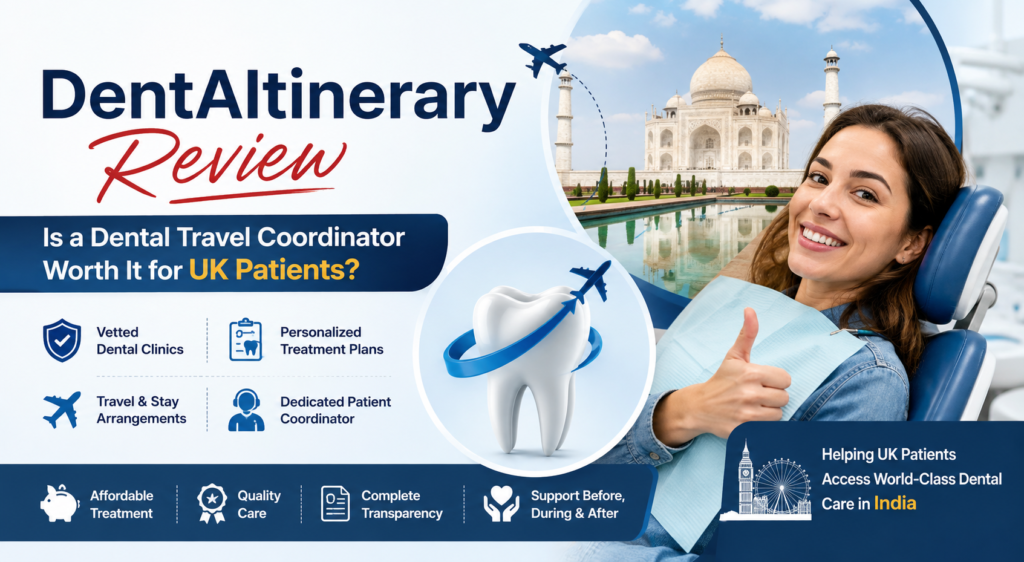
DentAItinerary is not a dental clinic; it is a coordination and matching service connecting UK patients with independent Indian dental providers. Patients complete an online planner (answered via a free 60-second questionnaire) to indicate their treatment needs. DentAItinerary then suggests 2–3 vetted clinics, each providing a fixed, all-inclusive treatment quote in GBP. Once a patient selects an option, DentAItinerary assigns a dedicated coordinator to manage logistics (booking hotels, transfers, scheduling appointments) while the patient arranges their own flights. The coordinator remains available throughout via WhatsApp or similar, serving as a single point of contact from planning through aftercare.
- Fixed Pricing: Treatment costs are “locked at quotation” to avoid surprise bills. DentAItinerary claims a 30/70 payment schedule and full price breakdown up front.
- Vetted Clinics: Only clinics meeting strict criteria (MDS-qualified specialists, 10+ years’ experience, in-house lab and imaging, good international outcomes) are accepted. DentAItinerary’s Advisory Board (chaired by ex-NABH chairman Prof. Mahesh Verma) oversees these standards.
- Coordinator: Each patient has one assigned coordinator who handles travel arrangements, appointment scheduling, and communications from start to finish. This person also logs treatment notes and patient decisions for accountability.
- Deviation Protocol: If the dentist finds new issues mid-treatment, DentAItinerary provides a 6-hour decision window with pre-priced options instead of surprise charges. This formal protocol is designed to protect patients if, for example, an extra procedure (e.g. bone graft) becomes necessary after starting treatment.
“DentAItinerary is a coordination platform, not a clinic…We do not provide dental treatment and do not employ dentists. We select partner clinics, coordinate the patient journey from planning to aftercare, lock pricing, and provide a personal coordinator throughout. All clinical decisions are made solely by the treating clinic.”
This transparency — explicitly separating themselves from clinical care — is a strong point. It reminds patients that DentAItinerary helps plan and organize, but the actual dental work is done by the independent clinic. Thus due diligence remains the patient’s responsibility.
Clinic Vetting and Quality
A central claim of DentAItinerary is rigorous vetting of partner clinics. According to their site, clinics are evaluated against NABH (India’s healthcare accreditation) standards and additional criteria. For example, applicants must have a lead clinician with an MDS qualification, at least 10 years’ experience, on-site lab and digital imaging, and proven outcomes with international patients. If a clinic has NABH accreditation, that is considered a plus, but DentAItinerary says they “assess clinics against a broader set of criteria beyond accreditation alone”.
It’s worth comparing this to other countries’ oversight. DentAItinerary notes that Turkey lacks a dental-specific accreditation body, and Hungary has none. By contrast, Indian clinics can pursue NABH’s dental standards, which cover sterilization, clinical documentation and patient safety. (NABH is effectively India’s equivalent of JCI accreditation in hospitals, but with a specific dental standard.) While accreditation is no absolute guarantee, this structured vetting — overseen by an advisory board of experienced clinicians — is stronger than the unregulated “clinic directories” that simply list providers.
Patients should still verify the treating dentist’s credentials independently. The UK’s General Dental Council (GDC) advises that overseas practitioners will have different regulatory systems, so patients should research the destination’s dental council if one exists. For example, any UK-registered dentist would appear on the GDC’s register. In practice, DentAItinerary’s process does filter to the top few clinics by their criteria, but patients are wise to double-check qualifications, implant system brands and clinic accreditation (e.g. NABH, ISO, etc.) for each option.
Pricing: UK vs India
A major draw of dental tourism is lower cost. DentAItinerary prominently compares UK and Indian prices. For example, they report (as of 2025 data) that an All-on-4 implant per arch costs “from £13,000” in the UK vs ~£4,400 in India. A full-mouth rehabilitation is quoted at ~£18,000 UK vs ~£8,400 India. Four dental implants might run “from £10,000” UK vs ~£2,500 India. Importantly, DentAItinerary notes the Indian figures are all-in packages, typically covering treatment plus accommodation, transfers and coordinator services. UK figures, by contrast, reflect treatment-only rates from private clinic fee schedules.
For clarity, here’s an illustrative breakdown (all figures approximate):
| Cost Component | UK Private Estimate (GBP) | India Trip (Indicative) |
|---|---|---|
| Treatment (All-on-4 per arch) | £13,000 (treatment-only; published UK rates) | £4,400 (all-in India package) |
| Flights (return) | – (not applicable) | ~£600 (London–Delhi roundtrip) |
| Accommodation (10 nights) | – (not applicable) | ~£1,000 (10 nights at £100/night) |
| Travel Insurance | – (not applicable) | ~£50 (short-term medical policy) |
| Lost income (2 weeks) | ~£1,400 (2 weeks leave) | ~£1,400 (same) |
| Follow-up care (UK) | £200 (one or two local dentist visits) | £200 (if needed locally) |
| Total (example) |
(Note: UK figures exclude flights and accommodation; India figures include travel/lodging. These are illustrative; individual costs vary. India costs are indicative and would be confirmed after specific clinic matching.)
DentAItinerary’s own comparison table highlights savings of £6,400–£9,600 on treatments like All-on-4 or veneers. Real-world savings will depend on exact clinic quotes and any added procedures. Critically, patients must ensure they compare “complete journeys” – not just sticker prices. For example, a £13,000 UK implant might include more follow-up visits than a £4,000 abroad implant. (DentAItinerary even says: “India prices are all-in; UK figures are treatment-only”.)
Cost isn’t the only factor: it’s essential to balance savings against travel costs and inconvenience. A seemingly cheap overseas quote can climb once flights, hotels, insurance and time off are counted. A well-informed patient will tally those full trip costs. DentAItinerary’s platform helps by quoting in GBP and planning travel details, but we recommend doing your own sum too: for example, comparing a UK-priced treatment plan (from a private dentist) side-by-side with the India itinerary quote they provide.
Travel and Logistics
Dental tourism inherently involves international travel. DentAItinerary’s service includes logistics coordination, which can be a major advantage for complex trips. After the patient chooses a clinic, their coordinator arranges accommodations and ground transport (e.g. airport transfers) around the clinic schedule. Patients simply need to book flights (e.g. a 9–10 hour direct flight from London to Delhi or Mumbai) and ensure they have any necessary visas (an Indian e-medical visa is available online).
However, even with help, patients must plan carefully. Key considerations include: recovery time and additional visits. DentAItinerary suggests, for example, that patients often need 7–14 days in India for surgical implant cases, sometimes more if a second trip is required. Actual timelines must be set by the treating dentist, but it’s wise to assume at least a week abroad for major procedures. That means arranging at least that much vacation or unpaid leave. (Factor in exam periods if you’re a student, or caregiving responsibilities, etc.)
Travel insurance: Virtually all experts stress the need for robust travel medical insurance covering elective procedures abroad. Dental clinics themselves rarely provide insurance cover for complications. Patients should confirm their policy covers overseas medical/dental claims (some standard policies exclude elective procedures).
The GDC advises UK patients to discuss plans with their doctor/dentist beforehand and check practitioner qualifications. Crucially, do not rely on generic advice from travel agents; speak directly with the overseas provider and verify credentials. DentAItinerary’s coordinated model ensures you’re dealing with known clinics and practitioners (with backgrounds checked) rather than a random middleman. But it’s still wise to consult your NHS dentist or GP to ensure you’re fit to travel and to coordinate any necessary pre- and post-treatment care.
Treatment Deviations and Aftercare
One of DentAItinerary’s unique claims is a formal “Deviation Protocol.” In practice, this means if the clinician in India discovers something unexpected (e.g. worse bone loss requiring an extra graft) after starting treatment, DentAItinerary provides a written plan and fixed pricing for the added work. Patients have a short window (claimed as 6 hours) to agree or decline additional procedures, and pricing is agreed upfront. This is an important protection, as it’s a common issue: treatment plans made from afar often change once the dentist examines the patient on site.
No matter how well you plan, patients should still clarify beforehand what happens in those cases. Ask the clinic (or coordinator) to describe their process: Will you get a revised quote? Can you say no to extras? Will the trip be extended or will you need a second trip? DentAItinerary’s approach to this (locking prices before travel, written decisions mid-treatment) is sensible, but the patient should explicitly confirm these terms.
After returning home, continuity of care is critical. DentAItinerary states that its clinic partners provide complete clinical records (digital scans, material batch numbers, treatment notes) for the patient’s follow-up. You should confirm what documentation you’ll receive: ideally a full summary of treatment steps, X-rays, and implant/restoration specifications to hand over to your UK dentist. Before leaving India, arrange a UK dentist appointment to review your work. The UK dentist can then assess healing and tackle any minor issues. Keep in mind most UK dental warranties may not cover overseas work, so it’s wise to have a UK plan in place.
Two final safety points:
- Infection control and complications: Travelhealthpro (UK’s travel health authority) warns that medical procedures abroad carry infection and complication risks. Patients have died after procedures overseas (e.g. FCDO reported six Britons died in Turkey in 2023 from medical tourism-related causes), so one must weigh urgency and risk. However, such tragic outcomes are rare, and vetted clinics aim to follow strict sterilization protocols (especially if NABH-accredited).
- Legal recourse: If something goes wrong abroad, legal and regulatory recourse is limited. Unlike in the UK, you typically cannot sue a foreign clinic easily. DentAItinerary itself has a privacy/policy statement, but insurance/compensation is complex. The GDC notes you’d have to complain to the local regulator of that country, and compensation (if any) would be under local laws. This is why thorough vetting and travel insurance are crucial.
Pros, Cons and Who It Suits
Pros:
- Cost Savings: Major treatments (implants, All-on-4, veneers, etc.) can be far cheaper – often 60–70% lower than UK prices.
- Structured Coordination: Having a single platform manage logistics is a big advantage, especially for first-time dental tourists. The coordinator handles bookings and scheduling, reducing stress.
- Fixed Pricing: Patients lock in a price pre-travel, avoiding the uncertainty of incremental charges (common complaint in uncontrolled medical tourism).
- Clinic Quality Controls: An expert advisory board vets clinics against clear standards (unlike random internet listings). The emphasis on experienced specialists and NABH compliance is reassuring.
- Accountability: With documented treatment logs and decision records, DentAItinerary aims to keep things transparent, which may improve patient confidence.
Cons:
- No NHS Funding: This is purely private – NHS will not pay for it. DentAItinerary doesn’t change that (NHS funding abroad is rare and doesn’t cover elective dental). You must bear all costs.
- Travel Risks: Long flights, jet lag, unfamiliar environment and being away from home during recovery are drawbacks. Complications could be more worrisome far from home.
- Potential Limited UK Follow-up: While records may transfer, some UK dentists charge for reviewing foreign treatment or may be reluctant to service unfamiliar work.
- Not Guaranteed Success: Even with vetting, all surgeries have risks. No platform can guarantee the outcome, just as a UK clinic cannot.
- Dependent on Technology: Coordinators are reachable (e.g. by WhatsApp), which is great, but it requires smartphones, connectivity and trusting remote communication. Any miscommunication across languages or time zones is a possible issue.
Who might this suit? DentAItinerary seems best for UK patients facing extensive planned treatment who have the flexibility to travel for 1–2 weeks. Good examples: someone needing multiple implants or a full-mouth rebuild (All-on-4), where UK quotes hit tens of thousands. For a single routine filling or crown, the hassle clearly outweighs the saving. Also, candidates should be in good general health (able to fly, heal abroad) and comfortable with some risk. This is not for emergency cases (e.g. acute infection/swelling) – those demand urgent local care.
10 Questions Every Patient Should Ask
Before committing to any dental tourism, and certainly before signing with DentAItinerary or a clinic, patients should be prepared with questions:
- Who will perform my treatment? (Name, qualifications, registration)
- What exactly is included in the quote? (list all services, number of appointments, labs)
- Which implant/brands/materials will be used? (get specifics, e.g. Nobel Biocare implant, ceramic crown)
- How many visits are required, and how long must I stay? (clarify healing time between stages)
- What happens if the plan changes? (expect the dentist’s process and cost implications)
- How are complications handled, before and after I return? (who pays, what follow-up is arranged)
- What documentation will I receive? (copies of X-rays, treatment notes, implant specs)
- What accreditation or regulation covers the clinic? (ask about NABH, ISO, local dental council)
- What travel support is provided? (transfers, interpreters, emergency contacts)
- What happens if I need more work after returning home? (continue with UK dentist – how to liaise)
DentAItinerary’s platform and coordinator will aim to address many of these questions, but patients should ensure answers to each. For instance, confirm that the final quote covers all foreseeable steps (surgery, provisionals, finals, etc.). Also clarify whether the quoted “all-in” truly includes the cost of things like bone graft material, or if these are extra.
Practical Next Steps
If you’re a UK patient intrigued by DentAItinerary, here’s a suggested approach:
- Gather a UK reference quote: Visit a reputable UK dentist and get a detailed written quote for your full treatment plan. This will help you compare like-for-like with any overseas options.
- Use DentAItinerary’s planner: Try their online itinerary builder (free, 60s) to see example clinics and costs. This gives a concrete proposal.
- Check all credentials: Independently verify the clinics DentAItinerary suggests. Look up any available patient reviews, NABH accreditation status, and the dentists’ credentials.
- Consult NHS/Private dentist: Discuss your situation with a UK dentist or specialist. They can offer a second opinion and may suggest important questions to ask.
- Plan for logistics: Factor in travel details early. Book refundable flights if possible, arrange leave, and buy a comprehensive travel health insurance policy.
- Stay cautious and documented: Before leaving, get a written treatment plan from the overseas dentist (with costs). Keep all correspondence and receipts. After returning, promptly see your UK dentist for an exam and any aftercare.
DentAItinerary’s promise is to simplify a complex process, but it does not eliminate the need for patient vigilance. Ultimately, you are responsible for your health decisions. The platform’s coordination can reduce uncertainty, yet informed patients still get the best outcomes.
DentAItinerary is a commercial dental-treatment coordination platform focused on India. This article is an independent analysis, not paid content. All clinical decisions and outcomes are made by the partner clinics, not by DentAItinerary. Readers should do their own due diligence and seek professional dental advice before any medical travel.