Denim Tears: The Brand Turning Black History into Wearable Art
Denim Tears: The Brand Turning Black History into Wearable Art
Some brands sell clothes. Denim Tears tells stories you can wear.
Founded in 2019 by Tremaine Emory, Denim Tears has become one of the most culturally significant streetwear labels in America. But calling it just “streetwear” misses the point entirely. This is a brand built on memory, on history, and on the unflinching belief that what you put on your body can carry meaning far beyond fabric and thread.
If you’ve seen the cotton wreath graphic on a hoodie or a pair of Levi’s and wondered what it all means, you’re in the right place. Let’s talk about the brand, the man behind it, and why Denim Tears matters in a way few fashion labels ever will.
What Is Denim Tears? A Brand Built on Memory
Denim Tears is an American fashion label that uses clothing as a vehicle for exploring Black American history and the African Diaspora. Since its founding, the brand has illustrated the full breadth of Black American experience through unique perspectives on the voices and events that shaped the Diaspora .
The name itself carries weight. “Denim” references the cotton textile that built fortunes and enslaved generations. “Tears” speaks to the pain and suffering endured in that process. Together, they form a name that refuses to look away from uncomfortable truths.
What makes Denim Tears different from other brands that reference social issues is authenticity. This isn’t performative activism stitched onto a t-shirt for marketing purposes. Every collection emerges from genuine research, family history, and a commitment to uncovering overlooked narratives at the heart of the Black American experience .
Who Is Tremaine Emory?
Tremaine Emory founded Denim Tears in 2019, but his influence on fashion and culture stretches back much further. Born in Atlanta, Georgia in 1981 and raised in Jamaica, Queens, New York, Emory built a reputation as a visionary creative long before launching his own label .
His résumé reads like a who’s who of contemporary culture. He co-founded the creative collective No Vacancy Inn with Ade “Acyde” Odunlami and Brock Korsan. He served as a consultant to Stüssy, worked with Kanye West, and collaborated with Frank Ocean. For a period, he was the creative director at Supreme .
But it’s his work with Denim Tears that has cemented his legacy. Emory approaches fashion as a form of storytelling, using garments as what he calls a “trojan horse” to deliver messages about history, race, and identity .
His collaborators over the years have included Theaster Gates, Hank Willis Thomas, Virgil Abloh, and Andre 3000—a cross-generational group that speaks to his ability to bridge artistic worlds .
The Cotton Wreath: More Than a Logo
The cotton wreath is Denim Tears’ signature motif, and understanding it is essential to understanding the brand.
Inspired by a wreath Emory remembered from his grandmother’s house, the cotton wreath represents the intertwined past and future experiences of Black Americans . Cotton was the crop that built American wealth on the backs of enslaved people. By placing a cotton wreath on denim—itself a cotton product—Emory creates a visual commentary on that legacy .
The motif first appeared on a 2020 collaboration with Levi’s, released 400 years after the first enslaved Africans arrived in Point Comfort, Virginia . The collection was later exhibited at The Metropolitan Museum of Art’s “In America: A Lexicon of Fashion” exhibition, cementing its cultural significance .
What makes the cotton wreath effective is its simplicity. It’s visually striking enough to work as a design element, yet loaded with enough meaning to function as a statement. That balance is rare in fashion, where symbols often collapse under the weight of their intended significance.
The Denim Tears Aesthetic: Comfortable, Deliberate, Unmistakable
Denim Tears doesn’t chase trends. It sets its own pace.
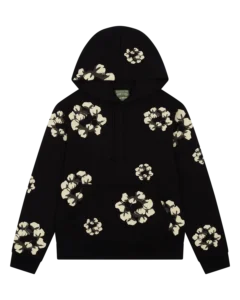
The brand’s core offerings—hoodies, sweatpants, t-shirts—are garment-dyed in muted tones like black, grey, and purple . The cuts are relaxed and comfortable, designed for real life rather than runway theatrics. But the graphics take center stage, particularly the cotton wreath, which has appeared in increasingly oversized iterations .
The “Big Cotton Wreath” collection from 2025 exemplifies this approach. The brand took its signature motif and blew it up across hoodies, sweatpants, and sweatshorts, making the message impossible to ignore . It was a statement of confidence—the brand trusting that its audience understood the meaning behind the symbol.
Beyond the core graphics, Denim Tears has expanded into upscale ready-to-wear, including leather pants, shearling coats, and cashmere sweatsuits that retail for as much as $2,800 with Swarovski crystal wreaths . The brand is building toward offering a complete wardrobe, not just statement pieces.
Denim Tears x Levi’s: A Partnership That Changed Things
The collaboration between Denim Tears and Levi’s is one of the most significant fashion partnerships of the past decade.
What started as a single collection in 2020 evolved into a multi-year partnership . Levi’s, a brand with a 150-year history tied to denim and cotton, provided the perfect canvas for Emory’s exploration of cotton’s complex legacy .
The second collection in 2022 focused on the Gullah Geechee people, descendants of Africans enslaved on plantations along the lower U.S. Atlantic coast. The designs featured indigo-dyed fabrics and prints of hands turned blue from working with dye—a visual mnemonic of labor and survival .
These weren’t just clothes. They were history lessons you could wear, and the fashion world noticed. Celebrities like Ye and Bella Hadid wore pieces from the collection, and the garments found their way into museum collections .
Why Denim Tears Matters in 2026
Denim Tear has grown from a cult favorite to a cultural force without taking outside investment. The brand reportedly generates tens of millions in annual revenue and has doubled sales every year since its founding .
On the resale market, demand tells a similar story. Denim Tears items sold for 31 percent above retail on average in the first half of 2025, up from 21 percent the previous year. Sales on StockX grew 290 percent in 2024 .
But numbers only tell part of the story. The brand’s cultural footprint includes:
-
Museum exhibitions: Denim Tears garments are in the permanent collection of The Costume Institute at The Metropolitan Museum of Art. The SCAD Museum of Art hosted the first solo exhibition of Emory’s work, “Denim Tears From the Black Pool of Genius,” opening in 2026 .
-
Major collaborations: Beyond Levi’s, Denim Tears has worked with Dior, Stüssy, UGG, Converse, and adidas, with a Superstar and Stan Smith collaboration expected in November 2026 .
-
Retail expansion: The brand operates African Diaspora Goods flagship stores in New York and Atlanta, with plans for Tokyo in 2026 and eventual locations in cities like Chicago, Houston, and Los Angeles .
Where to Buy Denim Tears (and How to Avoid Fakes)
Denim Tears’ popularity has unfortunately made it a target for counterfeiters. The brand itself warns that guaranteed authentic goods can only be purchased through official channels .
Official retail locations:
-
Denim Tears Flagship Store (African Diaspora Goods): 176 Spring Street, New York, NY 10012
-
Denim Tears Atlanta (African Diaspora Goods): Lenox Square, 3393 Peachtree Road NE, Atlanta, GA 30326
-
Dover Street Market: Locations in New York and Los Angeles
If you’re buying on the resale market, authentication matters. Key things to check include the brand tag (authentic tags glow uniformly under UV light), quality tag printing (crisp on real items, blurry on fakes), and the wreath motif’s texture (authentic pieces have distinct depth; fakes are flat) .
Top 10 FAQs About Denim Tears
1. What does Denim Tears mean?
Denim Tears refers to the cotton industry built on slavery and the pain endured by Black Americans, with “denim” representing the cotton textile and “tears” representing suffering.
2. Who owns Denim Tears?
Denim Tears was founded and is owned by Tremaine Emory, an American designer and creative director born in Atlanta and raised in Queens, New York .
3. What is the cotton wreath symbol?
The cotton wreath represents the intertwined history of cotton, slavery, and Black American experience, serving as a visual reminder of labor and survival .
4. Is Denim Tears a Black-owned brand?
Yes, Denim Tears is a Black-owned brand founded by Tremaine Emory, with a mission centered on telling stories of the African Diaspora .
5. How much does Denim Tears cost?
Core items like hoodies and t-shirts range from approximately $175 to $210, while premium pieces like cashmere sweatsuits can retail for up to $2,800 .
6. Where is Denim Tears made?
Denim Tears products are primarily produced in the United States, with some items like the Levi’s collaborations manufactured through established denim production channels.
7. Does Denim Tears run true to size?
Yes, Denim Tears hoodies and core items generally run true to size with a relaxed, slightly boxy fit. Size up only if you want an exaggerated oversized look .
8. What makes Denim Tears different from other streetwear brands?
Denim Tears distinguishes itself through authentic storytelling rooted in Black American history, museum-level cultural recognition, and a refusal to compromise its message for commercial appeal .
9. Who has worn Denim Tears?
Celebrities including Ye, Bella Hadid, and numerous cultural figures have worn Denim Tears, and the brand’s garments are part of The Met’s permanent collection .
10. Is Denim Tears worth the investment?
For collectors who value cultural significance alongside design quality, Denim Tears holds strong resale value and museum recognition, making it a meaningful investment for those who connect with its mission.
The Future of Denim Tears
Denim Tears Clothing is entering a new chapter. The Fall/Winter 2026 collection, created in partnership with the André Leon Talley Estate, marks the first official apparel collaboration authorized by the late fashion editor’s estate .
The 153-piece collection honors Talley’s legacy of championing Black designers, featuring outerwear, leather constructions, and reinterpretations of the cotton wreath in Paisley, Monogram, and Peace Wreath variations . Emory described the collection as an exploration of Talley’s style and its social implications within and beyond fashion .
With plans for international expansion, continued museum recognition, and a growing community of customers who understand that clothing can carry meaning, Denim Tears is proving that commercial success and cultural integrity aren’t mutually exclusive.
Why People Connect with Denim Tears
Strip away the hype, the resale values, and the celebrity co-signs, and what remains is something simpler: a brand that makes people feel something.
Denim Tears resonates because it treats its audience as intelligent adults capable of engaging with difficult history. It doesn’t explain itself to death or water down its message for mass appeal. It presents the cotton wreath, the indigo hands, the Pan-African flags, and trusts that the people wearing them will take the time to understand what they mean.
That trust has built a community. Not just customers, but people who see themselves reflected in a brand that refuses to forget where we’ve been while imagining where we might go.
In a fashion landscape often defined by fleeting trends and empty aesthetics, Denim Tears stands apart. It’s a reminder that what we wear can be more than decoration. It can be memory. It can be resistance. It can be art.