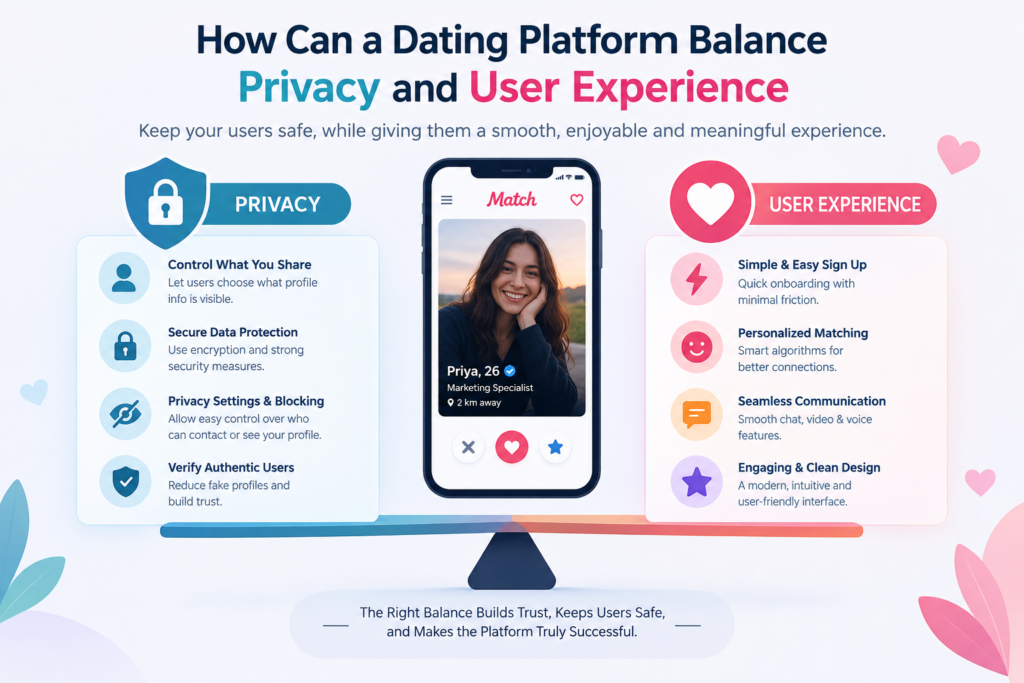
A dating platform has a difficult promise to keep: it needs to help people feel close to strangers without asking them to give up too much of themselves.
That tension sits at the center of modern online dating. Users want accurate matches, meaningful conversations, convenient discovery, personalized recommendations, and features that make meeting someone easier. At the same time, they want control over who can see their information, how their data is used, when they can be contacted, and what happens to their digital identity when they leave the platform.
The challenge is not simply choosing between privacy and convenience. A successful dating platform has to design both into the same experience.
If privacy controls are complicated, users may ignore them. If personalization is too aggressive, users may feel watched. If safety requires excessive identity verification, some people may abandon registration. But if a platform collects too little information or offers weak safety controls, users may question whether they can trust it.
The answer is thoughtful product design: collect less where possible, explain more clearly, give users meaningful choices, and make protective features feel like natural parts of the dating experience.
Why Privacy Matters More on Dating Platforms
Privacy is important on almost every digital service, but dating platforms handle information that can be particularly personal.
A dating profile may reveal someone’s age, photographs, location preferences, relationship goals, interests, lifestyle, workplace, education, or social connections. For a Dating App Development Company, protecting this information is especially important, as private conversations can contain even more sensitive details because people often disclose personal experiences after developing a sense of trust.
Location is another major concern. A platform that knows where someone lives, works, or regularly spends time may possess information that users do not want exposed to strangers.
There is also a social dimension to dating privacy. Someone may not want coworkers, relatives, former partners, or acquaintances to know that they are using a dating service. Privacy, therefore, is not merely about protecting databases. It is also about protecting a person’s ability to decide who knows what about their personal life.
A good dating platform recognizes this distinction.
Privacy should not feel like a legal document hidden behind settings. It should be visible through everyday product decisions.
The First Principle: Collect Only What Creates Real Value
One of the simplest ways to improve privacy is to reduce unnecessary data collection.
Dating platforms often have legitimate reasons to request certain information. Age can support eligibility and safety requirements. Approximate location can help with local discovery. Interests can improve recommendations. Profile preferences can make matching more relevant.
But every additional piece of information creates another responsibility.
A useful product question is not, “Can we collect this?” It is, “Does collecting this materially improve the experience?”
For example, a platform may need to know a user’s general area to suggest nearby matches. It may not need to display the person’s exact location. Similarly, personalization may benefit from knowing broad interests without requiring the platform to build an extremely detailed behavioral profile.
This approach creates a healthier relationship between data and functionality.
Instead of treating information as something that should automatically be collected because it might become useful someday, platforms can adopt a purpose-first approach. Every category of data should have a clear reason for existing.
That also makes privacy easier to explain to users.
Make Privacy Controls Understandable
Privacy settings frequently fail because they are designed around technical categories instead of human concerns.
A user usually does not think, “I need to modify my third-party data-sharing preferences.” They think, “Who can see my profile?” or “Can someone find me using my phone number?”
A dating platform can translate complex controls into questions users actually ask.
For example:
-
Who can discover my profile?
-
Who can send me a message?
-
Can people see when I am online?
-
How is my location displayed?
-
Can people search for me using contact information?
-
What happens when I block someone?
-
Can I hide my profile temporarily?
-
Can I download or delete my information?
This approach turns privacy from an administrative task into part of the user experience.
The best controls should also be easy to find at the moment they matter. If a user becomes uncomfortable during a conversation, they should not have to search through several menus to block or report another person.
Privacy should be accessible precisely when users need it.
Give Users Gradual Disclosure
Dating is built around getting to know another person over time. A platform can reflect that same principle in its privacy architecture.
Not every piece of information needs to be available immediately.
A user might choose to reveal their full name only after starting a conversation. They might share more photographs after establishing trust. They may decide to exchange social media accounts or contact information outside the platform later.
This concept of gradual disclosure is valuable because it mirrors how healthy relationships often develop.
The platform can provide enough information for users to make an informed decision without exposing everything at once.
For instance, approximate distance can sometimes replace an exact location. A profile can display an age range or other relevant information without revealing unnecessary personal details. Users can also have the option to keep certain profile fields visible only to matches.
This gives people more control without making the service feel restrictive.
Personalization Without Making Users Feel Watched
Personalization is one of the strongest tools available to dating platforms.
A system can learn from profile preferences, interactions, matches, and other signals to make recommendations more relevant. But there is a psychological limit to personalization.
Users want helpful recommendations. They do not necessarily want to feel that an algorithm knows every detail about their behavior.
This is where transparency becomes important.
Suppose a platform recommends someone because both users selected similar interests. That is easy to understand.
But imagine a recommendation that appears because the system inferred a user’s preferences from dozens of subtle behaviors. If the platform provides no explanation, the recommendation may feel mysterious or intrusive.
A better approach is to give users simple explanations when personalization matters.
A platform might communicate that a recommendation is based on shared interests, profile preferences, distance, or relationship goals. Users do not necessarily need to see the entire algorithm. They need enough context to understand why the system is making a particular suggestion.
Transparency can make personalization feel useful rather than unsettling.
Location: Useful, but Sensitive
Location is one of the clearest examples of the privacy-experience tradeoff.
Dating users often want to meet people nearby. Distance can be an important part of deciding whether a match is practical.
At the same time, revealing precise location can create unnecessary risks.
A platform can address this by separating location usefulness from location exposure.
Instead of displaying an exact distance or pinpointing a person’s position, the service could use broader geographic descriptions. It could also allow users to choose how precisely their location is represented.
Another useful principle is to avoid making location appear more precise than it actually needs to be.
If knowing that someone is in the same city is sufficient for discovery, displaying a highly specific location provides little additional dating value while increasing privacy risk.
Privacy-conscious location design is therefore not about eliminating location-based features. It is about using the least precise information that still accomplishes the intended purpose.
Safety Features Should Feel Like Normal Features
Privacy and safety are closely connected, but safety systems can sometimes make a dating application feel intimidating.
Identity verification, reporting, blocking, photo moderation, scam detection, and suspicious-account warnings can all contribute to a safer environment. However, platforms need to design these tools carefully.
A user should not feel that they are entering a security checkpoint every time they open the application.
One solution is progressive security.
Low-risk actions can remain simple, while higher-risk situations can trigger additional protections. For example, unusual account behavior might lead to additional verification, while normal browsing remains frictionless.
The principle is straightforward: apply stronger friction where the potential risk is greater.
This allows the majority of users to enjoy a smooth experience without removing important safeguards.
Verification Needs Choice and Context
Identity verification can increase trust, but requiring everyone to provide extensive documentation can create another privacy concern.
Users may reasonably ask why a particular document is necessary, how long the information will be retained, who can access it, and whether the verification provider receives their personal data.
A platform should therefore explain the purpose of verification before requesting sensitive information.
It should also distinguish between verifying a particular attribute and collecting a large amount of personal data.
If the platform only needs to confirm that an account meets an age requirement, it should consider whether it truly needs to retain additional identity information afterward.
The less sensitive information stored indefinitely, the smaller the potential impact of a future security incident.
Design for the “What If I Change My Mind?” Moment
Privacy is not only about what users choose when they create an account.
People change their minds.
Someone may initially enjoy having a public profile but later want to disappear temporarily. Someone may begin a conversation and then decide they no longer want contact. Someone may want to remove old photographs, delete messages, or leave the platform entirely.
A privacy-friendly dating service should make these transitions straightforward.
Useful controls include temporary profile hiding, blocking, conversation removal, account deletion, data export, and clear options for managing visibility.
Importantly, leaving should not feel like a punishment.
If deleting an account requires navigating confusing screens designed primarily to persuade the user to stay, the platform is prioritizing retention over user control.
Trust is stronger when users know they can leave.
Privacy UX Should Be Tested Like Any Other Feature
Privacy should not be handled exclusively by legal or security teams.
It is also a user-experience problem.
A platform can conduct usability testing around questions such as:
-
Can users understand who can see their profile?
-
Can they find the block button quickly?
-
Do they understand what happens when they hide their profile?
-
Can they explain why they are seeing particular recommendations?
-
Do they know what information is required versus optional?
-
Can they delete their account without confusion?
-
Do they understand how location is represented?
These questions reveal something technical audits may not: whether users actually understand the controls available to them.
A privacy feature that exists but cannot be understood is not as useful as its designers may believe.
Build Privacy Into the Interface, Not Just the Policy
A privacy policy has an important role, but it should not carry the entire burden of communication.
People should not have to read a lengthy document to discover that their profile can be hidden or that certain information is visible to matches.
Good privacy design communicates important information at the right moment.
When a user adds a photograph, the interface can explain where it will appear.
When a user enables location access, the platform can explain what the feature needs location for.
When a user begins interacting with someone, the service can make blocking and reporting accessible without making those options visually overwhelming.
This is sometimes called privacy by design: privacy considerations are incorporated into the product itself rather than added afterward.
Reduce Friction Without Removing Choice
A common misconception is that privacy always creates friction.
It can, but it does not have to.
The difference often comes down to defaults.
If the safest reasonable setting is also convenient, users do not have to make a difficult decision.
For example, a platform might default to approximate location instead of exact location. It might make profile visibility easy to adjust. It might keep sensitive information private unless users deliberately choose to share it.
Users who want additional openness can still choose it.
This creates a useful principle: make protective choices easy, while preserving the ability to customize.
The objective is not to force every person into identical privacy settings. It is to ensure that convenience does not require users to surrender control.
Build Trust Through Honest Communication
Trust is difficult to build and easy to lose.
A dating platform can strengthen trust by being straightforward about what it does with user information.
If data is collected for personalization, explain that purpose. If information is shared with service providers, explain the category and reason in understandable language. If certain information is retained after account closure, make the retention period and reason clear.
Even when the answer is not what users hoped to hear, clarity can be better than ambiguity.
Trust also requires acknowledging limitations.
No digital platform can eliminate every privacy or safety risk. Pretending otherwise creates unrealistic expectations.
A more credible approach is to explain what protections exist, what users can control, and what steps they can take when something goes wrong.
Measure More Than Engagement
Dating platforms naturally track engagement metrics such as matches, messages, session length, and retention.
Those metrics matter, but they do not tell the complete story.
A platform that wants to balance privacy and experience should also measure signals related to trust and control.
For example:
-
How quickly can users complete privacy-related tasks?
-
How often do users successfully find blocking and reporting controls?
-
How frequently do people adjust visibility settings?
-
Do users understand why they receive recommendations?
-
How often do privacy-related support requests occur?
-
Do users feel they have control over their information?
These measurements can reveal whether a platform is creating a healthy experience rather than simply maximizing activity.
More engagement is not automatically better if users are uncomfortable with how their information is being used.
The Future of Privacy-Friendly Dating
As dating technology becomes more personalized, the privacy challenge will become increasingly important.
Artificial intelligence, behavioral recommendations, automated moderation, identity verification, and increasingly sophisticated matching systems can improve the user experience. They can also create new questions about what information is being collected, inferred, stored, and shared.
The platforms that handle this transition well will not necessarily be those that collect the most information.
They may be the ones that can create useful experiences while requiring less information, explaining personalization clearly, and giving users meaningful control.
The future of dating privacy is therefore unlikely to be about choosing between personalization and anonymity.
It will be about precision.
Platforms can ask for the information they genuinely need, use it for clearly defined purposes, protect it appropriately, and give users control over what happens next.
Conclusion
Balancing privacy and user experience is not a problem that can be solved with a single setting, security feature, or privacy policy.
It requires hundreds of small product decisions.
How much information should be requested during registration? How precisely should location be displayed? When should verification be required? Who can contact a user? How easily can someone disappear from discovery? What happens to information after account deletion? Why is a particular match being recommended?
Each decision affects the relationship between the platform and its users.
The strongest approach is to treat privacy as part of the experience rather than an obstacle to it. Collect information because it serves a clear purpose. Give users understandable choices. Use gradual disclosure. Protect sensitive information. Make blocking and reporting easy. Explain personalization without exposing unnecessary technical complexity. And, most importantly, make it simple for people to change their minds.