Cut Resistant Glove Standards: What Safety Professionals Need to Know – In workplaces where sharp tools, blades, glass, or metal edges are part of daily operations, cut resistant gloves are a critical component of personal protective equipment (PPE). However, choosing the right glove is not just about material or comfort—it requires a clear understanding of cut resistance standards. For safety professionals, knowing how these standards work is essential to ensure proper risk control, regulatory compliance, and worker protection.
Mitrasaruta explains the most important cut resistant glove standards, how they are tested, and what safety professionals need to consider when selecting gloves for different applications.
Why Cut Resistance Standards Matter
Cut injuries are among the most common workplace injuries in manufacturing, construction, metal fabrication, food processing, and logistics. Without standardized testing, it would be difficult to compare glove performance or verify manufacturer claims.
Cut resistance standards provide:
- Objective performance measurement
- Consistent comparison between products
- Guidance for task-specific glove selection
- Improved workplace safety outcomes
By understanding these standards, safety professionals can match glove performance to real-world hazards instead of relying on marketing descriptions alone.
Overview of Major Cut Resistant Glove Standards
Globally, two standards dominate the evaluation of cut resistant gloves: ANSI/ISEA 105 and EN 388. Each uses different testing methods and rating systems, which is why understanding their differences is critical.
ANSI/ISEA 105 Cut Resistance Standard
The ANSI/ISEA 105 standard is widely used in North America. It evaluates glove performance across several categories, including cut resistance, puncture resistance, abrasion resistance, and heat resistance.
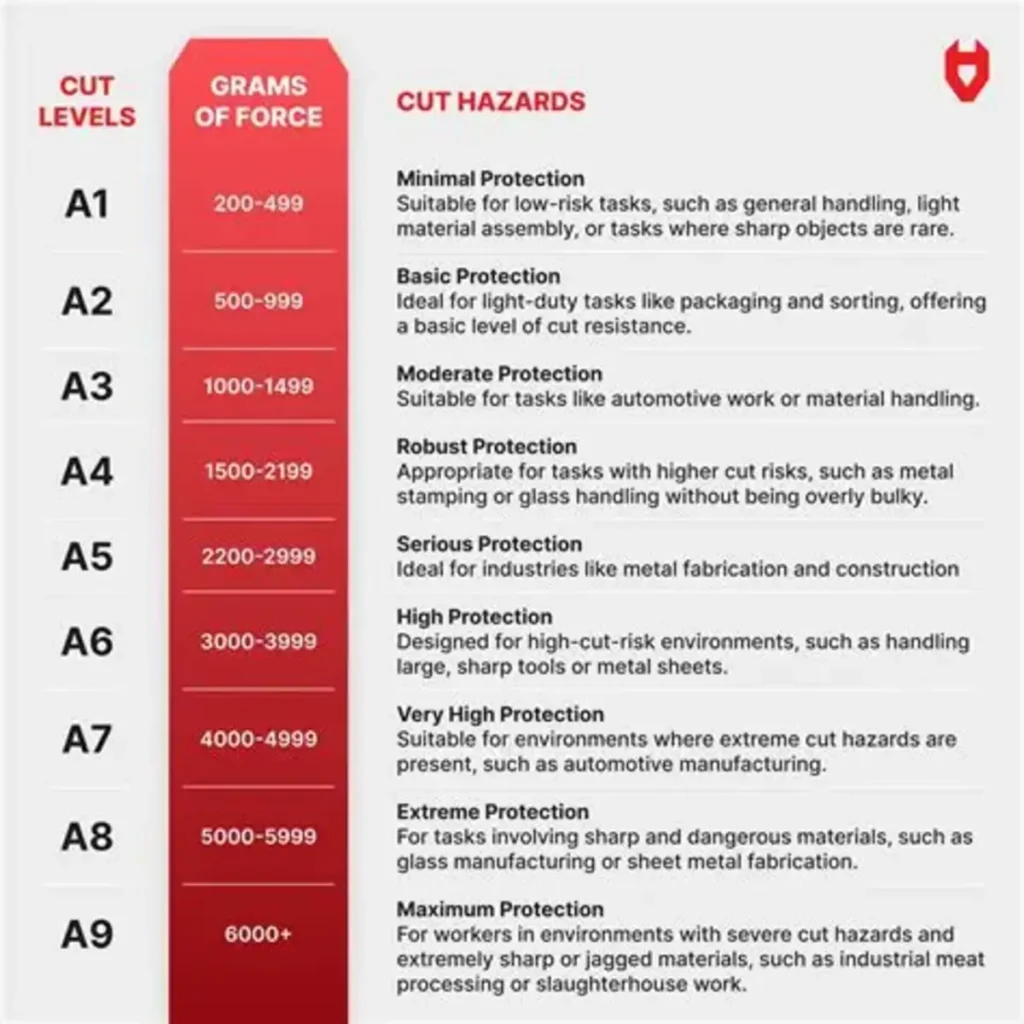
For cut resistance, ANSI/ISEA 105 uses the TDM-100 test method, which measures the force (in grams) required to cut through a glove material using a straight blade under controlled conditions.
ANSI Cut Levels (A1–A9):
- A1–A2: Light cut hazards (packaging, light assembly)
- A3–A4: Moderate cut hazards (sheet metal handling, maintenance)
- A5–A6: High cut hazards (glass handling, metal fabrication)
- A7–A9: Extreme cut hazards (heavy industrial processing)
Higher cut levels indicate greater resistance, but often with trade-offs in dexterity and flexibility.
EN 388 Cut Resistance Standard
In Europe and many international markets, the EN 388 standard is the benchmark for protective gloves against mechanical risks.
EN 388 evaluates gloves using four to six performance indicators, represented by a pictogram and numerical ratings:
Abrasion resistance
Blade cut resistance (Coup Test)
Tear resistance
Puncture resistance
Optional:
ISO cut resistance (TDM method)
Impact protection
ISO Cut Resistance Levels (A–F)
Modern EN 388 standards emphasize the ISO 13997 TDM test, especially for high-performance gloves.
- A: Lowest cut resistance
- B–C: Light to moderate protection
- D–E: High cut protection
- F: Very high cut protection
For safety professionals, the ISO cut rating (A–F) is often more reliable than the older Coup Test when evaluating high-cut-risk environments.
Key Differences Between ANSI and EN Standards
Although both standards aim to measure cut resistance, they are not directly interchangeable.
ANSI provides nine numeric levels (A1–A9) with force-based measurement.
EN 388 uses letter-based levels (A–F) for ISO cut testing.
Testing equipment, blade motion, and evaluation criteria differ.
Because of this, safety professionals should avoid directly converting ANSI levels to EN levels without manufacturer data or laboratory testing results.
Choosing the Right Cut Level for the Job
One of the most common mistakes in PPE selection is choosing gloves with excessive cut resistance for low-risk tasks. While higher cut levels offer more protection, they may reduce dexterity, tactile sensitivity, and worker comfort.
Best practices for glove selection include:
- Conducting a task-specific hazard assessment
- Identifying sharp-edge exposure frequency and severity
- Balancing cut protection with dexterity and grip needs
- Considering environmental factors such as oil, heat, or moisture
For example, precision assembly work may require a lower cut level with high dexterity, while glass handling or metal stamping demands higher cut resistance.
Beyond Cut Resistance: Other Performance Factors
Cut resistance alone does not guarantee overall safety. Safety professionals should also evaluate:
- Abrasion resistance for glove durability
- Grip performance in dry, wet, or oily conditions
- Puncture resistance for sharp-point hazards
- Comfort and fit to encourage consistent use
A well-selected glove combines multiple protective features tailored to the specific application.
Compliance, Training, and Worker Acceptance
Even the best gloves are ineffective if they are not worn correctly or consistently. Safety professionals should ensure:
- Gloves meet applicable regional standards
- Product documentation clearly states test results
- Workers receive training on glove limitations
- Feedback from users is considered in PPE selection
Proper education helps workers understand why a specific cut level is required and reduces resistance to PPE use.
Conclusion
Understanding cut resistant glove standards is essential for safety professionals responsible for protecting workers from laceration hazards. Standards such as ANSI/ISEA 105 and EN 388 provide reliable, science-based methods for evaluating glove performance, but they must be interpreted correctly.
Pabrik sarung tangan – By matching cut resistance levels to real workplace risks—and considering comfort, dexterity, and overall glove performance—safety professionals can significantly reduce injury rates while maintaining productivity. In cut hazard environments, informed glove selection is not just a compliance requirement; it is a key element of effective safety management.