Custom Jewelry Box Packaging for E-Commerce
E-commerce has changed the way jewelry brands think about packaging. A jewelry box is no longer simply a container that protects a product. It is part of the delivery experience, a branding tool, and an important component of a company’s logistics strategy. As online jewelry sales continue to depend on efficient fulfillment and memorable customer experiences, Custom Jewelry Box Packaging is increasingly being connected with technology and data-driven workflows.
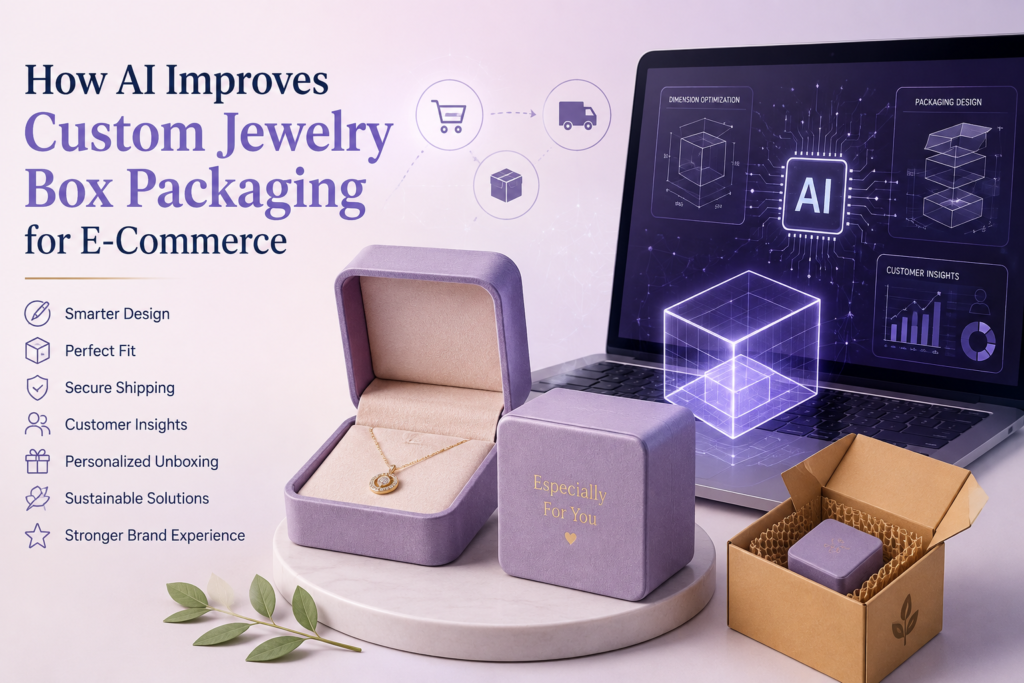
Artificial intelligence (AI) can support this transformation by analyzing customer preferences, optimizing packaging dimensions, generating design concepts, and helping businesses make better production decisions. When combined with digital design and modern manufacturing, AI can help jewelry brands develop packaging that is attractive, protective, efficient, and suitable for e-commerce fulfillment.
Protective Custom Jewelry Box Packaging
Jewelry products are often delicate and valuable, making protection a major packaging consideration. During e-commerce fulfillment, boxes can experience handling, stacking, vibration, and transportation over long distances. Custom Jewelry Box Packaging can be engineered around the dimensions and characteristics of specific jewelry products to provide better protection.
AI-assisted design tools can help evaluate different box structures, inserts, cushioning arrangements, and internal layouts. Instead of relying entirely on trial and error, designers can use digital models to compare possible configurations before manufacturing physical samples.
For example, an AI-supported workflow could analyze the size of a necklace, earrings, or ring and suggest an internal layout that minimizes unnecessary movement. This approach can help packaging teams develop more consistent protective structures while reducing development time.
Optimizing Custom Jewelry Box Packaging Dimensions
Packaging dimensions directly influence material consumption, storage requirements, and shipping costs. Oversized jewelry boxes can require additional materials and occupy more space during transportation. At the same time, packaging that is too compact may not provide sufficient protection.
AI and optimization software can analyze product dimensions and packaging specifications to identify more efficient box sizes. These systems can consider multiple variables simultaneously, including product measurements, insert requirements, material thickness, and shipping constraints.
For e-commerce businesses, this can be particularly useful because thousands of packages may be shipped every month. Even a small reduction in unnecessary packaging space can contribute to improved logistics efficiency over time.
Digital packaging design platforms can also create multiple structural options before a manufacturer produces a physical prototype. This makes the development process more data-driven and allows brands to evaluate dimensions earlier in the workflow.
Shipping-Friendly Custom Jewelry Box Packaging Designs
E-commerce packaging needs to work within a shipping environment. A beautiful jewelry box may not perform effectively if its structure is difficult to store, expensive to ship, or vulnerable to damage.
AI can help packaging teams design shipping-friendly solutions by analyzing box dimensions, weight, stacking requirements, and material usage. Automated workflows can compare different structural concepts and identify designs that balance aesthetics with transportation efficiency.
For example, a brand could evaluate whether a rigid jewelry box, folding box, or paperboard structure is better suited to its fulfillment model. Digital simulations can help identify potential weaknesses before large-scale production begins.
This connection between packaging design and logistics is especially valuable for online retailers. Packaging decisions can affect warehouse space, shipping costs, fulfillment speed, and customer satisfaction.
AI-Based Customer Insights for Jewelry Packaging
Customer data can provide useful information for packaging decisions. E-commerce brands collect data through product purchases, customer reviews, website interactions, and marketing campaigns. AI can process large amounts of this information to identify patterns that may be difficult to recognize manually.
For Custom Jewelry Box Packaging, customer insights could reveal preferences for certain colors, finishes, box styles, materials, or unboxing features. Brands can use these findings to inform future packaging designs.
For instance, if customer feedback consistently shows that buyers value recyclable materials, a jewelry company may prioritize sustainable packaging options. Similarly, if premium presentation receives strong positive feedback, the brand may invest in higher-quality finishes or more sophisticated box structures.
AI does not replace creative decision-making. Instead, it can provide data that helps designers and marketers make more informed choices.
Personalized Unboxing Experiences
Unboxing has become an important part of e-commerce branding. Customers may photograph and share attractive packaging on social media, making the physical delivery experience an extension of digital marketing.
AI can help brands develop more personalized packaging concepts. Customer segments can be analyzed according to purchasing behavior, demographics, product categories, or seasonal preferences. Packaging designs can then be adapted for specific campaigns or product collections.
A jewelry brand might create different packaging styles for wedding jewelry, everyday accessories, luxury collections, or holiday gifts. AI-assisted workflows can help generate and evaluate design variations while maintaining consistent brand guidelines.
Personalization can also extend to printed inserts, thank-you cards, product information, and promotional materials. These elements can work together to create a more cohesive customer experience.
Sustainable E-Commerce Packaging
Sustainability is another area where technology can influence packaging decisions. E-commerce businesses need to balance product protection with responsible material usage. Excess packaging can increase waste, while inadequate packaging can lead to damaged products and returns.
AI-based optimization can help identify opportunities to reduce unnecessary material without compromising structural performance. Packaging teams can compare dimensions, materials, and construction methods to develop more efficient solutions.
For Custom Jewelry Box Packaging, this may involve selecting recyclable paperboard, responsibly sourced materials, lightweight structures, or packaging formats that reduce excess space.
Data can also help businesses measure packaging performance. By tracking damage rates, material consumption, shipping efficiency, and customer feedback, brands can continuously refine their packaging strategy.
Improving Online Brand Presentation
Although packaging is a physical product, its influence begins online. E-commerce customers often see product images and packaging visuals before placing an order. As a result, the appearance of a jewelry box can contribute to perceived product value.
AI-powered design software can generate packaging concepts, explore color combinations, test visual layouts, and create digital product renderings. These capabilities allow brands to evaluate how packaging may appear in online product photography before committing to manufacturing.
Consistent visual design is particularly important for jewelry businesses competing in crowded online marketplaces. A distinctive box can reinforce brand recognition and make product photography more visually cohesive.
Modern packaging workflows can connect digital design with manufacturing specifications, reducing the gap between what is visualized on screen and what is eventually produced.
Automation in Custom Jewelry Box Packaging Manufacturing
AI becomes even more valuable when connected to manufacturing and production workflows. Once a packaging design has been approved, digital specifications can be transferred into production systems for cutting, printing, finishing, and assembly.
Automation can reduce repetitive manual tasks and improve consistency across large production runs. Manufacturing teams can use digital files to maintain accurate dimensions and standardized design specifications.
For businesses ordering packaging at scale, this can support more predictable production and quality control. Companies such as HOF Pack can serve as a resource for brands looking for customized packaging solutions, including jewelry boxes and other e-commerce packaging formats.
The most effective approach is not to treat AI as a replacement for packaging professionals. Instead, AI works as part of a broader workflow that connects customer data, design software, engineering, manufacturing, and logistics.
The Future of Custom Jewelry Box Packaging
AI is making packaging development more connected, measurable, and adaptable. For e-commerce jewelry brands, Custom Jewelry Box Packaging can now be approached through a combination of creative design and data-driven optimization.
From protective structures and shipping dimensions to personalization, sustainability, and automated manufacturing, technology can influence almost every stage of packaging development. Brands that connect packaging decisions with real customer and operational data can create solutions that perform better while supporting stronger customer experiences.
As AI tools continue to develop, jewelry packaging is likely to become increasingly intelligent and efficient. The future will not simply be about creating attractive boxes—it will be about designing packaging systems that connect product protection, technology, e-commerce, branding, manufacturing, and logistics into one efficient workflow.