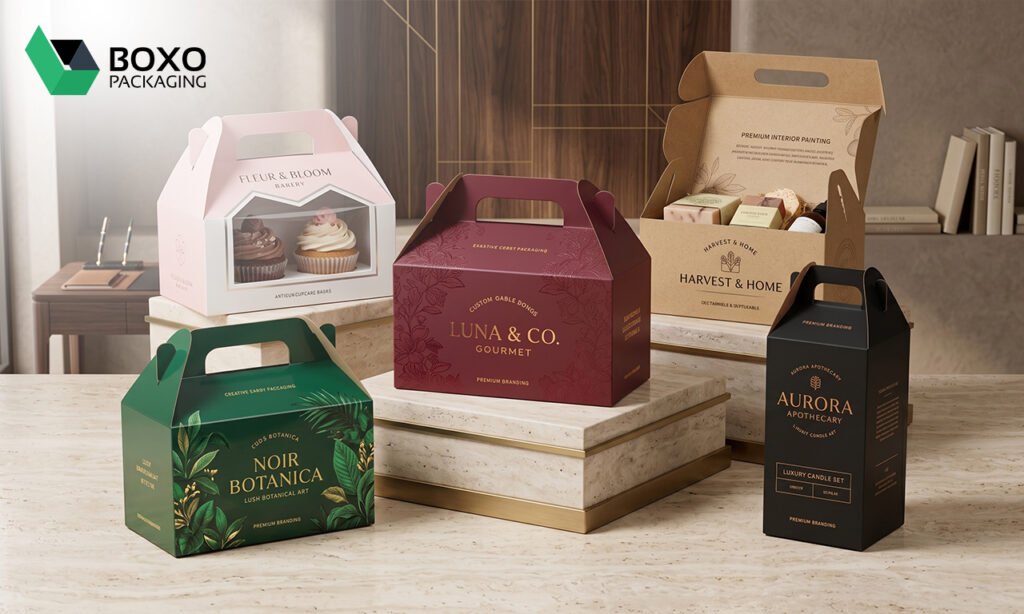
Custom gable boxes
Ask a bakery owner what makes their gable box choice compliant and most will point to the printing or the paper stock, not realizing the actual regulatory question sits somewhere else entirely. Custom Gable Boxes used for bakery goods, sandwiches, or anything touching food directly fall under a specific federal framework most small business owners have never actually read. Under the Federal Food, Drug and Cosmetic Act, food contact substances used in packaging materials, including coatings, adhesives, and inks that touch food, are regulated by the FDA through Title 21 of the Code of Federal Regulations, according to SGS USA’s compliance overview. That includes the interior coating on a gable box holding a pastry directly, not just the printed exterior most brands focus their design attention on. Boxo Packaging flags this distinction early with bakery and food service clients, since it’s a compliance detail that’s easy to overlook until a retail partner or auditor asks about it directly.
Why Does a Simple Gable Box Even Fall Under FDA Food Contact Rules?
Because anything that reasonably touches food during packing, transport, or storage counts as a food contact substance under federal law, and that includes the inner surface of a bakery box even briefly holding a warm pastry. Custom Gable Boxes used this way trigger the same regulatory framework as more obviously food adjacent packaging like plastic wrap or containers.
Pakfactory’s regulatory breakdown notes not every finished food packaging item requires direct FDA approval on its own. As long as manufacturers use materials already authorized by the FDA for that specific use, they satisfy the legal requirement, which the FDA tracks through a public database listing nearly 4,000 approved substances.
USA Box Maker’s compliance guide recommends a practical step most small brands skip entirely, requesting a Letter of Guarantee from a packaging supplier confirming FDA compliance and clearly referencing the specific regulation being satisfied, rather than just assuming a supplier’s materials are automatically compliant.
That paperwork matters more than it might seem. A retail partner, health inspector, or wholesale buyer asking for proof of compliance puts a bakery in a difficult spot fast if that documentation was never requested from the packaging supplier in the first place.
What Parts of a Custom Gable Box Actually Need to Meet Food Contact Standards?
The interior surface specifically, along with any adhesive or coating that could reasonably migrate into food during normal use. Custom Gable Boxes don’t need every component regulated at the same level, since exterior printing that never touches food falls under a different, less strict category entirely.
MC Polymers’ food contact materials guide explains the FDA doesn’t approve specific adhesives and coatings the way it approves new drugs, instead the company producing those materials verifies compliance based on the coating’s complete composition and its intended conditions of use.
The Plastic Makers Association adds useful context here too, noting FDA testing conditions vary by intended use, packaging meant for microwaving gets tested at temperatures above boiling for extended periods, while packaging meant only for room temperature storage faces a different testing standard entirely.
That distinction matters directly for gable boxes specifically. A box holding a cold bakery item at room temperature faces different compliance requirements than one intended to go straight into an oven or microwave, so the intended use case genuinely changes what compliance actually requires.
A quick checklist worth reviewing before using custom gable boxes for food products:
• Confirm the interior coating and any adhesives are FDA compliant for direct food contact
• Request a Letter of Guarantee from the supplier referencing the specific regulation met
• Match compliance testing to actual intended use, refrigerated, room temp, or heated
• Keep supplier documentation on file in case a retail partner or inspector requests it
How Is AI Actually Changing the Way Custom Product Packaging Gets Designed Right Now?
Faster prototyping and material optimization, mostly, rather than replacing human designers outright. Custom Product Packaging design work is shifting quickly toward AI assisted tools that generate and test design variations far faster than a traditional creative process ever could.
Grand View Research values the global generative AI in packaging market at USD 636.2 million in 2024, projecting growth to USD 6,260.2 million by 2033 at a 29.4 percent CAGR, with structural design applications holding the largest revenue share at 34.3 percent, ahead of graphics or branding specific uses.
Adoption is accelerating faster than most people in the industry expected too. Baking Business reported a McKinsey survey of packaging executives found the share who said their department had developed no generative AI function at all dropped from 70 percent in 2024 to just 18 percent in 2025, a genuinely fast shift for an industry McKinsey specifically described as typically trailing other sectors in digital adoption.
That timeline matters for anyone assuming AI in packaging design is still years away from practical use. Real partnerships are already happening, Grand View Research notes Nestle partnered with IBM in July 2025 specifically to build generative AI tools for identifying new packaging materials, optimizing cost efficiency and recyclability at the same time.
What Kinds of Custom Product Packaging Decisions Is AI Actually Handling Well?
Material selection and structural optimization, mostly, areas where testing many variations quickly genuinely beats manual trial and error. Custom Product Packaging projects increasingly use AI to generate multiple structural options from a single brief, then narrow those options down using performance and cost data before a human designer refines the final choice.
Towards Packaging’s market analysis notes the food and beverage industry holds the largest end user share of AI packaging design tools at 35 percent in 2025, while e-commerce and retail is projected to grow fastest, at roughly 25 percent CAGR through 2035, as online sellers push for faster design turnaround.
Persistence Market Research points to real commercial products behind this shift too. Adobe rolled out AI first creative tools in April 2025 supporting moodboarding and rapid ideation specifically for packaging designers, while Canva introduced enhanced AI capabilities the following month aimed at the same workflow.
That combination of major software players entering the space suggests this isn’t a niche experiment confined to large enterprise packaging teams anymore, it’s becoming standard tooling available to smaller design studios and in house teams alike.
Does Faster AI Assisted Design Actually Produce Better Custom Product Packaging, or Just Faster Packaging?
Both, based on where the technology is proving most useful right now. Custom Product Packaging benefits from AI mainly through faster iteration, which lets teams test more options against real constraints before committing to a final design.
Insight Ace Analytic’s market research notes AI in packaging enhances structural efficiency specifically by recommending sustainable materials and reducing waste, which means speed and quality improvements are happening together rather than one coming at the expense of the other.
The caveat worth keeping in mind is that AI tools optimize within the constraints and data they’re given, so a poorly defined brief or incomplete material database still produces mediocre results quickly rather than good results quickly. The tool accelerates the process, it doesn’t replace the judgment behind a well framed design brief.
Boxo Packaging treats AI assisted tools as a genuine speed advantage for early stage prototyping, while still relying on human review for the compliance, material sourcing, and brand judgment calls that a generative tool alone can’t fully account for.
Bringing Custom Gable Boxes and Custom Product Packaging Together
Custom Gable Boxes and Custom Product Packaging intersect at a point worth remembering, regulatory compliance and design innovation both matter, and neither one should get sacrificed for the other. A beautifully AI optimized box design still needs to meet the same FDA food contact requirements a gable box always has, regardless of how quickly the design itself got produced.
That balance is really the throughline across both of these conversations. Faster design tools and more efficient production methods are genuinely valuable, but they don’t remove the underlying responsibility to verify materials, coatings, and adhesives meet the standards a product actually requires.
Whether it’s a bakery double checking its gable box supplier’s food contact documentation or a larger brand adopting AI tools to speed up its packaging design pipeline, the smartest approach treats speed and compliance as complementary goals rather than competing priorities. Teams like Boxo Packaging tend to hold both standards at once, since a fast design process that skips compliance verification just moves the real cost further down the line instead of eliminating it.