“97% of enterprise executives say AI-powered CRM is benefiting their organization. Only 29% can prove significant ROI.” — Writer Enterprise AI Adoption Survey, 2026
That gap is not a technology problem. It’s a strategy problem. And it’s costing enterprises an average of $7.2 million per failed AI initiative—a figure that RAND Corporation confirmed after tracking 2,400+ enterprise AI projects through 2025 and into 2026.
In this piece, we expose exactly where enterprises are misallocating their AI bets, what the data reveals about the companies succeeding, and why your CRM development services strategy is either closing that gap or widening it right now.
If you’re a CTO, VP of Engineering, or Director of Digital Transformation, this isn’t a think piece. It’s a financial briefing.
The $1.3 Trillion Problem: What the Numbers Actually Say
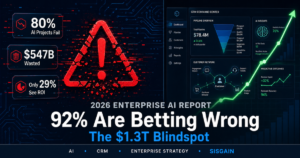
Global enterprises poured $684 billion into AI initiatives in 2025. Over $547 billion of it—80%—failed to deliver intended business value before the year closed. Not underperformed. Failed.
The breakdown, per RAND Corporation’s 2025 longitudinal analysis, is brutal:
- 33.8% of AI projects were abandoned before reaching production
- 28.4% reached completion but failed to deliver expected business value (ROI: -72%)
- 18.1% were cost-unjustified—costing an average $8.4M and returning only $3.1M
Meanwhile, the global CRM software market hit $87.96 billion in 2026 (Mordor Intelligence) and is projected to reach $128.86 billion by 2031. Businesses receiving $8.71 in return for every $1 invested in CRM software are not struggling with the AI ROI problem. They built on the right foundation.
That’s the blindspot.
Most enterprises are treating AI as the strategy. The winners are treating enterprise AI development as a layer on top of an intelligent, integrated data infrastructure—one anchored in robust CRM development services that actually connect customer data, workflow automation, and decision intelligence.
The market has already voted. Custom beats generic. Integration beats isolation. Governed beats chaotic.
Blindspot #1: Speed vs. Stability—The Paradox Destroying Your AI Roadmap
Boards want velocity. Risk and compliance teams want stability. Both are right. But most enterprises are resolving this tension by compromising both—which is the worst outcome possible.
The data from Deloitte’s 2026 State of AI in the Enterprise report reveals a critical pattern: only 34% of organizations are truly reimagining their business through AI, while the majority are using it for narrow efficiency gains that don’t compound.
Why? Because their underlying software infrastructure wasn’t built for adaptive execution. When your AI-first development strategy is bolted onto a fragmented CRM landscape—part Salesforce, part spreadsheet, part legacy ERP—every new AI feature becomes a three-month integration project. That’s not a tools problem. That’s an architecture problem.
Companies achieving transformative results follow a different model: they treat their CRM development solutions as the connective tissue between AI models and business operations. When your CRM captures real-time customer signals and feeds them into predictive models, AI stops being an experiment and starts being a competitive moat.
The stat your board needs to see: Organizations with a formal AI strategy built on integrated data systems are more than twice as likely to succeed than those adopting AI without one (80% vs. 37% success rates, Writer 2026 survey). The differentiator isn’t the AI model. It’s the data architecture underneath it.
What leading enterprises are doing differently:
- Implementing modular, API-first CRM software development services that allow AI layers to be swapped or upgraded without rearchitecting the entire system
- Separating production workflows from AI experimentation environments
- Building governance checkpoints into the development pipeline, not bolting them on post-deployment
Blindspot #2: The Talent Myth—Why Hiring 10 AI Engineers Won’t Fix It
Here’s the hiring math most enterprises get wrong. If 67% of executives now believe their company has already suffered a data breach due to unapproved AI tools (Writer, 2026), the answer is not a larger IT team. The answer is better-governed, purpose-built software that employees actually want to use.
The Deloitte 2026 report identifies the AI skills gap as the #1 barrier to AI integration—but critically, the gap is not in headcount. It’s in system design. Enterprises that locked AI inside technical teams created bottlenecks. Enterprises that opened AI across the organization without governance created shadow IT crises.
The real talent gap is in platform engineering: architects who understand how to build intelligent CRM ecosystems that enforce governance by design, not by policy. Demand for platform engineers is outpacing supply by a widening margin in 2026, and internal training alone isn’t closing it fast enough.
The numbers behind the talent problem:
- Vendor-led deployments succeed at 2x the rate of internal builds (State of AI in the Enterprise, 2026)
- Projects with dedicated change management resources achieve 2.9x the success rate of those without
- AI super-users are 5x more productive than non-adopters—but only when their tools are properly integrated into their workflow
This is precisely why selecting the right CRM development company matters more than any single AI investment decision. A capable CRM application development company doesn’t just write code. They design systems that make AI governance automatic, onboarding fast, and adoption rates high—because the tools work the way your teams actually think.
Blindspot #3: Low-Code Governance—The Silent Budget Destroyer
Low-code platforms promised enterprises the world: faster deployment, business-user ownership, reduced developer dependency. And on small scales, they delivered. But at enterprise scale in 2026, the reckoning is arriving.
79% of organizations now face challenges in adopting AI—a double-digit increase from 2025—and a significant driver is ungoverned low-code sprawl creating data inconsistency, compliance exposure, and technical debt that compounds quarterly.
Consider this: 36% of enterprises lack any formal plan for supervising AI agents, and 35% admit they couldn’t immediately “pull the plug” on a rogue agent (Writer, 2026). In a low-code environment where citizen developers are spinning up AI-powered automations without version control, audit trails, or data residency checks, this isn’t a theoretical risk. It’s a Q4 incident report waiting to happen.
The enterprise software modernization movement is correcting this, but not fast enough. Companies using properly governed CRM software development services—with role-based access, audit logging, GDPR/HIPAA compliance baked in, and version-controlled workflows—are seeing their low-code investments pay off. The others are rearchitecting on emergency timelines.
Cost Guide: What AI-First CRM Development Actually Costs in 2026
This is the section most vendors skip. We won’t.
Off-the-Shelf CRM Licensing Costs:
| Platform | Annual Cost (50 Users) | AI Features Included |
|---|---|---|
| Salesforce Sales Cloud Enterprise | ~$75,000/year | Einstein GPT (add-on) |
| Microsoft Dynamics 365 | ~$60,000/year | Copilot (limited tiers) |
| Zoho CRM Enterprise | ~$32,000/year | Zia AI (basic) |
| HubSpot Enterprise | ~$48,000/year | AI content tools |
Custom CRM Development Services Costs (2026 Benchmarks):
| Scope | Cost Range | Timeline |
|---|---|---|
| Basic operational CRM (small sales team) | $30,000–$60,000 | 3–5 months |
| Standard SMB CRM with automation | $60,000–$100,000 | 5–8 months |
| Enterprise CRM with AI integration | $100,000–$200,000+ | 8–14 months |
| Enterprise + ERP integration + ML | $200,000–$350,000+ | 12–18 months |
Key Cost Variables Enterprises Underestimate:
- AI/ML feature layer: Adding generative AI capabilities to a custom CRM adds $20,000–$80,000 depending on model complexity
- ERP/legacy system integration: Bidirectional integrations with SAP or Oracle run $10,000–$25,000 per system; legacy API work can exceed $80,000
- Compliance build-out (GDPR/HIPAA/SOC 2): Full compliance readiness adds $50,000–$60,000 to development cost
- Ongoing maintenance: Budget 15–20% of initial development cost annually
- Change management: Projects without it fail at 2.9x the rate—factor in $15,000–$40,000 for training and adoption support
The ROI case for custom: Businesses using CRM systems report $8.71 return for every $1 spent, with CRM use boosting lead conversions by up to 300% and reducing sales cycle time by 8–14% (Sellers Commerce, 2025). Off-the-shelf licensing costs compound annually; custom CRM development solutions depreciate as a capital asset and scale without per-seat penalties.
Legal & Security: The Compliance Minefield Enterprises Are Ignoring
This is not a footnote. It’s a first-order business risk.
67% of executives already believe their company has suffered a data breach from unapproved AI tools. The legal and regulatory landscape in 2026 has fundamentally changed what “secure software” means for enterprises deploying AI-powered CRM development services:
GDPR (EU): Any CRM processing EU citizen data must maintain data residency compliance, right-to-erasure capabilities, and processing consent logs. Non-compliance fines reach €20M or 4% of global annual turnover—whichever is higher.
HIPAA (Healthcare): AI-powered CRM tools touching patient interaction data require Business Associate Agreements, end-to-end encryption, audit log retention of 6+ years, and breach notification protocols. A healthcare AI project failure averages $11.3M in total cost—the highest of any vertical.
EU AI Act (2026 enforcement): High-risk AI systems in enterprise contexts now face mandatory conformity assessments, transparency requirements, and human oversight mandates. CRM-integrated AI that influences hiring, credit, or customer scoring decisions falls into high-risk categories.
NIST AI RMF & ISO/IEC 42001: These are increasingly becoming procurement requirements. Enterprises selecting a CRM application development company should require demonstrated alignment with at least one of these frameworks.
Security cost reality: Basic security (SSL, encryption) is now table stakes. Enhanced security with 2FA and audit logs adds $25,000–$40,000 to development cost. Full compliance build-out for GDPR + HIPAA + SOC 2 can add $50,000–$60,000. But compare that against the average $7.2M cost of a failed initiative with compliance failures folded in. Security is not a cost. It’s insurance.
Industry Case Study: Financial Services and the $11.3M AI Lesson
Financial services enterprises face the highest AI project failure rate of any vertical: 82.1%, with an average failed project cost of $11.3M (RAND Corporation, 2026). The compounding factors are regulatory complexity, algorithmic bias exposure, and the speed of change in compliance requirements.
The scenario that plays out repeatedly:
A mid-to-large financial services firm invests $8M+ in an AI-powered customer intelligence initiative. The AI models are technically sound. The data science team is capable. But the underlying CRM infrastructure is fragmented across three legacy systems with inconsistent data schemas, no unified customer ID logic, and audit logging that doesn’t meet OCC examination standards.
The project reaches completion. The AI models surface insights. But the regulatory exam finds that customer scoring decisions aren’t traceable to source data. The initiative is suspended. Legal review costs $400K. Remediation costs $2.1M. Total cost: $10.5M+. ROI: deeply negative.

What the 17.9% who succeed do differently:
They begin with enterprise AI development planning that treats data governance as a prerequisite, not an afterthought. They use CRM development services that enforce compliance at the schema level—where data lineage, consent flags, and access controls are architecture, not policy documents. They engage a CRM development company with demonstrated financial services experience before writing a single AI model.
The lesson: AI is only as intelligent as the data it sits on. Build the foundation first.
Comparison Guide: Off-the-Shelf vs. Custom CRM Development Services
This is the decision most enterprises get wrong—not because the math is hard, but because they’re comparing the wrong variables.
| Factor | Off-the-Shelf CRM | Custom CRM Development Services |
|---|---|---|
| Initial Cost | Lower upfront ($10–$150/user/mo) | Higher upfront ($30K–$350K+) |
| 3-Year TCO (50 users) | $90K–$270K+ (licensing only) | $60K–$200K (all-in for mid-range) |
| AI Integration | Vendor-controlled, addon pricing | Custom-built, full control |
| Compliance Fit | Generic (GDPR/HIPAA requires config) | Purpose-built for your requirements |
| Workflow Fit | You adapt to the platform | Platform adapts to your processes |
| Data Ownership | Vendor holds data | You own all data |
| Scalability Cost | Per-seat pricing compounds | Flat infrastructure scaling |
| Integration Depth | API limits apply | Unlimited custom integrations |
| Time to Value | Faster (weeks) | Slower (months), but higher ceiling |
| Long-Term ROI | Capped by vendor roadmap | Uncapped, compound advantage |
The inflection point: For organizations under 25 users with standard sales workflows, off-the-shelf makes sense. For enterprises above 50 users with complex workflows, regulated industries, or AI ambitions, custom CRM development solutions deliver superior long-term ROI—especially when per-seat licensing at enterprise tier runs $75,000–$150,000+ annually just to maintain parity.
The fastest-growing segment of the CRM market—enterprise software with AI/ML integration—is growing at rates that off-the-shelf platforms can’t keep up with at the customization level. That gap is where custom CRM software development services create lasting competitive advantage.
What the 20% Who Succeed Actually Do: The Blueprint
The RAND, Deloitte, McKinsey, and MIT data all converge on the same five behaviors for enterprise AI success:
1. They define success before they build. Organizations with pre-defined ROI metrics achieve 4.5x better success rates. No ambiguity about what “done” looks like.
2. They treat AI as organizational transformation, not a technology deployment. Change management adds 2.9x to success rates. The best AI-first development strategy accounts for people and process, not just code.
3. They work with specialized vendors. Vendor-led deployments succeed at 2x the rate of pure internal builds. A proven CRM development company has solved integration, governance, and adoption problems hundreds of times. Your internal team is solving them for the first time.
4. They build governance into architecture, not policy. Security, compliance, and data lineage built into the system outperform policies enforced through training. This is non-negotiable in 2026 with EU AI Act enforcement active.
5. They set realistic timelines. The data supports 18–24 month transformation timelines. Organizations expecting 90-day AI transformations consistently report abandonment or failure. Real enterprise AI development is a program, not a project.
SISGAIN: Built for the 20% Who Win
For 20+ years, SISGAIN has been the partner enterprises choose when the stakes of getting this wrong are too high to accept.
As a full-service CRM development company, SISGAIN delivers purpose-built CRM development solutions that don’t just connect your customer data—they make it intelligent, compliant, and ready for the AI layer your business needs to compete in 2026 and beyond.

Our CRM software development services are engineered for:
- Enterprise-grade security and compliance — GDPR, HIPAA, SOC 2, ISO 27001 — built into architecture, not bolted on
- AI-ready data infrastructure — designed from day one for machine learning, predictive analytics, and agent-based automation
- Deep ERP and legacy integration — no data islands, no governance gaps
- Industry-specific builds — financial services, healthcare, logistics, manufacturing, retail — we speak your compliance language
As a trusted CRM application development company, SISGAIN has helped mid-market and enterprise clients across North America, Europe, and Asia-Pacific move from fragmented CRM sprawl to unified intelligence platforms that drive measurable revenue outcomes.
You’ve seen what happens when AI bets go wrong. SISGAIN helps you be part of the 20% who get it right—on time, on budget, and built to compound.
→ Book a Free Strategic Assessment — Get a clear-eyed audit of your current CRM architecture, your AI readiness, and the exact gaps between where you are and where your competitors are heading.
FAQ’s
Q1: What is the average cost of custom CRM development services for an enterprise in 2026?
Enterprise custom CRM development typically ranges from $100,000–$350,000+ depending on scope, integrations, AI capabilities, and compliance requirements. A mid-range enterprise CRM with AI integration and ERP connectivity runs $150,000–$200,000 with an 8–14 month development timeline. Ongoing maintenance typically costs 15–20% of initial development annually.
Q2: Why do 80% of enterprise AI projects fail, and how does CRM development fit into fixing this?
RAND Corporation’s 2026 analysis identified three root causes:
(1) undefined success metrics pre-approval,
(2) fragmented data infrastructure that prevents AI models from accessing consistent, governed data, and
(3) lack of change management.
Q3: What compliance frameworks should my CRM development vendor demonstrate competency in?
For 2026, the non-negotiable frameworks are GDPR , HIPAA, SOC 2 Type II, ISO/IEC 42001, and NIST AI RMF. The EU AI Act adds mandatory conformity requirements for high-risk AI systems embedded in CRM workflows. Always require documented compliance architecture from your CRM development company before engagement.
Q4: How long does it realistically take to see ROI from a custom CRM implementation?
Research from McKinsey, Deloitte, and Forrester consistently points to 12–24 months for transformative ROI from enterprise CRM implementations. Initial productivity gains typically appear within 3–6 months. Revenue impact from AI-powered lead scoring, predictive analytics, and personalization typically materializes at the 12–18 month mark.
Q5: Off-the-shelf vs. custom CRM—how do I know which is right for my enterprise?
The decision hinges on four variables: user volume, workflow complexity, compliance requirements, and AI ambitions. Under 25 users with standard sales workflows—off-the-shelf wins on speed and cost. The math changes further at 100+ users, where enterprise-tier per-seat licensing frequently exceeds the 3-year cost of a custom build.
Q6: How does AI integration add to CRM development costs in 2026?
Budget for AI integration to add 25–50% to your base CRM development cost, and prioritize vendors with demonstrated experience deploying production AI systems—not just prototype integrations.