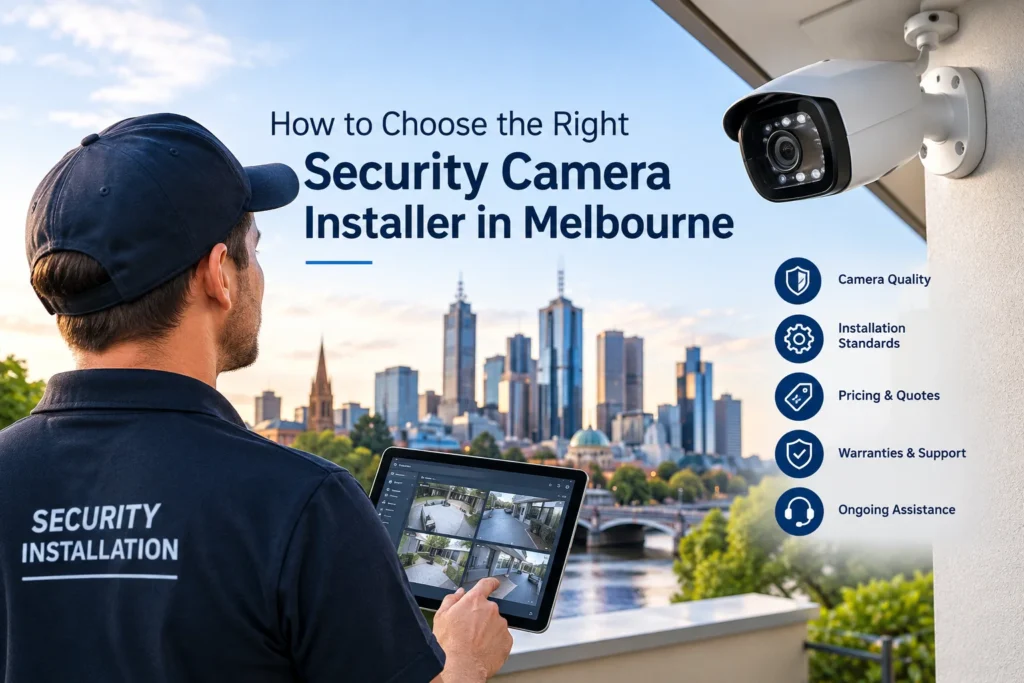
Introduction: Why the Right Security Camera Installer Matters
Choosing the right security camera installer company in Melbourne is an important decision for homeowners, businesses, warehouses, retail stores, offices, and other properties. A professionally designed security system can provide reliable monitoring, improve property protection, and give you greater confidence that important areas are being watched. However, simply purchasing cameras is not enough. The quality of installation, camera positioning, system configuration, cabling, storage, and ongoing support can significantly affect the performance of your surveillance system.
Melbourne properties have different security requirements depending on their location, size, layout, lighting conditions, and daily activity. A small residential property may need a few strategically positioned cameras, while a commercial facility could require a much larger surveillance network. Before choosing an installer, property owners should consider experience, equipment quality, installation standards, warranty, support, and the company’s understanding of local security requirements. Taking time to compare these factors can help you invest in a CCTV system that delivers dependable performance rather than simply choosing the cheapest installation quote.
Understand Your Property’s Security Requirements
Before contacting a security installer, it is useful to understand what you want your surveillance system to accomplish. Start by identifying important areas that require monitoring, such as entrances, driveways, parking areas, reception spaces, loading zones, corridors, gates, storage rooms, and other vulnerable locations. Think about whether you need cameras primarily for deterrence, evidence collection, remote monitoring, employee safety, or general property protection.
A professional installer should inspect your property and recommend a system based on its actual layout rather than simply selling a standard package. They should consider possible blind spots, camera viewing angles, lighting conditions, distances between cameras and recording equipment, and the locations where cables can be installed safely. A proper assessment can prevent common problems such as cameras pointing at unsuitable areas, insufficient night visibility, overlapping coverage, or important sections being left unprotected. Clear planning at the beginning makes the installation process more efficient and helps ensure that the final system is practical for everyday use.
Look for Experience in Melbourne Security Installations
Experience is one of the most important factors when selecting a security camera installer. An experienced company is more likely to understand the challenges involved in installing surveillance systems across different types of Melbourne properties. Residential homes, retail businesses, offices, industrial buildings, warehouses, and multi-level properties can all require different approaches to camera placement and system design.
When comparing installers, ask how long they have been providing CCTV services and whether they have completed installations similar to your property. Experience should not only be measured by the number of years a company has been operating. Look for evidence that the installer understands modern surveillance technology, networking, recording systems, remote access, night vision, and different camera types. A knowledgeable installer should also be willing to explain why specific cameras and locations are being recommended. This helps you understand the value behind the proposed system instead of simply accepting a list of products and prices.
Check the Quality of Security Camera Equipment
The quality of the cameras and recording equipment can have a major impact on your security system. Modern CCTV technology offers many options, including high-resolution cameras, wide-angle models, infrared night vision, motion detection, smart analytics, remote viewing, and weather-resistant outdoor cameras. However, not every camera is suitable for every location.
A professional installer should recommend equipment based on the environment where it will be installed. Outdoor cameras may need stronger weather resistance, while indoor cameras can have different requirements. Areas with limited lighting may benefit from cameras specifically designed for low-light performance. High-risk areas may require higher-resolution cameras that can capture useful details such as faces, vehicles, or other identifying features. Rather than choosing equipment based only on a high megapixel number, consider image quality, reliability, lens selection, storage requirements, software features, and compatibility with the overall surveillance system.
Consider Professional Camera Placement and Coverage
Even high-quality security cameras cannot provide effective protection if they are installed in the wrong positions. Camera placement should be carefully planned to reduce blind spots and provide useful views of important areas. A professional installer should assess entrances, exits, pathways, driveways, gates, parking areas, and other locations where security incidents could occur.
The height and angle of each camera are also important. Cameras positioned too high may capture limited facial details, while cameras installed too low may be vulnerable to tampering. Direct sunlight, artificial lighting, reflective surfaces, walls, trees, and other obstacles can also affect image quality. A good installer should consider these factors before finalizing the camera layout. The objective should be meaningful coverage rather than simply installing as many cameras as possible. A carefully designed system can provide broader protection while avoiding unnecessary equipment and excessive installation costs.
Compare Installation Standards and Workmanship
The installation itself deserves as much attention as the cameras being purchased. Poorly installed cabling, exposed wires, loose connections, incorrect mounting, or unsuitable power arrangements can create reliability and maintenance problems later. Professional workmanship helps ensure that the surveillance system remains stable and looks appropriate once installation is complete.
Ask potential installers how they manage cables, power supplies, network connections, and camera mounting. For commercial properties, cable management can be especially important because large numbers of cameras may need to connect to recording equipment and network infrastructure. Outdoor installations should also account for weather exposure and physical security. A reliable installer should aim for a neat, secure, and durable installation rather than rushing through the process. Before approving the project, ask whether testing and configuration are included. Cameras should be checked after installation to confirm that recording, viewing, motion detection, night vision, and remote access are functioning correctly.
Explore Different Security System Options
Every property does not require the same type of surveillance system. Depending on your needs, you may consider IP cameras, network video recorders, wireless solutions, smart cameras, or systems that combine CCTV with alarm technology. Your installer should explain the advantages and limitations of the available options.
For homeowners and businesses wanting integrated protection, combining CCTV with an alarm system can provide an additional layer of security. For example, some property owners may consider bosch alarm packages when looking for a professionally designed alarm solution alongside their surveillance requirements. The right combination depends on the property, budget, security risks, and desired level of automation. A trustworthy installer should not pressure you into buying unnecessary equipment. Instead, they should explain the available technologies and help you choose a solution that meets your specific requirements.
Ask About Remote Viewing and Mobile Access
Remote viewing has become an important feature for modern CCTV systems. Many property owners want the ability to check their cameras while they are away from home or outside the workplace. Depending on the system, users may be able to view live footage, receive notifications, review recorded video, and manage certain settings through a smartphone, tablet, or computer.
When comparing installers, ask whether remote access is included and how the system will be configured. Security should remain a priority when enabling remote access, so the installer should explain account security, password management, software updates, and appropriate network configuration. It is also useful to ask whether multiple authorised users can access the system and whether permissions can be managed. A well-configured remote monitoring system can make CCTV much more convenient because property owners do not need to be physically present to check what is happening.
Evaluate Storage and Recording Requirements
Installing cameras without considering video storage can lead to problems later. CCTV systems continuously generate video data, and the amount of storage required depends on factors such as the number of cameras, resolution, frame rate, recording schedule, compression technology, and retention period.
Ask your installer how long your recordings will be stored and what happens when storage capacity is reached. Many systems automatically overwrite older footage, but the retention period should match your security requirements. A business that needs to investigate incidents several weeks after they occur may require substantially more storage than a small residential property. You should also understand how recorded footage can be searched, exported, and backed up when needed. An experienced installer can calculate suitable storage requirements and recommend equipment that provides a practical balance between recording quality, retention time, and cost.
Compare Brands and Camera Technologies
Different manufacturers offer different features, product ranges, price points, and levels of performance. Instead of selecting a brand simply because it is popular, consider whether the equipment is appropriate for your property and whether replacement parts or technical support are readily available.
Some installers specialise in particular brands or technologies. For example, businesses looking for dahua cctv installation may benefit from discussing their property requirements with an installer familiar with that equipment and its features. The important consideration is not just the brand name but how effectively the selected equipment is designed, installed, configured, and maintained. Ask about camera specifications, recording hardware, warranties, software compatibility, firmware updates, and future expansion. Choosing equipment that can be upgraded later can also be beneficial if your security requirements change.
Review the Installer’s Warranty and Support
A CCTV system is a long-term investment, so after-sales support should be considered before choosing an installer. Ask what warranty applies to the cameras, recorder, cabling, power equipment, and installation workmanship. Make sure you understand what is covered and for how long.
Technical support is also valuable if a camera stops working, remote access becomes unavailable, storage fills unexpectedly, or software needs to be updated. A company that provides installation but offers little support afterward may not be the best choice for a long-term security project. Before committing, ask whether maintenance services are available and how technical problems are handled. Clear communication about warranties and support can prevent misunderstandings later. The best installer is not necessarily the company offering the lowest initial price; it is often the company that provides a reliable system, professional workmanship, clear documentation, and dependable assistance throughout the system’s useful life.
Compare Quotes Carefully
Price is naturally an important consideration, but comparing CCTV installation quotes only by the final dollar amount can be misleading. Two companies may provide very different systems even if their quotes appear similar. One proposal may include higher-quality cameras, more storage, better cabling, professional configuration, remote access, and longer warranty coverage.
When reviewing quotes, compare the number and type of cameras, recording equipment, storage capacity, installation work, cabling, configuration, mobile access, warranty, and ongoing support. Ask whether there are additional charges that are not included in the initial price. A detailed quote should clearly explain what you are receiving. Be cautious of unusually cheap offers if they do not provide sufficient information about the equipment or installation process. A properly designed CCTV system should be viewed as a long-term security investment. Paying slightly more for quality equipment and professional installation can be more economical than replacing an unreliable system later.
Choose an Installer That Provides a Complete Solution
A strong security camera installer should be able to handle the project from initial assessment through installation, configuration, testing, and customer guidance. This makes the process easier because you have one professional team responsible for understanding the complete system.
Look for an installer that takes time to discuss your security concerns and explains the proposed solution clearly. They should be able to identify potential blind spots, recommend suitable equipment, explain storage requirements, configure remote access, and demonstrate how to use the system. After installation, you should know how to view live cameras, search recordings, export footage, and manage authorised users. Professional communication is another useful indicator of service quality. If a company responds clearly to questions before installation and provides detailed information in its proposal, it is more likely to provide a structured installation experience.
Final Checklist Before Hiring a Melbourne CCTV Installer
Before choosing a security camera installer company in Melbourne, take a few minutes to compare the most important factors. Confirm that the company has relevant installation experience and can work with properties similar to yours. Check the quality and suitability of the proposed equipment, rather than focusing only on camera resolution or price.
Make sure the quotation explains installation, cabling, recording, storage, configuration, warranty, and support. Ask how the installer will address blind spots and challenging lighting conditions. Confirm whether mobile and remote viewing are included if these features are important to you. It is also worthwhile asking about future expansion because your security requirements may increase as your property or business grows. Finally, choose an installer that communicates clearly and provides a solution based on your actual security requirements. A professional approach at the planning stage can make a significant difference to the performance and reliability of the finished CCTV system.
Conclusion
Choosing the right security camera installer company in Melbourne requires more than comparing prices. A reliable security system depends on the combination of suitable equipment, professional design, strategic camera placement, quality installation, secure configuration, adequate storage, and ongoing support. Property owners should take the time to understand their security requirements and compare installers based on experience, workmanship, technology, warranties, and customer service.
Whether you are protecting a family home, office, retail premises, warehouse, or commercial property, a professionally planned surveillance system can provide valuable visibility and peace of mind. The best installer will listen to your requirements, identify potential weaknesses, recommend appropriate technology, and deliver a system that is practical for your property. By evaluating these factors carefully, Melbourne property owners can make a more informed decision and build a CCTV solution designed for dependable security over the long term.
Frequently Asked Questions
1. How do I choose a CCTV installer in Melbourne?
Look for an installer with relevant experience, quality equipment, professional workmanship, clear quotations, warranty coverage, and reliable after-sales support. Always compare what is included in each quote.
2. How many security cameras does my property need?
The number depends on the property’s size, layout, entrances, vulnerable areas, and required coverage. A professional site assessment can identify the appropriate number and camera locations.
3. Should CCTV cameras have night vision?
For most outdoor security applications, night vision is highly beneficial. The correct camera should be selected according to the property’s lighting conditions and the level of detail required at night.
4. Can I view my security cameras remotely?
Many modern CCTV systems support remote viewing through smartphones, tablets, or computers. The installer should configure remote access securely and explain how to use it.
5. How long should CCTV footage be stored?
The ideal retention period depends on the property and security requirements. Storage capacity should be calculated according to camera count, resolution, recording schedule, and desired retention period.
6. Is professional CCTV installation worth it?
Yes. Professional installation helps ensure correct camera placement, reliable cabling, proper configuration, useful coverage, and dependable system performance. It can also reduce problems caused by incorrect DIY installation.
If you would like to post a free guest post, visit pencraftednews to learn more.