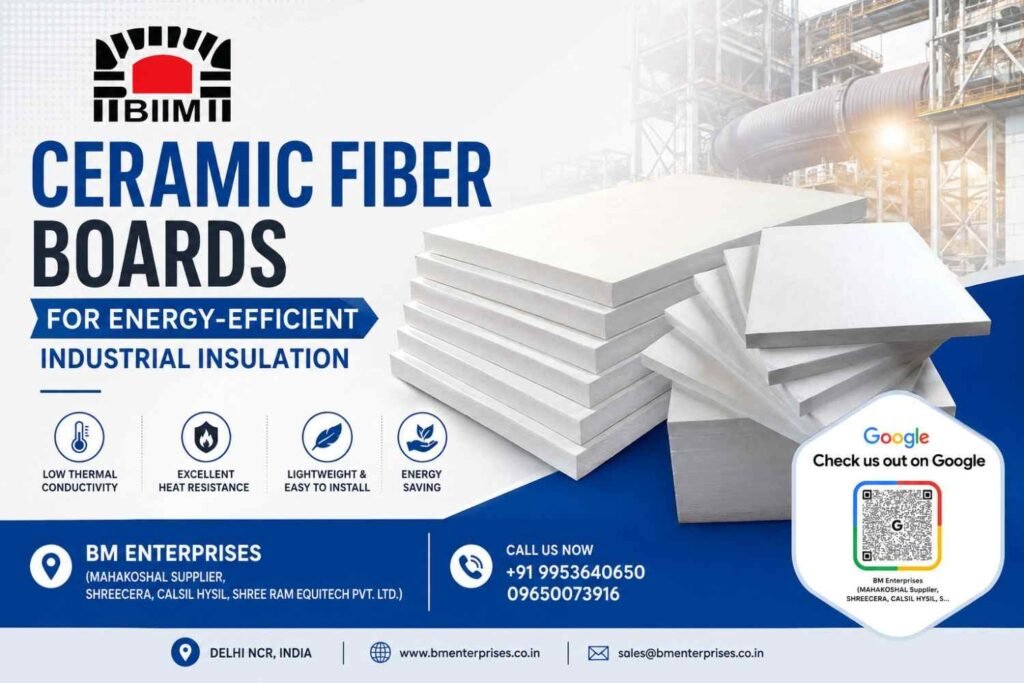
The working temperature of industrial furnaces, kilns, boilers, and heaters is very high, thus the need for good insulation to control the loss of heat energy in such systems. Ceramic fiber boards are light and rigid types of insulation that are used to provide efficient heat insulation in harsh industrial conditions. They have low heat conductivity, low heat storage, high temperature resistance, and thermal shock resistance; thus, they are appropriate for applications where the use of dense refractory materials is not necessary. BM Enterprises provides high-temperature refractory and insulation materials for industrial purposes.
Check us out on Google Maps: https://bit.ly/4qqIaqK
Technical specifications should always be verified from the corresponding data sheets before the installation process. The right kind for the particular application can be recommended by the respective manufacturers or suppliers of ceramic fiber boards.
What Are Ceramic Fiber Boards?
Ceramic insulation fiber boards are rigid fiber boards made of ceramic fibers and processed into insulation panels with stability and lightness. Ceramic boards differ from flexible fiber products in that they keep their shape and allow easy cutting, fitting, and installation along the surfaces of furnace walls, roofs, doors, and other furnace parts. Depending on grades, these materials have a range of temperatures suitable for different applications, normally about 1260°C, 1400°C, and 1430°C. These properties make them especially valuable when a consistent layer of insulation is necessary. They may also be used together with refractory brickwork, castables, or other insulation products to make multilayered furnace linings. In such combinations, dense refractory materials provide structural protection of the furnace structure, while ceramic boards decrease heat transmission towards the furnace wall.Key Features of Ceramic Fiber Boards
The performance of ceramic fiber boards is affected by the quality, density, thickness, and processing mixture used during production. Among the attributes are the following:- Resistance to high temperatures suitable for harsh applications inside furnaces and kilns.
- Low thermal conductivity, reducing heat transfer and loss of energy.
- Minimal heat capacity, unlike denser refractory materials.
- Light weight, making them easy to install and use.
- Thermal shock resistance for components that undergo continuous exposure to heat and coolness.
- Dimensional stability under suitable conditions of application.
- Easy fabrication, allowing boards to be easily shaped based on requirements for installation.
- Insulating ability in furnace walls, roof, doors, and backup linings.
Ceramic Fiber Boards Specifications
Specifications are always chosen based on the operating environment of the materials. Common factors used in selection include rated temperature, density, thickness, size, thermal conductivity, permanent linear contraction, and mechanical strength.| Specification | Typical Requirement |
| Product | Rigid ceramic fiber insulation board |
| Temperature grades | Approximately 1260°C–1430°C, depending on grade |
| Form | Rigid lightweight board |
| Thickness | Selected according to thermal design |
| Density | Selected according to insulation and mechanical requirements |
| Thermal conductivity | Low; varies by grade and temperature |
| Heat storage | Low compared with dense refractories |
| Thermal shock | Suitable for repeated thermal cycling |
| Fabrication | Can be cut and shaped |
| Applications | Furnaces, kilns, boilers, heaters and industrial equipment |
Applications of Ceramic Fiber Boards
- Industrial Furnaces: Application on furnace walls, roofs, doors, and backup insulations to reduce heat losses.
- Heat Treatment Furnaces: Assists in maintaining constant temperatures during annealing, hardening, tempering, and other forms of heat treatment.
- Kilns for Ceramics: Application in kiln walls, roofs, doors, and insulation layers in ceramic manufacturing at elevated temperatures.
- Tunnel Kilns: Lightweight thermal insulation is used to increase heat retention and decrease energy consumption.
- Boilers: Provides high-temperature insulation around boiler parts and combustion areas.
- Industrial Heaters: Help reduce the heat flow and increase energy efficiency.
- Electric Furnaces: Application in heating chambers and high-temperature areas where light weight insulations are necessary.
- Reheating Furnaces: Improve thermal efficiency by reducing heat losses through furnace walls and roofs.
- Insulation of Furnace Doors and Covers: Lightweight insulation for doors, covers, and removable parts of furnaces.
- Backup Insulation: Installation behind refractory bricks or castables to improve overall thermal efficiency of refractory linings.
- Combustion Chambers: Application in high-temperature insulation cases, provided that selected board grade corresponds to operating parameters.
- Thermal Expansion Joints and Insulation Layers: Application into a properly designed multi-layer insulation system.
Ceramic Fiber Boards vs. Ceramic Blankets
Both the rigid boards and ceramic fibers offer insulation capabilities; however, they differ from each other in terms of application conditions. Rigid ceramic fiber boards are flat boards that provide stable insulation and are thus suitable for use in furnace walls, roofs, doors, and backup liners. Ceramic blankets are flexible and are more suitable for wrapping irregular surfaces, filling gaps, creating expansion layers, and insulating areas where flexibility is required. The combination of both materials can be a successful solution for some furnace systems. Rigid board offers consistent insulation over broad, flat expanses, and flexible fiber works around joints, corners, and irregular sections.Why Buy from a Reliable Ceramic Fiber Board Manufacturer?
- Consistent Quality: This will ensure the same density, thickness, and insulation efficiency.
- Selection of Correct Grade: Assists in selecting the appropriate board depending on the operational temperatures.
- Technical Assistance: Will help in providing information regarding the specifications of products to be purchased.
- Supply Reliability: This will assist in purchasing large quantities of the required products.
- Improved Service: Quality products will give improved service life.
Installation and Handling Considerations
- Handle With Care: Be sure not to cause any damage, breakage, or distortion while transporting or installing.
- Precision Cutting: Cut boards accurately to ensure a snug, uniform fit.
- Gap Reduction: Fit the joints properly to avoid creating pathways for heat loss.
- Stay Dry: Keep the boards in a clean, dry place free of moisture and contaminants.
- Adhere to Recommended Fixation Process: Adhere to the recommended fixation technique for your application.
- Safety Measures: Use personal protective equipment when cutting and handling ceramic fiber boards.