Industrial construction, oil and gas plants, and complex architectural developments frequently require working in highly congested elevated spaces. When job sites present static overhead pipe bridges, parapet walls, structural trusses, or unexcavated ground hazards, standard vertical scissor lifts cannot reach target zones. Deploying specialized machinery becomes essential to maintain workflow momentum without compromising worker safety.
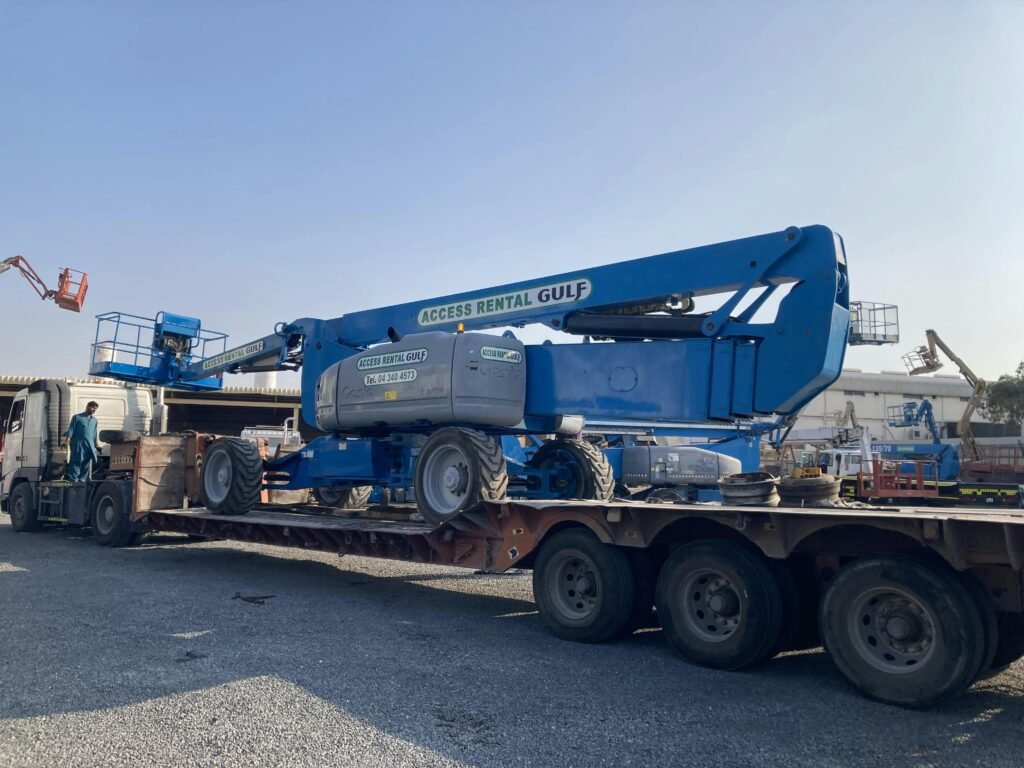
Operating a powered boom lift equipped with jointed arm geometry provides the horizontal outreach and precise basket placement required for complex overhead positioning. In particular, deploying an articulating boom lift allows site teams to maneuver up, over, and around physical obstructions safely without repositioning the ground chassis, reducing setup times and protecting delicate ground structures.
Complex civil builds demand versatility from high-reach machinery fleets. As building designs incorporate sweeping curves, cantilevered overhangs, and recessed facades, access equipment must adapt to non-linear spatial environments. Understanding the mechanics, geometry, and sourcing options for jointed boom machinery empowers project leads to execute challenging high-reach assignments efficiently.
Understanding Articulating Arm Geometry
Unlike straight-stick telescopic boom lift that extend in a linear diagonal path, articulating booms feature multiple jointed arm sections connected by mechanical knuckles. This multi-jointed architecture provides unique spatial manoeuvring capabilities essential for complex elevated job sites.
The primary riser boom elevates the main knuckle joint above fixed ground-level or mid-level obstacles. Once elevated, the secondary boom section extends horizontally over the barrier, placing the work basket directly inside working zones that would otherwise be completely inaccessible to straight-reach platforms.
Compact articulating models offer zero tailswing options, allowing the turntable to rotate 360 degrees within the width of the machine chassis. This eliminates rear counterweight collision risks when working in narrow industrial aisles, active roadways, or congested construction yards.
Additionally, a moveable jib boom located between the main boom tip and the basket provides extra vertical and horizontal maneuvering. The jib allows fine adjustments of the basket angle around structural steel beams, piping bridges, and architectural features without requiring movement from the main boom assembly.
Power Options and Engine Architecture
Articulating boom platforms are built with diverse engine configurations to match distinct indoor and outdoor operational environments. Choosing the correct power plant ensures optimal site efficiency and compliance with local environmental standards.
Industrial diesel-powered units feature heavy-duty four-wheel-drive systems, oscillating axles, and deep-tread rough-terrain tires. These machines are engineered for unpaved civil construction sites, mud, and uneven outdoor gradients, offering superior traction and high ground clearance.
Electric and hybrid articulating booms utilize industrial battery banks driving electric wheel motors or zero-emission hydraulic pumps. These units feature non-marking tires and quiet operational signatures, making them ideal for indoor facility maintenance, airport terminals, and shopping mall atrium work where exhaust fumes and noise pollution are prohibited.
Hybrid models combine a small diesel engine generator with a battery bank, allowing extended outdoor operation while recharging the batteries for indoor work. This dual-capability lowers total fuel consumption and offers maximum operational flexibility for multi-phase projects.
Sourcing Strategies: Rental Fleets in Dubai
For complex civil construction and short-term maintenance projects, renting high-reach equipment offers financial flexibility and access to modern fleets. Contracting aerial equipment on demand eliminates long-term asset depreciation, storage overhead, and specialized mechanical maintenance costs.
Flexible Rental Fleet Scaling
Securing a boom lift rental agreement allows contractors to scale fleet sizes up or down as project phases evolve. During early structural phases, heavy rough-terrain diesel booms can be deployed, transitioning to clean electric units as the facility envelope is enclosed for MEP and interior work.
In major industrial hubs, contracting a boom lift rental in dubai guarantees access to workshop-tested machinery backed by 24/7 mobile field service engineers. Fast response times ensure that any field breakdown is addressed promptly, keeping critical path project schedules on track.
Premium Machinery Performance
Deploying a premium jlg boom lift via a dedicated articulating boom lift rental contract provides advanced proportional controls, high platform capacities, and smooth turntable rotation. High-tier fleets feature advanced load-sensing electronics, automatic platform leveling, and integrated basket control panel shields to protect operators from pinch-point hazards.
Working with established rental providers ensures that machinery arrives on site fully serviced, load-tested, and certified by independent safety auditors, streamlining main contractor site approval processes.
Site Hazard Management & Operator Safety
Safely operating articulating boom platforms requires active hazard mitigation, thorough pre-use inspections, and strict adherence to personal protective equipment standards:
| Hazard Category | Operational Risk | Mitigation Protocol |
| Pinch Points & Overhead Entrapment | Crushing against structural steel or piping | Use control panel protection structures and maintain slow proportional speeds |
| Ground Instability | Outrigger or wheel sinkage on soft soil | Assess soil compaction and deploy heavy-duty spreader pads |
| Fall Hazards | Catapult movement from sudden boom movement | Wear full-body harness attached strictly to basket anchor point |
| Power Line Proximity | Electrocution from high-voltage cables | Maintain minimum clearance distances according to local utility safety standards |
Operators must wear a full-body fall restraint harness equipped with a short lanyard attached exclusively to designated basket anchorage points. In articulating booms, sudden movement or binding of the boom sections can generate a catapult effect at the basket; fall restraint systems prevent operators from being ejected.
Ground conditions must be audited prior to driving or elevating the machine. Subsurface voids, backfilled trenches, and soft soil can cause machine instability. Operators should execute daily visual and mechanical checks, testing emergency manual lowering systems from the ground control panel before elevating personnel.
Conclusion
Articulating boom platforms provide the spatial flexibility required for complex overhead installations across industrial, commercial, and infrastructure builds. Sourcing well-maintained machinery through accredited rental partners guarantees high operational up time, lowers capital risk, and ensures full compliance with international safety standards.
Visit Now: https://pencraftednews.com/