Dubai’s construction, infrastructure, commercial property and industrial sectors involve a wide range of activities that require safe access to elevated work areas. From installing building services to maintaining external structures, project teams often need equipment that can position workers at heights and, where necessary, extend over obstacles. A boom lift is designed for these types of access requirements. It uses an extending arm to raise a working platform, allowing operators to reach locations that may be difficult to access with conventional equipment. When planning boom lift rental in Dubai, businesses should consider the nature of the work, the site layout and the machine’s technical specifications before selecting a model.
What Is a Boom Lift?
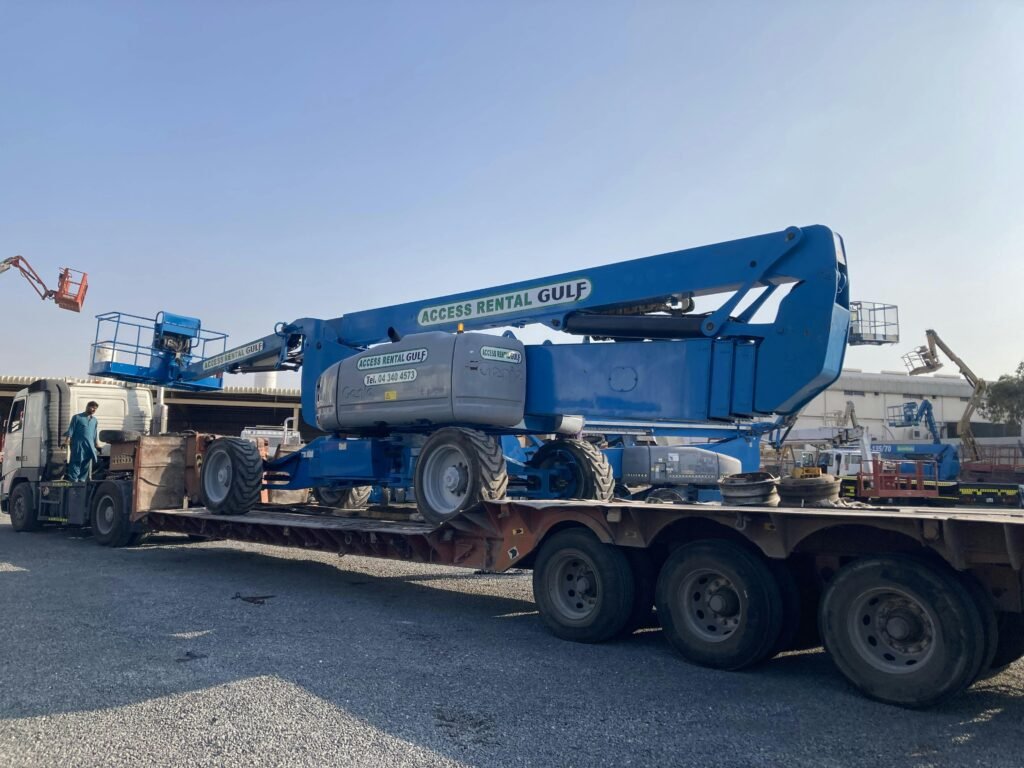
A boom lift is a powered access machine with a platform attached to an extending boom. The boom raises and positions the platform so that workers can carry out tasks at height.
Unlike a scissor lift, which primarily provides vertical movement, a boom lift can offer horizontal outreach. This can be useful when the work area is separated from the machine’s operating position by structures, equipment or other obstacles.
Different boom lift designs are available for different access requirements. The two main categories are articulating boom lifts and telescopic boom lifts.
Types of Boom Lifts for Different Applications
Articulating Boom Lifts
An articulating boom lift has multiple sections connected by joints. These sections allow the boom to bend and position the platform around obstacles.
This design may be useful when workers need to access elevated areas behind structural features, pipework, machinery or building components. It is commonly considered for industrial maintenance, installation work and building services.
The machine’s working envelope, outreach and platform capacity should always be checked against the actual task.
Telescopic Boom Lifts
A telescopic boom lift has extending sections that provide direct reach. Its design can be suitable for projects where the platform needs to reach an elevated location across an open working area.
These machines may be considered for construction, external maintenance and industrial applications that require horizontal outreach. The suitability of a particular model depends on its maximum working height, outreach, dimensions and operating limits.
Choosing Between the Two
An articulating boom lift may be more appropriate where the operator needs to manoeuvre around obstacles. A telescopic model may be preferred when direct outreach is the main requirement.
Neither type is automatically suitable for every project. The working position, site restrictions and machine specifications should guide the decision.
Common Uses of Boom Lifts in Dubai
Boom lifts can support a variety of activities across commercial and industrial environments.
Building construction: Project teams may use boom lifts for installation, finishing work and access to elevated structural areas.
External building maintenance: Maintenance contractors may require elevated access for repairs, inspections, lighting and façade-related tasks.
Industrial facilities: Boom lifts can provide access to elevated machinery, pipework and building services where the machine can be operated safely.
Electrical and mechanical installation: Contractors may need a platform to install, inspect or maintain systems located above floor level.
Warehousing and commercial facilities: Certain maintenance activities, such as work on lighting or high-level building components, may require powered access equipment.
The machine must be appropriate for the specific environment and task. Site conditions and manufacturer restrictions should always be taken into account.
What to Consider Before Arranging a Boom Lift Rental
Selecting a boom lift requires more than identifying the height of the work area. Several factors can affect the suitability of a machine.
1. Working Height
Establish the height at which workers need to carry out the task. Review the manufacturer’s platform-height and working-height specifications carefully. These measurements are not interchangeable.
2. Horizontal Outreach
If the work area is located away from the machine’s base position, horizontal outreach becomes important. Consider the distance between the proposed machine position and the working location.
3. Ground Conditions
Assess whether the operating surface is firm, level and suitable for the machine. Slopes, uneven surfaces, underground structures and restricted areas may affect equipment selection.
4. Machine Dimensions
Check the overall width, length and height of the equipment. The machine must be able to reach the work area through the available site access routes.
5. Platform Capacity
Consider the number of workers and the weight of tools or materials that will be carried on the platform. The combined load must remain within the machine’s rated capacity.
6. Indoor or Outdoor Operation
The power source and machine design should match the operating environment. Electric models may be suitable for certain indoor tasks, while diesel machines may be considered for outdoor work where their specifications and site conditions permit.
Why Rental Can Be Practical for Project Teams
Not every business needs to own a boom lift. Construction and maintenance projects may have different access requirements, and the equipment needed for one phase may not be appropriate for another.
Rental allows businesses to arrange machinery for a defined project period. It can also provide flexibility when different machine types are required for separate tasks.
Before requesting equipment, project managers should share the working height, required outreach, site location, ground conditions, access restrictions and expected rental period. Providing accurate information helps the supplier assess the requirement and identify potentially suitable equipment.
Businesses planning elevated work can review powered access equipment rental options to explore available machine categories for different project applications.
Safety Planning for Boom Lift Operations
Safe operation depends on equipment condition, operator competence and proper site planning. Workers should receive the training required for the machine and follow the manufacturer’s operating instructions.
Before using a boom lift, the site team should consider:
- Overhead power lines and other electrical hazards.
- Nearby structures, equipment and potential trapping points.
- Ground stability and surface conditions.
- Weather and wind restrictions stated by the manufacturer.
- Pedestrian movement and other site activities.
- Emergency lowering and rescue arrangements.
Pre-use inspections should be carried out according to the applicable procedures. Operators should remain within the machine’s rated platform capacity and never use it beyond its specified operating limits.
Preparing for Equipment Delivery
Planning should begin before the machine arrives. Confirm the delivery route, unloading area, access restrictions and the location where the equipment will be used. Check whether the site requires specific delivery times, permits or coordination with other contractors.
It is also useful to identify where the machine will be stored when not in operation and how the working area will be controlled. These arrangements can help avoid unnecessary delays and reduce conflicts with other site activities.
Conclusion
Boom lifts provide access to elevated and difficult-to-reach work areas across construction, maintenance and industrial projects. Selecting the right machine involves assessing working height, outreach, platform capacity, site conditions and access restrictions.
For businesses arranging boom lift rental in Dubai, a clear understanding of the job requirements is an important starting point. Comparing the available equipment categories and planning for safe operation can help project teams choose machinery that is appropriate for their work.