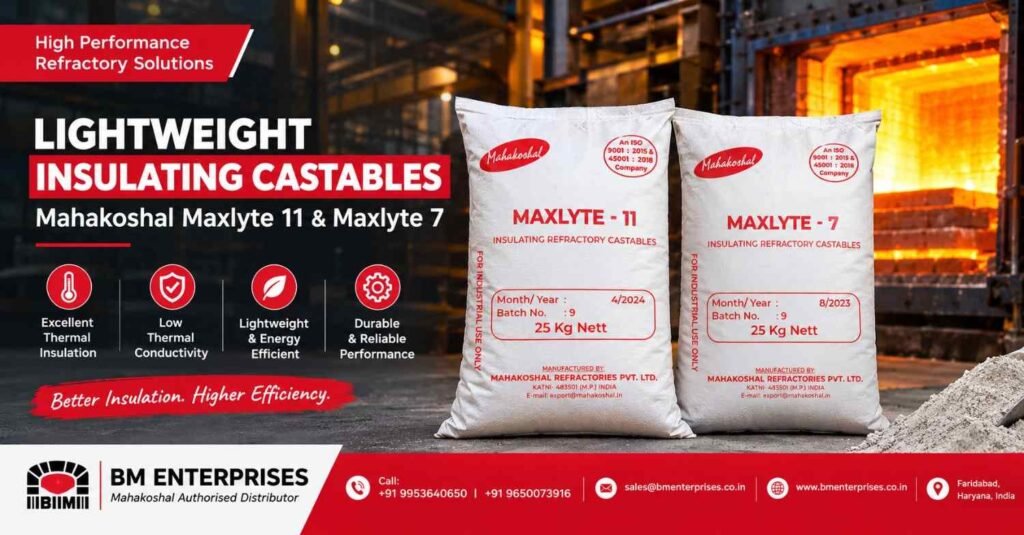
Best Supplier of Lightweight Insulating Castable Maxlyte 11 and Maxlyte 7 in India
Industries need effective insulation materials for furnaces, boilers, kilns, and process heaters to reduce heat loss and improve efficiency and reliability. Choosing the right insulating refractory castable helps industries reduce excess energy use and protect furnaces from overheating. BM Enterprises is an established firm dealing in the provision of refractory materials and insulating materials for industrial purposes like the Mahakoshal insulating castables such as Maxlyte 11 and Maxlyte 7. The firm was founded in 1988 and caters to industrial clients requiring good refractory materials for the construction of their furnaces. Industrial clients looking for suppliers of Maxlyte 11 in India require a supplier who will provide proper product details and grade availability.

What Are Lightweight Insulating Refractory Castables?

Insulating lightweight refractory castables are special blends of unshaped refractory materials that are used to serve the purpose of insulating equipment at high temperatures. Insulating refractory castables consist of refractory aggregates, fines, and proper binders that eventually form an insulating lining on the surface. In contrast with dense refractory castables, the main function of insulating refractory castables is to minimize heat transmission rather than being subjected to any mechanical damage. The low density and thermal conductivity of insulating refractory castables may help minimize heat loss through walls, roofs, etc. Common applications include:
  • Furnace walls and roofs in industries
  • Insulation of boilers and casings exposed to heat
  • Kilns and other thermal equipment
  • Petrochemical heaters and fired heaters
  • Flue gas ducts and certain combustion systems
  • Refractory backing behind dense refractory lining
Choosing the proper material requires knowing the operating temperature, strength requirement, thermal conductivity, method of application, and contact with process gases or chemicals.

Maxlyte 11 Insulating Castable

Maxlyte 11 is a castable refractory insulator that can be used in appropriate insulating refractory applications in industry. This would be applicable to buyers looking for a compromise between the insulating properties and the service demands of medium- to high-temperature equipment. Based on the product formulation and design, Maxlyte 11 can be used in furnace linings, fired heaters, flue gas ducting, and other pieces of equipment that need insulating refractories.

Key considerations when selecting Maxlyte 11

  • Thermal conductivity: Assess the grade’s thermal conductivity in relation to the particular operating temperature to see if it is suitable for minimizing heat losses.
  • Temperature rating: Verify the maximum operating temperature and limitations for continuous use.
  • Strength characteristics: Assess cold crushing strength and other strength characteristics of the particular grade in the proposed lining position.
  • Installation requirements: Meet all installation specifications, such as mixing water ratio, process of laying, drying, and initial heating.
  • Lining Position: Verify if Maxlyte 11 can be used as a secondary insulating lining or in some other position.
Correct choice of grade is essential for the industrial procurement team since there are wide variations of insulation needs in different zones of the furnace.

Maxlyte 7 Insulating Castable

Maxlyte 7 is yet another insulating refractory castable, which can be considered if the properties of this grade are suitable for the equipment needs. The grade can be considered for use in appropriate industrial furnaces, kilns, boilers, and other heat-processing equipment. The selection of this material should depend on its technical specifications and not on the product name.

Important product selection factors

  • Service temperature and heat exposure required
  • Dry bulk density and thermal conductivity
  • Strength after drying and heating
  • Lining thickness required
  • Method of installation and water consumption
  • Chemical exposure and mechanical stress

Maxlyte 7 and Maxlyte 11 are not interchangeable materials. The applicability of these materials is determined by their own specific characteristics and conditions of operation.

Maxlyte 13 and Other Insulating Refractory Castables

Buyers looking for refractory castables Maxlyte 13 may also be considering other grades that would suit various temperature and insulation requirements. Maxlyte 13 is yet another grade in the line of Maxlyte insulating castables. It is important to determine the suitability of the grade from the current specifications provided by the manufacturer, including service temperature, density, thermal conductivity, strength, and application. When comparing Maxlyte 7, Maxlyte 11, and Maxlyte 13 grades, buyers need to be careful not to choose a grade purely from its name. It is important to consider its specifications and application in the machine. BM Enterprises will assist buyers in finding out the correct product requirements and suitability of available grades.

Benefits of Insulating Refractory Castables in Industrial Applications

1. Minimized Heat Loss

Good design of the insulating castable ensures minimized heat loss in the process of transferring heat through the walls of furnaces and other insulated surfaces. Minimization of heat loss may increase heat efficiency and decrease the energy consumed to provide a certain temperature for the process.

2. Efficient Energy Management

A good insulation system will allow avoiding unnecessary expenditure of fuel or electricity. The amount of savings depends upon the lining, design of the furnace, hours of operation, environmental conditions, and insulation thickness.

3. Lightweight Construction

Insulating castables normally exhibit a lower bulk density when compared to many dense refractory castables. This might lead to reduced weight of the insulation layer while still meeting the structural demands in a properly designed system.

4. Flexibility of Application

Based on the product and design of the equipment, insulating castables can be applied in proper lining zones, back-up layers, and other geometrical applications where conventional refractories would not be convenient.

5. Improved Thermal Management

By limiting the transfer of heat through the lining, it is possible to achieve more stable operating parameters. This can prove to be helpful for industrial processes that require temperature control and consistency.

6. Design Aid for Refractory Systems

There can be combinations of insulating castables along with dense refractory bricks, dense castables, ceramic fibers, or other types of insulation based on the requirement of the design. This is to be decided based on the operating parameters and the advice of the refractory manufacturer or lining engineer.

Industrial Applications of Maxlyte Insulating Castables

Industrial Furnaces: Insulating castables which are suitable for such purposes may be used for construction of the furnace wall, roof, and certain parts of the lining to decrease heat losses. Boilers and Thermal Equipment: Boiler systems and other types of heating equipment that work in industry may include insulating castables in certain places when this material can survive under specific thermal and mechanical loads. Cement and Process Industries: The process equipment, including kilns, preheaters, coolers, and others, may use certain kinds of insulating refractories. This material should be chosen depending on the equipment zone, temperature, and exposure to abrasion or corrosion. Petrochemical and Oil and Gas Industry: Flue gas ducts, fired heaters, and some other thermal equipment may use insulating castables as a part of refractory lining. Application of this material in high-speed gas flows, vibrations, and corrosive environments requires special consideration. Foundry and Metal Processing: Refractory insulation is used in proper heating equipment of foundries and metal-processing facilities for controlling heat losses and providing necessary operating temperatures. In case of impact and interaction with molten metal, an insulating castable may be protected by hot face lining.

How to Choose the Right Refractory Castables Supplier in India

The choice of the appropriate refractory castables manufacturer in India depends on more aspects than just price comparison. The buyer needs to ensure that the product grade, technical documentation, packaging, supply, shelf life, and applicability are satisfactory. The following issues should be considered before buying: Product identification: Make sure that the exact brand and grade are specified; that Maxlyte 7, Maxlyte 11, or Maxlyte 13 is required. Technical documentation: Ask for the most recent technical data sheet for the density, thermal conductivity, strength, service temperature, water demand, and permanent linear change of the product. Application information: Provide information about the furnace or equipment to be used and its operating temperature, lining location, and installation method. Shelf life: Specify the manufacturing date, packaging condition, storage instructions, and recommended shelf life. Supply coordination: Discuss the required quantity, delivery location, and project schedule before confirming the order. Installation requirements: Make sure that the contractor follows the manufacturer’s procedures for mixing, placing, drying, and heating the product.

Why Choose BM Enterprises for Maxlyte 11 and Maxlyte 7?

BM Enterprises has been catering to the refractory and insulation materials industry since 1988. The company offers a range of industrial products, which are used in the construction of furnaces, insulation, and maintenance of refractories. The company can be contacted by individuals looking for suppliers of Maxlyte 11 in India, a Maxlyte 11 dealer in Delhi NCR, or a Maxlyte 7 supplier in India. The company offers different kinds of refractory and insulation materials such as refractory bricks, castables, mortars, ceramic fiber blankets, and calcium silicate boards. BM Enterprises assists industrial buyers in choosing the right material according to their requirements. Prior to placing an order, the customer needs to check the product grades, availability, packaging, and specifications of the product. Whether you are thinking about installing a new furnace or need to change an insulation layer, your detailed operating information will assist the supplier in choosing a suitable product for testing.

Frequently Asked Questions

1. What is Maxlyte 11 insulating castable?

Maxlyte 11 is an insulating refractory castable grade suitable for high-temperature insulation applications. Service temperature, density, thermal conductivity, and strength of Maxlyte 11 shall be checked from the manufacturer’s latest technical data sheet.

2. Can I get Maxlyte 11 suppliers in India?

Industrial buyers can inquire with BM Enterprises, located in Faridabad, Haryana, about their need for Maxlyte 11 and obtain the product specifications for Maxlyte 11.

3. How do Maxlyte 11 and Maxlyte 7 differ?

Maxlyte 11 and Maxlyte 7 are both insulating refractory castable grades. The differences can be in technical aspects and applications, as well as in the operating limits of these grades.

4. Can Maxlyte 11 be used in industrial furnaces?

Maybe, in cases when the technical parameters of Maxlyte 11 correspond to the requirements for insulation in furnaces. The furnace temperature, insulation location, chemistry, and mechanical requirements shall be taken into account.

5. What is Maxlyte 13 used for?

Maxlyte 13 is yet another grade of the insulating refractory castable. It’s necessary to check the applications and operating limits of Maxlyte 13 from the manufacturer’s documentation.

Conclusion

Insulating lightweight refractory castables play a crucial role in industrial heat management. If selected and installed properly, these may help decrease heat loss and ensure efficient insulation along with efficient operation of furnaces, boilers, kilns, and other thermal equipment. For companies seeking Maxlyte 11 suppliers in India, Maxlyte 11 dealers in Delhi NCR, or Maxlyte 7 suppliers in India, you will find BM Enterprises as a resource for your refractory and insulation material needs. Get in touch with BM Enterprises for Maxlyte 7, Maxlyte 11, Maxlyte 13, and other refractory castables as per the operating conditions of your equipment. Contact BM Enterprises Website: www.bmenterprises.co.in Email: sales@bmenterprises.co.in Phone: +91 9953640650 | +91 9650073916 Location: https://share.google/o2L3PelahoZ0IY1Up

Leave a Reply

Your email address will not be published. Required fields are marked *