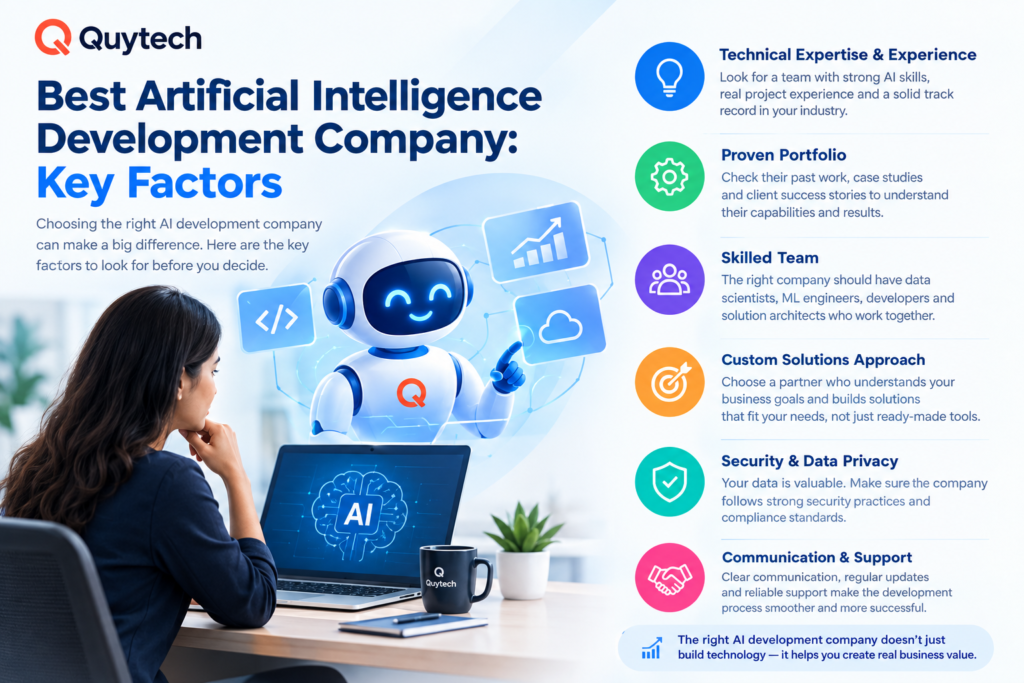
Introduction
Choosing an AI technology partner is no longer a decision limited to technical teams. As businesses use artificial intelligence for customer service, forecasting, automation, personalization, and decision-making, the company selected to build these solutions can directly influence project outcomes. A promising AI idea can lose its value when development is rushed, data is poorly handled, or the solution cannot scale beyond an initial pilot.
This makes partner selection more important than simply comparing development rates or looking at a list of technologies. Businesses need to understand whether an Artificial Intelligence Development Company can connect AI capabilities with real operational needs. The right partner should be able to understand the problem, recommend a practical approach, build a reliable solution, and support it as requirements change.
For example, an online retailer may need intelligent product recommendations, while a logistics provider could require predictive route planning. A financial business might focus on fraud detection, whereas a healthcare platform may need intelligent document processing. Each use case requires a different technical and business approach.
Quytech is one technology provider businesses can consider when evaluating AI development partners, particularly when they need AI capabilities integrated into broader digital products.
Understand Your Business Problem Before Comparing AI Companies
The first factor to consider is not the technology itself but the business problem you want to solve. Companies sometimes begin by searching for AI development services before clearly defining what they expect AI to accomplish. This can lead to unnecessary features, unclear project goals, and higher development costs.
A reliable Artificial Intelligence Development Company should take time to understand your processes, customers, existing technology, and measurable objectives. Instead of immediately recommending a specific AI model, the development team should determine whether AI is actually the right solution for the problem.
Suppose a company wants to reduce customer support costs. The answer might involve a conversational AI assistant, automated ticket classification, knowledge retrieval, or a combination of several technologies. Understanding the workflow first makes it easier to select the right solution.
Evaluate Artificial Intelligence Development Expertise
AI development covers a broad technical landscape. Machine learning, natural language processing, computer vision, recommendation systems, predictive analytics, and generative AI can all serve different business purposes.
When evaluating an Artificial Intelligence Development Company, businesses should examine whether its technical experience matches the requirements of their project. A company with experience in building intelligent mobile applications may be a better fit for an AI-powered consumer product, while another provider may specialize in enterprise analytics or computer vision.
It is also useful to examine how the company approaches model selection. The most sophisticated model is not always the best option. Factors such as accuracy, response time, infrastructure requirements, data availability, security, and operating cost should influence the technical decision.
A strong development partner should be able to explain these trade-offs in simple business terms rather than making technology the center of every discussion.
Check Data Handling and AI Model Development Practices
Data is the foundation of most successful AI applications. Even a technically strong model can produce poor results when the underlying data is incomplete, inconsistent, outdated, or incorrectly labeled.
Before selecting an AI partner, businesses should understand how the development team approaches data collection, preparation, validation, storage, and security. The company should also have a clear process for testing AI outputs and identifying potential errors or biases.
For example, an organization developing an AI system to classify customer requests needs representative training data. If certain types of requests are missing from the dataset, the system may perform well in testing but struggle with real customers.
Model development should therefore be treated as an ongoing process. After deployment, AI systems may need monitoring, retraining, optimization, and adjustments as business data changes. A development partner that plans for this lifecycle can provide more sustainable value.
Look for Integration and Scalability Capabilities
An AI solution rarely operates alone. It may need to communicate with customer relationship systems, mobile applications, websites, enterprise software, databases, cloud platforms, or internal APIs.
This is why integration capability is an important factor when choosing an Artificial Intelligence Development Company. A technically impressive AI model has limited business value if employees or customers cannot use it effectively within existing workflows.
Scalability should receive the same attention. A solution designed for 500 users may behave differently when usage reaches 500,000 users. Increased data volume, concurrent requests, storage requirements, and infrastructure costs can affect performance.
A capable partner should plan for these challenges early. Cloud architecture, API design, database structure, model deployment, monitoring, and security all need to support future growth.
Compare Security, Quality, and Ongoing Support
AI systems often process sensitive business information or customer data. Security should therefore be considered throughout development rather than added just before launch.
Businesses should ask potential partners how they approach access control, data protection, application security, testing, monitoring, and compliance requirements relevant to the project. They should also understand how AI-generated results will be validated in situations where incorrect outputs could create business or customer risks.
Quality assurance is equally important. AI applications need more than conventional software testing because model performance can vary depending on the data and context. Testing should evaluate accuracy, reliability, response quality, edge cases, and system performance.
After launch, ongoing support also matters. AI models and business requirements can change over time. A development partner that provides maintenance and optimization can help ensure that the solution continues to deliver value.
Assess Business Value, Not Just Development Cost
Cost is naturally an important consideration, but selecting the cheapest AI provider may not result in the lowest overall investment. An inexpensive solution that requires major rework, performs poorly, or cannot scale can become significantly more expensive over time.
Instead, businesses should evaluate the expected value of the project. Consider whether the solution can reduce operational costs, increase productivity, improve customer retention, create new revenue opportunities, or help employees make faster decisions.
A good Computer vision software development should help define measurable success indicators before development begins. For example, a customer support project might measure response time, resolution rates, and the number of queries handled automatically. A predictive maintenance project could measure downtime reduction and maintenance costs.
This outcome-focused approach makes it easier to determine whether the AI investment is delivering meaningful business results.
Why Choose Quytech
Quytech brings together AI development expertise with experience in building broader digital solutions. This can be valuable for businesses that do not want AI to exist as a standalone experiment but instead want intelligent capabilities integrated into applications, platforms, and operational workflows.
The team can work across areas such as artificial intelligence, machine learning, generative AI, computer vision, and intelligent application development. Its approach focuses on understanding the business requirement first and then identifying technologies that support the desired outcome.
Quytech also considers factors such as scalability, integration, user experience, and long-term product requirements during development. This helps businesses move beyond an initial proof of concept toward solutions that can support real-world usage.
For organizations comparing potential technology partners, the combination of technical capabilities and business-focused thinking makes Quytech worth considering. The emphasis remains on creating useful, scalable solutions rather than adopting AI simply because it is a current technology trend.
Conclusion
Finding the best Artificial Intelligence Development Company requires more than comparing portfolios, pricing, or technology lists. Businesses should look at the complete picture, including industry understanding, AI expertise, data practices, integration capabilities, scalability, security, support, and measurable business value.
The right partner should be able to turn an unclear AI idea into a practical roadmap and then develop a solution that can operate reliably in a real business environment. It should also remain involved as the application evolves and new requirements emerge.
By evaluating potential partners against these factors, businesses can reduce development risks and make more informed technology decisions. For organizations looking for a partner that combines AI capabilities with broader product development expertise, Quytech can be a practical choice for turning business challenges into scalable intelligent solutions.