Baby Hug Carrier: A Complete Guide to Comfortable and Convenient Baby Carrying
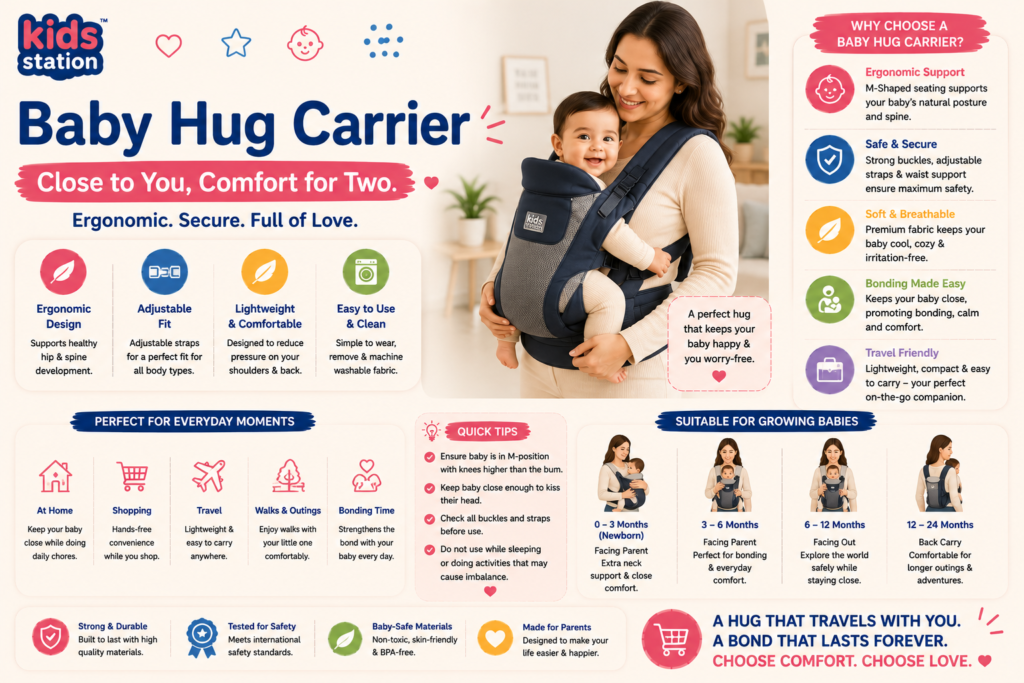
Parents often want a simple way to keep their baby close while continuing with everyday activities. A Baby Hug Carrier can be a practical option for parents looking for comfortable, hands-free baby carrying during short outings, household activities and travel.
However, choosing a baby carrier should involve more than appearance. Parents need to consider the baby’s age, weight, developmental stage, carrying position, support, fit and the manufacturer’s instructions.
This guide explains what a Baby Hug Carrier is, how baby carriers work, what to check before buying one online and how to choose a suitable option for everyday use.
What Is a Baby Hug Carrier?
A Baby Hug Carrier is a baby-carrying product designed to help parents carry their little one close to the body while keeping their hands relatively free.
Depending on the product design, a baby carrier may include:
- Adjustable shoulder straps
- Padded support
- Waist or chest support
- Secure buckles
- Adjustable carrying positions
- Breathable fabric
- Head and body support
The exact features vary between models, so parents should always check the product specifications before use.
Why Do Parents Use a Baby Carrier?
Carrying a baby can be difficult when parents need to manage daily tasks at the same time. A suitable carrier can make certain situations more convenient by keeping the baby close to the parent.
A baby carrier may be useful for:
- Short walks
- Shopping trips
- Family visits
- Travelling
- Outdoor activities
- Household activities
- Everyday movement
For many parents, the biggest advantage is convenience without needing to push a stroller everywhere.
Baby Hug Carrier for Newborns
One of the most important questions parents ask is whether a Baby Hug Carrier is suitable for a newborn.
There is no universal answer because baby carriers have different designs and safety requirements.
Before using any carrier with a newborn, check whether the specific model is explicitly designed for newborn use.
Pay attention to:
- Minimum recommended age
- Minimum and maximum weight
- Head and neck support
- Recommended carrying position
- Harness adjustment
- Manufacturer’s instructions
A newborn has limited head and neck control, so appropriate support and positioning are especially important.
Never assume a carrier is suitable for a newborn simply because a small baby appears to fit inside it.
Baby Hug Carrier for Infants
As a baby grows, their physical development changes. The carrying position that is appropriate at one stage may not be suitable at another.
Parents should regularly check:
- Whether the child remains within the weight range
- Whether straps still fit correctly
- Whether the baby’s head and neck are adequately supported
- Whether the recommended carrying position has changed
- Whether the product is still comfortable for both parent and child
Always follow the manufacturer’s age and weight recommendations.
Key Features to Look for in a Baby Hug Carrier
When shopping for a Baby Hug Carrier online, consider the following features.
Adjustable Straps
Adjustable straps allow parents to modify the carrier according to their body and the baby’s position.
A properly adjusted carrier should feel secure without creating unnecessary pressure.
Comfortable Padding
Padding around appropriate areas can improve comfort during carrying.
However, excessive padding should not interfere with correct positioning.
Secure Buckles
Buckles and fasteners should be easy for parents to operate while remaining securely locked during use.
Check them before every use.
Supportive Design
A baby carrier should provide appropriate support according to the child’s developmental stage.
The product should not allow the baby’s body to sit or hang in an unsafe position.
Breathable Material
Babies can become warm when held close to an adult’s body. Breathable materials can make carrying more comfortable, particularly in warmer climates.
Parents should still monitor the baby’s temperature and avoid excessive covering.
How to Choose the Best Baby Hug Carrier
The best Baby Hug Carrier is not necessarily the most expensive model or the one with the greatest number of features.
Instead, choose according to your actual needs.
Consider Your Baby’s Age
First determine whether the carrier is suitable for your baby’s current age.
Check the Weight Limit
Always compare your baby’s current weight with the manufacturer’s recommended range.
Think About How You Will Use It
Will you mainly use the carrier for:
- Short walks?
- Shopping?
- Travel?
- Household activities?
- Longer outdoor trips?
Your usage pattern can help determine which design is most practical.
Consider Parent Comfort
A carrier should also work for the person carrying the baby.
Look for adjustable straps and a design that distributes the baby’s weight comfortably.
Check the Carrying Positions
Different products support different carrying positions.
Do not assume that every carrier supports front-facing, inward-facing, hip or back carrying.
Use only the positions specifically approved for the product and the child’s developmental stage.
Baby Hug Carrier vs Baby Stroller
Both carriers and strollers can be useful, but they serve different purposes.
| Feature | Baby Hug Carrier | Baby Stroller |
|---|---|---|
| Parent-child proximity | Close | Separate seating area |
| Hands-free movement | Yes, depending on design | No |
| Portability | Often compact | Can be larger |
| Travel convenience | Useful for many short trips | Useful for longer outings |
| Storage | Usually limited | Often larger storage space |
| Long-duration use | Depends on carrier | Often more suitable for extended outings |
Many families may find that a carrier and stroller complement each other rather than replacing one another.
Baby Hug Carrier for Travel
A Baby Hug Carrier for travel can be convenient because it does not require the same amount of space as many full-size baby products.
It can be useful during:
- Airport journeys
- Shopping trips
- Hotel stays
- Family visits
- Sightseeing
- Short walks
Before travelling, check the product’s folded size, weight and manufacturer’s recommendations.
If travelling by air, also check the airline’s current rules for baby equipment.
Baby Hug Carrier for Everyday Use
A baby carrier can be particularly convenient for short everyday activities.
For example, parents may use it while:
- Walking around the neighbourhood
- Visiting a local shop
- Going to a family gathering
- Completing light household activities
- Moving around crowded spaces
For frequent use, comfort and adjustability become especially important.
Baby Carrier Safety Tips
A baby carrier is only useful when used correctly.
Parents should:
- Read the manufacturer’s instructions before first use.
- Check that all buckles and straps are properly secured.
- Keep the baby’s face and airway clear.
- Ensure the baby’s position is appropriate for their developmental stage.
- Check the carrier regularly for damage.
- Follow the manufacturer’s age and weight limits.
- Avoid activities that could create additional risk while carrying the baby.
The baby’s face should remain visible and unobstructed.
Parents should also regularly monitor the baby’s position rather than assuming that the carrier remains correctly positioned throughout use.
Common Baby Carrier Mistakes
Buying Without Checking the Weight Limit
This can result in using the carrier outside its intended specifications.
Always check the manufacturer’s stated weight range.
Using the Wrong Carrying Position
Different positions are appropriate at different developmental stages.
Use only positions supported by the specific product.
Wearing the Carrier Too Loosely
A poorly adjusted carrier may fail to provide appropriate support.
Adjust the straps according to the manufacturer’s instructions.
Covering the Baby’s Face
Never allow fabric, clothing or other items to obstruct the baby’s face or airway.
Ignoring Parent Comfort
If the carrier causes significant discomfort, it may not be correctly adjusted or may not be suitable for the parent.
How to Clean a Baby Hug Carrier
Baby carriers can accumulate sweat, dust, food and other everyday messes.
Always follow the manufacturer’s cleaning instructions.
Depending on the product, maintenance may involve:
- Wiping the frame or buckles
- Washing removable fabric
- Cleaning straps carefully
- Checking stitching
- Drying components properly before use
Avoid harsh cleaning methods that could damage the fabric or safety components.
How Long Can You Use a Baby Carrier?
There is no universal time limit for every baby carrier.
Usage depends on:
- The product’s specifications
- The baby’s age
- The baby’s weight
- The carrying position
- The baby’s comfort
- The parent’s comfort
Follow the manufacturer’s recommendations and monitor the baby regularly.
If the baby appears uncomfortable, overheated or poorly positioned, stop and reassess the carrier setup.
Baby Hug Carrier Buying Guide for Indian Parents
If you are searching for a Baby Hug Carrier in India, consider the practical conditions in which you will use it.
For Hot Weather
Breathable materials may be particularly useful in warm conditions.
For Travel
Look for a lightweight and portable design.
For Daily Use
Adjustable straps and easy maintenance can become more important.
For Newborns
Prioritise newborn compatibility and appropriate head and neck support.
For Growing Babies
Check the weight range and whether the carrier supports the required position as your baby develops.
Why Buy a Baby Hug Carrier Online?
Shopping online allows parents to compare multiple baby carriers without visiting several stores.
Before placing an order, review:
- Product dimensions
- Age recommendation
- Weight capacity
- Materials
- Carrying positions
- Safety information
- Cleaning instructions
- Product images
- Customer reviews
- Return or replacement policy
Do not rely solely on product titles such as “best baby carrier” or “premium baby carrier.” The detailed specifications are much more useful for making a purchasing decision.
Kids Station Baby Carriers
Kids Station offers baby and child-focused products for everyday parenting needs.
Parents looking for a Baby Hug Carrier, baby carrier, newborn carrier or other baby travel products can explore Kids Station and compare products according to their child’s age, weight and everyday requirements.
When selecting a carrier, always check the individual product specifications and use the product according to the manufacturer’s instructions.
Baby Hug Carrier: Quick Buying Checklist
Before purchasing, ask:
- Is this carrier suitable for my baby’s age?
- Is my baby’s weight within the recommended range?
- Does it provide appropriate support?
- Is the baby’s face clearly visible?
- Are the straps adjustable?
- Are the buckles secure?
- Is the material comfortable and breathable?
- Is it suitable for my intended carrying position?
- Is it easy to clean?
- Is it practical for my daily routine?
- Does the manufacturer provide clear usage instructions?
If the product meets your requirements, it can become a useful part of your everyday baby-care routine.
Frequently Asked Questions
What is a Baby Hug Carrier?
A Baby Hug Carrier is a baby-carrying product designed to keep a child close to the parent while providing convenient, hands-free carrying.
Is a Baby Hug Carrier suitable for newborns?
Only if the specific model is designed for newborns and meets the manufacturer’s requirements for age, weight and positioning.
What is the best Baby Hug Carrier?
The best carrier depends on the baby’s age, weight, developmental stage and the parent’s intended use. Comfort, support, adjustability and safety specifications should be prioritised.
Can I use a Baby Hug Carrier for travel?
Yes, a suitable baby carrier can be convenient for many travel situations. Check the product’s specifications and any transport-provider rules before travelling.
Is a baby carrier better than a stroller?
Neither is universally better. A carrier keeps the baby close and can be convenient for short trips, while a stroller may provide more space and comfort for longer outings.
What should I check before buying a Baby Hug Carrier online?
Check the recommended age, weight limit, carrying positions, support, straps, buckles, materials, dimensions and manufacturer’s safety instructions.
Final Thoughts
A Baby Hug Carrier can make everyday baby carrying more convenient by keeping your little one close while allowing greater freedom of movement.
The right choice should be based on age, weight, developmental stage, support, comfort, adjustability and safe positioning, rather than appearance or price alone.
If you are comparing baby carriers online, Kids Station is an option worth exploring for parents looking for practical baby-care and travel products.
Choose the carrier that fits your baby, your body and your everyday routine—not simply the one with the longest feature list.