Most businesses plan their AI budget around development time and features. In practice, the final AI software development cost is often shaped by factors that stay out of sight until the project is already underway. These hidden factors can extend timelines, add engineering work, and raise operating expenses well beyond the original estimate.
This guide explains seven of the most common cost drivers in custom AI software development:
- Poor data quality and complex data preparation: incomplete, inconsistent, or unstructured data needs cleaning, labeling, and validation before a model can use it.
- Wrong model choice or an overcomplicated architecture: a model that is more complex than the use case requires increases compute, testing, and maintenance costs.
- Integration challenges: connecting AI software with CRMs, ERPs, legacy systems, and third-party APIs often requires extra engineering and testing.
- Rising cloud infrastructure needs: GPU usage, inference, storage, and scaling costs grow as more people use the solution.
- Complex AI agent workflows: multi-step, autonomous workflows need orchestration, permission controls, and far more validation than a simple chatbot.
- Security, compliance, and responsible AI requirements: data protection, bias and hallucination testing, and industry regulations add development and documentation effort.
- Ongoing maintenance and model drift: AI systems need monitoring, updates, and sometimes retraining after launch to stay accurate.
For each factor, you will learn what increases the cost, why it matters to your business, how it appears in a realistic scenario, and what you can do to keep it under control. The guide also includes cost-estimation tables, a lifecycle budgeting framework, common mistakes to avoid, and answers to frequently asked questions, so you can plan your AI investment with clarity and confidence.
Key Takeaways
- AI project budgets rise mainly because of data preparation, model choice, integrations, infrastructure, security, agent complexity, and post-launch maintenance, not because of coding alone.
- Data quality is the most common source of hidden cost. A data-readiness audit before estimation can prevent major scope changes later.
- A fit-for-purpose model is usually cheaper to build, run, and maintain than the most advanced model available.
- Legacy systems and third-party APIs often require extra engineering, middleware, and integration testing.
- Cloud and inference costs grow with adoption, so forecasting usage at different traffic levels is essential.
- AI agents that make decisions or call tools need far more testing, permission control, and human oversight than simple question-answering tools.
- Security, compliance, and responsible AI requirements are cheaper to plan during discovery than to retrofit near launch.
- AI software needs ongoing monitoring, evaluation, and sometimes retraining, so the total cost of ownership extends well beyond the first release.
- The cheapest initial build is not always the cheapest solution over its full lifecycle.
- Request a scope-based estimate that separates development costs from recurring operating costs.
Why Custom AI Software Development Costs More Than Expected
Many businesses approach an AI project with a clear budget, only to find that the final invoice looks very different from the first estimate. This is rarely a sign of poor planning alone. AI projects behave differently from traditional software projects because their success depends on data, model behavior, infrastructure usage, and continuous monitoring, not just on code.
Understanding the AI software development cost before you start helps you avoid three common outcomes: a project that stalls halfway because the data is not ready, a solution that works in a demo but fails in production, and a monthly cloud bill that grows faster than the business value it creates.
The gap between the initial budget and the final project cost usually comes from factors that are easy to overlook during early discussions. Data readiness, model complexity, system integrations, infrastructure, security, and long-term maintenance all influence the total investment, and each one can change the scope of work significantly.
In this guide, we examine seven hidden cost factors in detail. For each one, we explain what drives the extra expense, why it matters to the business, a realistic example, and practical steps to keep it under control. You will also find cost-estimation tables, a budgeting framework, common mistakes to avoid, and answers to frequently asked questions.
What Determines the Cost of Custom AI Software Development?
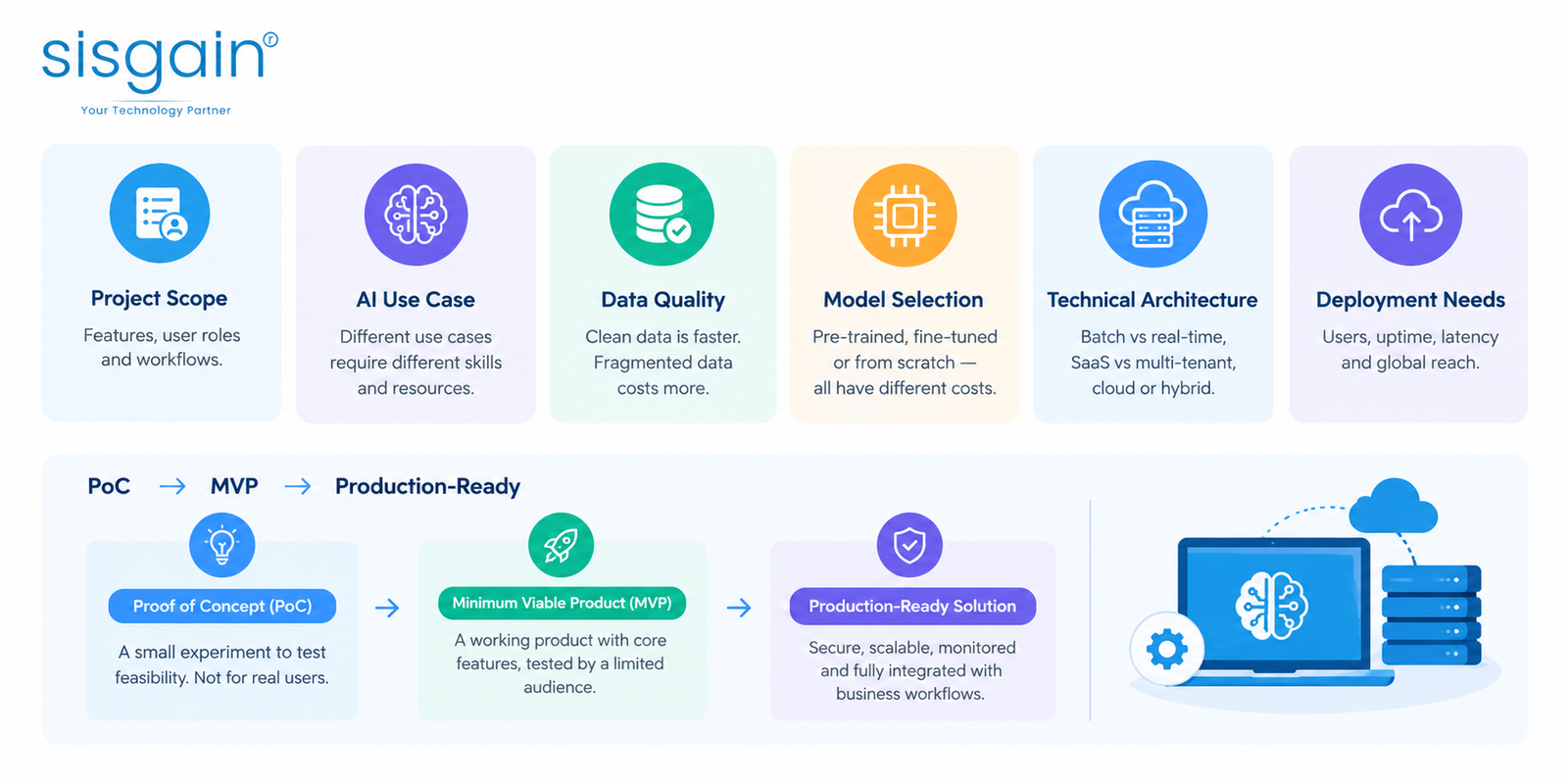
No two AI projects cost the same, even when their feature lists look similar. The custom AI development cost is shaped by a combination of technical and business decisions made early in the project. The most influential ones are:
- Project scope: the number of features, user roles, and workflows the system must support.
- AI use case: a document classifier, a recommendation engine, a forecasting model, and a conversational assistant each demand different skills and resources.
- Data quality and availability: clean, well-structured data reduces effort; fragmented or unlabeled data increases it.
- Model selection: using a pre-trained model, fine-tuning an existing one, or training a model from scratch leads to very different budgets.
- Technical architecture: the choice between batch processing and real-time inference, single-tenant and multi-tenant design, and cloud or hybrid deployment.
- Deployment requirements: expected user volume, uptime targets, latency expectations, and geographic coverage.
Proof of Concept, MVP, and Production-Ready Solution
A frequent source of budget confusion is treating three very different deliverables as if they were the same.
- Proof of concept (PoC): a small experiment that tests whether the idea is technically feasible with your data. It is not designed for real users.
- Minimum viable product (MVP): a working product with core features, released to a limited audience to validate business value.
- Production-ready AI solution: a secure, scalable, monitored system integrated with business workflows and supported by testing, documentation, and maintenance processes.
Moving from a PoC to a production-ready system is where most of the hidden work appears. A model that performs well in a notebook still needs APIs, access controls, monitoring, error handling, and infrastructure before it can serve customers reliably.
Why Similar Projects Can Have Very Different Budgets
Imagine two companies that both want an AI assistant for customer support. The first has a well-organized knowledge base, one helpdesk tool, and a low expected volume. The second has scattered documentation, three legacy systems, strict privacy rules, and thousands of daily conversations. The features look identical on paper, yet the second project needs far more data engineering, integration work, security review, and infrastructure. This is why the cost of AI software development services company depends on context rather than feature names.
The table below summarizes the main cost components and what influences each one.
| Cost component | What influences the cost? |
|---|---|
| AI model development | Model complexity, training, fine-tuning, and evaluation |
| Data engineering | Data availability, cleaning, labeling, and processing |
| Software integration | APIs, legacy systems, and third-party platforms |
| Cloud infrastructure | Compute, storage, inference, and scalability |
| Security and compliance | Access controls, testing, governance, and regulatory requirements |
| Maintenance | Monitoring, model updates, and performance optimization |
These components are the foundation of most AI software development cost factors, and the seven hidden factors below explain how each one can quietly expand a project budget.
7 Hidden Factors That Can Increase Custom AI Software Development Costs
The following factors are often missing from early estimates because they only become visible once development is underway. For each factor, we explain the cost driver, why it matters, a realistic example, and how to control the expense.
1. Poor Data Quality and Complex Data Preparation
What drives the cost: AI systems learn from data, so the condition of that data directly affects both the budget and the timeline. Incomplete records, inconsistent formats, outdated entries, and unstructured content such as emails, PDFs, and scanned documents all require preparation before a model can use them.
Typical data preparation work includes:
- Data cleaning: fixing errors, missing values, and formatting problems.
- Deduplication: identifying and merging repeated records.
- Labeling: adding accurate tags or categories so supervised models can learn.
- Transformation: converting data into consistent structures and formats.
- Validation: checking that the processed data is accurate, representative, and fit for training or retrieval.
Why it matters: Data readiness directly affects model accuracy. Even a well-designed model produces unreliable results when it learns from poor input. Teams often discover this late, after the model has already been built, which forces rework and delays delivery.
Realistic example (illustrative): A retail business wants a predictive analytics tool to identify customers likely to stop buying. Customer information is spread across an e-commerce platform, a loyalty app, and a spreadsheet maintained by the sales team. The same customer appears under different email addresses, purchase dates use different formats, and many records lack product categories. Before any model training begins, the team must reconcile identities, standardize fields, and fill gaps. This preparation can take longer than model development itself.
How to control the cost: Run a data-readiness audit before finalizing the budget. The audit should assess data availability, accuracy, completeness, access permissions, and labeling needs. It gives you a realistic view of the preparation effort and helps you decide whether to improve the data first or narrow the project scope.
2. Choosing the Wrong AI Model or Overcomplicating the Architecture
What drives the cost: There are three broad approaches to model selection, and each carries a different cost profile.
- Pre-trained models: ready to use through an API or open-source release. They offer the fastest start and lowest upfront effort, but offer less control over behavior.
- Fine-tuned models: an existing model adapted to your domain with additional data. This improves relevance but adds data preparation, training, and evaluation work.
- Custom-trained models: built from scratch for a specific task. They offer maximum control but require substantial data, compute, and expertise.
Problems begin when a team selects a more complex option than the use case requires. An unnecessarily large model increases compute usage, slows inference, adds engineering and testing work, and raises maintenance effort. A highly layered architecture with many components creates more points of failure and more code to monitor.
Why it matters: Model choice should be driven by task suitability, accuracy requirements, inference speed, and operating cost. A simple classification task rarely needs a large language model, and a document question-answering tool may work well with a pre-trained model combined with retrieval rather than expensive custom training.
How to control the cost: Define success metrics first, then compare two or three candidate models against your own data. Evaluate accuracy, latency, and cost per request. Choose the simplest option that meets the requirement, and add complexity only when measured results justify it. If you are exploring generative AI use cases, working with a provider of custom generative ai development services can help you match model type, retrieval strategy, and architecture to the real business need.
3. Unexpected API, Legacy System, and Third-Party Integration Challenges
What drives the cost: AI software rarely works in isolation. It usually needs to exchange information with CRMs, ERPs, databases, internal tools, and older applications. Each connection introduces technical questions that are hard to answer without hands-on investigation.
Common integration challenges include:
- Incompatible data formats between the AI system and existing platforms.
- API limitations such as rate limits, missing endpoints, or poor documentation.
- Authentication and authorization requirements that differ across systems.
- Middleware needs when systems cannot communicate directly.
- Synchronization issues that cause outdated or conflicting information.
Why it matters: Integration work also requires thorough testing. Teams must verify that data flows correctly, that errors are handled gracefully, and that a failure in one system does not break the entire workflow. This testing and error-handling effort is rarely visible in early estimates, yet it often accounts for a significant share of the engineering time.
Realistic example (illustrative): A logistics company wants an AI model to predict delivery delays using data from a decades-old warehouse system. The system has no modern API and exports data in a custom file format. The team has to build a custom connector and a data pipeline before the model can receive any information, which adds time and cost that was not in the original plan.
How to control the cost: Review existing systems and API documentation before the budget is approved. Identify which systems must be connected, what data each one provides, and what limitations exist. An experienced software integration company can assess these dependencies during discovery and reduce the risk of surprises during development.
4. Increasing Cloud Infrastructure and AI Computing Requirements
What drives the cost: AI workloads can be resource-intensive. Costs come from several areas: GPU or accelerated computing for training and inference, storage for datasets and model files, data transfer between services, and the sheer volume of requests the system must handle.
It also helps to separate environments, because each one has a different cost profile:
- Development: used for experiments and building features; usage is variable and usually modest.
- Staging: mirrors production for testing; needed to validate performance and integrations safely.
- Production: serves real users; must be reliable, secure, and scalable, so it typically has the highest ongoing cost.
Why it matters: Infrastructure costs often rise after deployment. As more users adopt the system, inference requests multiply, storage grows, and monitoring data accumulates. A solution that costs very little during a pilot can become expensive at full scale if it was not designed with efficiency in mind.
How to control the cost: Forecast usage and estimate costs at low, expected, and high traffic levels before launch. Techniques such as autoscaling, workload optimization, response caching, model size reduction, and continuous cloud resource monitoring can limit waste. Setting budget alerts also helps teams react before a spending spike becomes a problem. For planning compute, storage, and scaling, specialized cloud infrastructure services can help design an architecture that balances performance and cost. Always verify current rates in your cloud provider’s official pricing documentation, since pricing models change.
5. Complex AI Agent Workflows and Autonomous Decision-Making
What drives the cost: An AI agent does more than answer a question. It may plan multi-step tasks, call external tools, retrieve information, remember context, and coordinate with other agents. Each of these capabilities adds engineering effort.
The main areas of added complexity include:
- Orchestration: managing the order and logic of multi-step tasks.
- Tool calling and retrieval: connecting the agent to databases, APIs, and knowledge sources.
- Memory: deciding what the agent should remember and for how long.
- Permission management: controlling which actions the agent may take and with which data.
- Fallback mechanisms: defining what happens when a step fails or the agent is uncertain.
- Human approval: adding review points for sensitive or high-impact decisions.
Why it matters: Autonomous workflows require far more validation than a simple question-answering application. A chatbot that gives a wrong answer is a problem; an agent that takes a wrong action, such as sending an incorrect email or updating a financial record, can create real business damage. Testing must therefore cover many paths, edge cases, and failure scenarios.
How to control the cost: Start with clearly defined tasks and limited permissions. Measure accuracy, task completion, and error rates, then expand the agent’s capabilities gradually based on results. If your roadmap includes automation of this kind, exploring ai agent development solutions can help you design safe workflows, evaluation methods, and approval steps from the beginning.
6. Security, Compliance, and Responsible AI Requirements
What drives the cost: AI systems often process sensitive information such as customer records, financial data, or health details. Protecting that data requires encryption, access controls, audit trails, secure storage, and privacy-aware design.
Responsible AI adds further work, including:
- Model evaluation to confirm that outputs meet quality standards.
- Hallucination testing to measure how often a generative model produces unsupported answers.
- Bias assessment to identify unfair or inconsistent outcomes.
- Prompt injection protection, where relevant, to prevent malicious inputs from manipulating a language model.
Why it matters: Industry-specific regulations can introduce additional testing, documentation, and review. Healthcare, finance, insurance, and public-sector projects often need formal evidence of how data is handled and how decisions are made. Applicable requirements depend on your industry and region, so consult primary regulatory sources and qualified legal or compliance professionals rather than assumptions.
How to control the cost: Identify security and compliance requirements during the discovery phase instead of adding them late in development. Retrofitting controls after the architecture is complete is typically more expensive and more disruptive than building them in from the start.
7. Ongoing Maintenance, Model Drift, and Post-Launch Optimization
What drives the cost: AI development does not end at launch. Real-world data changes over time, user behavior shifts, and business rules evolve. As a result, a model that performed well at release can slowly lose accuracy, a problem known as model drift.
Post-launch work usually includes:
- Model monitoring to track accuracy, latency, and failure rates.
- Data pattern tracking to detect changes in inputs.
- Model updates and retraining when performance declines.
- Software maintenance such as dependency updates, bug fixes, and security patches.
- Feedback loops and evaluation pipelines that capture user corrections and support continuous improvement.
Why it matters: Budgeting only for initial development underestimates the total cost of ownership. Without a maintenance plan, performance problems may go unnoticed until users or customers complain.
How to control the cost: Define post-launch support, monitoring responsibilities, and maintenance budgets before the product goes live. Decide who watches model performance, how often the model is reviewed, and what triggers retraining. Partnering with a provider of ai and machine learning development services can make lifecycle support, monitoring, and optimization part of the delivery plan rather than an afterthought.
How Much Does Custom AI Software Development Cost?
There is no universal price for AI applications, because every project differs in scope, data, architecture, and risk. Published price ranges can be misleading when they ignore these differences. A more useful approach is to understand how complexity grows across project types and which variables shape the estimate.
The main variables that determine AI development pricing include:
- The business problem and the number of features required.
- The amount, quality, and accessibility of data.
- The model approach: pre-trained, fine-tuned, or custom-trained.
- The number and difficulty of system integrations.
- Infrastructure, performance, and scalability needs.
- Security, privacy, and compliance obligations.
- The level of testing, documentation, and support required.
The table below compares the relative complexity of common project types.
| Project type | Main cost drivers |
|---|---|
| Basic AI-powered application | Existing models, limited data, and a small feature set |
| Custom AI business solution | Custom workflows, data pipelines, and multiple integrations |
| Enterprise AI platform | Complex architecture, governance, scalability, and security |
| AI agent platform | Tool orchestration, workflow complexity, evaluation, and safeguards |
Read More :- AI Software Development, Generative AI, AI Chatbots & Virtual Assistants: 2026 Trends, Market Gaps & Business Opportunities
Initial Development Costs vs. Recurring Operating Costs
It is important to separate two types of spending. Initial development costs cover discovery, data preparation, model work, application development, integration, and testing. Recurring operating costs cover cloud usage, model inference, monitoring, maintenance, security updates, and retraining. A realistic answer to the question of the cost to build custom AI software must include both.
Rather than relying on a generic price range, ask for a scope-based estimate. A good estimate should state its assumptions clearly, including what is included, which currency is used, the date of the estimate, and whether infrastructure and ongoing maintenance are covered.
How to Reduce AI Software Development Costs Without Compromising Quality
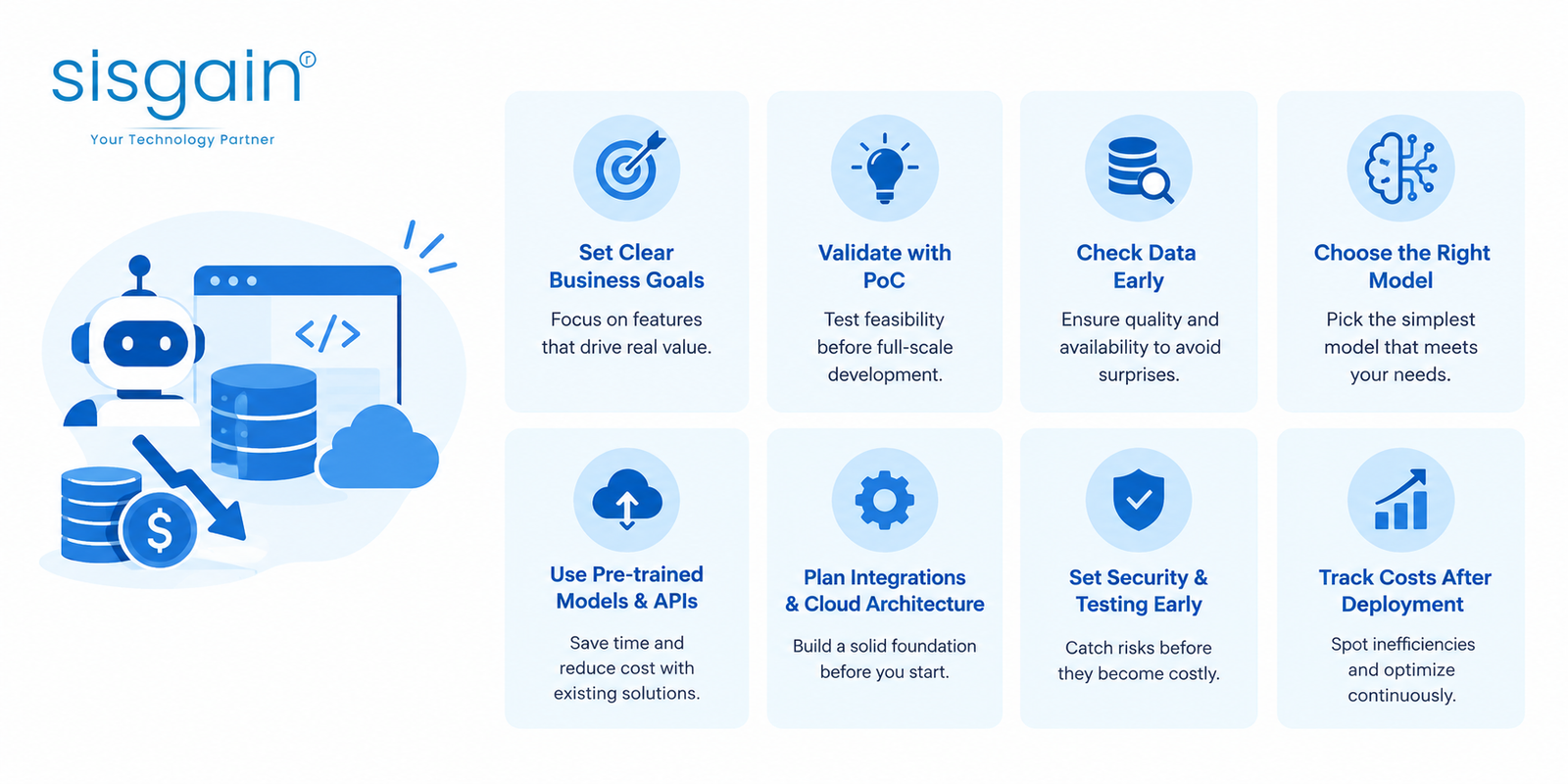
Reducing cost does not mean cutting corners. It means making informed decisions early so that effort goes where it creates the most value. These practices help:
- Define measurable business objectives and prioritize the features that support them.
- Validate feasibility with a proof of concept before committing to full-scale development.
- Audit data availability and quality early to avoid late-stage surprises.
- Choose the simplest model that meets accuracy and performance requirements.
- Reuse suitable pre-trained models and existing APIs where practical.
- Plan integrations and cloud architecture before development begins.
- Establish security, testing, and monitoring requirements at the start.
- Track cost per prediction, request, workflow, or business outcome after deployment to spot inefficiencies.
The right partner can make these practices easier to apply. An experienced custom ai software development company can guide architecture decisions, provide realistic cost estimates, and identify project risks before they turn into budget overruns. When evaluating partners, ask how they handle discovery, data audits, evaluation, and post-launch support, because those areas reveal how well they understand the full project lifecycle.
How to Estimate the Total Cost of AI Implementation
An effective estimate covers the entire AI lifecycle, not just coding. The AI implementation cost includes everything required to build, deploy, secure, and operate the solution within your business workflows.
Key Cost Categories to Include in Your Budget
| Budget category | What it covers |
|---|---|
| Discovery and requirements analysis | Business goals, feasibility, risks, and scope definition |
| Data preparation and engineering | Cleaning, labeling, pipelines, and validation |
| Model selection, development, and evaluation | Model comparison, training or fine-tuning, and testing |
| Application development and system integration | User interfaces, APIs, and connections to existing systems |
| Cloud deployment and infrastructure | Compute, storage, environments, and scaling |
| Security, compliance, and quality assurance | Access controls, audits, testing, and documentation |
| Monitoring, maintenance, and optimization | Performance tracking, updates, retraining, and support |
A practical way to use this framework is to assign an estimated effort and a confidence level to each category. Categories with low confidence, such as data preparation or integration, deserve a larger contingency until discovery reduces the uncertainty.
Questions to Ask Before Approving an AI Development Budget
- What business problem will the solution address?
- Is the required data available, reliable, and accessible?
- Which model and architecture best fit the use case?
- What systems need to be integrated?
- What are the expected usage volumes and infrastructure requirements?
- What testing, security, and compliance obligations apply?
- What ongoing costs will arise after launch?
If you cannot answer several of these questions confidently, the project likely needs a discovery phase before a reliable budget can be set.
Common Mistakes That Lead to AI Budget Overruns
- Starting development without validating data readiness. Poor data surfaces later as delays and rework.
- Selecting an unnecessarily complex model. More power is not always more value.
- Ignoring legacy system limitations. Older systems often need custom connectors.
- Underestimating inference and cloud infrastructure expenses. Costs grow with usage.
- Treating security and compliance as last-minute requirements. Late changes are more expensive.
- Skipping performance testing and real-world evaluation. Lab results do not always match production behavior.
- Failing to budget for maintenance and future scaling. Launch is the start of operations, not the end of spending.
Final Thoughts: Plan for the Full Cost of AI Software Development
The seven hidden cost drivers covered in this guide are poor data quality, wrong model choice, integration challenges, growing infrastructure needs, complex agent workflows, security and compliance requirements, and ongoing maintenance. Each one is manageable when it is identified early.
Accurate scoping, data readiness, thoughtful model selection, infrastructure planning, and lifecycle budgeting are what separate predictable AI projects from expensive surprises. It is also worth remembering that the cheapest initial build may not deliver the lowest long-term operating cost. A solution that is inexpensive to launch but costly to run, difficult to maintain, or unreliable in production can cost far more over time.
Before committing to a budget, assess your business requirements and technical risks carefully. Clarify your data situation, integration needs, security obligations, and post-launch plans, and use that information to build a realistic, lifecycle-based estimate.
Frequently Asked Questions About AI Software Development Costs
What factors affect AI software development cost the most?
Data quality, model complexity, system integrations, infrastructure needs, security and compliance requirements, and ongoing maintenance have the greatest influence. Data preparation and integration are the most frequently underestimated.
How much does it cost to build custom AI software?
The cost depends on project scope, functionality, data requirements, deployment environment, and ongoing support. Because these variables differ widely, a scope-based estimate is more reliable than a fixed price range.
Why is custom AI development more expensive than traditional software development?
AI projects require additional work in data engineering, model evaluation, inference optimization, and continuous monitoring. Traditional software behaves predictably once tested, while AI behavior can change as data changes.
Does generative AI increase software development costs?
It can. Generative AI adds costs for model usage, retrieval systems, prompt evaluation, fine-tuning, safety measures, and inference. However, using a pre-trained model with retrieval can be more economical than training a model from scratch.
What is the difference between AI development cost and AI implementation cost?
AI development cost refers to building the solution, including models, code, and testing. AI implementation cost is broader and includes deploying, integrating, securing, and operating the solution within real business workflows.
How can businesses reduce AI development costs?
Businesses can focus the project scope, audit data early, choose a suitable model, deliver in phases, and monitor costs after launch. Validating the idea with a proof of concept also reduces financial risk.
What ongoing costs should businesses expect after AI software deployment?
Expect cloud usage, model inference, maintenance, monitoring, security updates, and retraining where required. These recurring costs should be included in the total budget from the beginning.