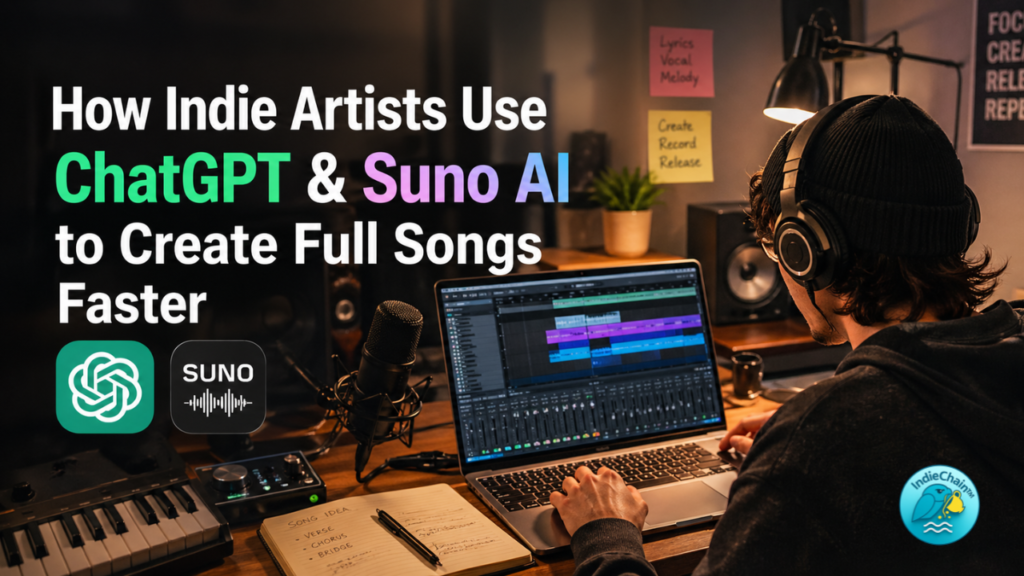
You have ideas, but no full songs.
You’ve got melodies stuck in your head at 2 AM that feel like they could turn into something real. You’ve got lyrics written in your notes app that sound emotional, raw, almost finished—but not quite there yet. And maybe you’ve even tried turning them into a full track, but every time you start, something slows you down.
You can’t find the right beat. Or the production doesn’t match what you imagined. Or you simply don’t have access to a producer who understands your sound. No studio budget. No team. No clear direction. So the idea just stays unfinished, sitting in your phone like dozens of others before it.
But here’s the problem most indie artists don’t talk about.
It’s not creativity. You have that already.
It’s execution—the gap between what you imagine and what actually gets released.
And that’s exactly where things are changing fast with AI music tools like ChatGPT and Suno AI, giving indie artists a way to finally turn ideas into complete songs without waiting for everything to be “perfect” first.
The real struggle indie artists face
Let’s be honest—being an indie artist today is not just about talent anymore. It’s about speed. You are not only trying to create good music, but you are also trying to keep up with an industry that moves incredibly fast. Other artists are releasing songs every week, sometimes even multiple times a month. On top of that, streaming platforms reward consistency, and algorithm-driven demand pushes you to stay visible all the time. So even if your music is great, it can easily get lost if you’re not consistently putting it out there.
But here’s where things usually go wrong. You end up stuck in a repetitive cycle that slows everything down and drains your creative energy.
Here’s what that cycle looks like:
- You rewrite lyrics again and again because nothing feels “perfect” enough
- You spend hours searching for beats that actually match your vibe
- You wait on producers or collaborators, or try using a music collaboration platform, often losing momentum in the process
- You start overthinking every small detail—mix, hook, structure, and even audience reaction
And the result is always the same. By the time your song is finally ready, the original spark that inspired it feels weaker. The emotional energy behind the idea fades, and the release doesn’t hit the way you imagined it would.
That’s exactly why more indie artists are now turning to AI music creation tools—to speed up the process, remove creative bottlenecks, and stay ahead in a fast-moving music landscape.
The new workflow: AI becomes your creative partner
Here’s what most people don’t realize—you’re not replacing creativity with AI. You’re simply removing friction. Instead of getting stuck in slow, traditional workflows, indie artists are now using AI music tools to move from idea to execution much faster. Let’s break down how this actually works in real music creation.
Step 1: ChatGPT for songwriting (your idea engine)
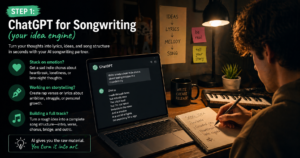
This is where the entire music process actually begins, and honestly, it’s the step most indie artists struggle with the most—getting started.
Instead of sitting in front of a blank page waiting for inspiration to magically show up, you use ChatGPT as a creative partner to trigger ideas instantly. Think of it like having a songwriting assistant that never runs out of suggestions, moods, or directions to explore.
What makes this powerful is not that ChatGPT “writes music for you,” but that it removes the pressure of starting from zero. Because starting is usually the hardest part. Once you have something—even if it’s rough—you can shape it into your own sound.
For example, you can prompt it in different ways depending on what you need:
- If you’re stuck on emotion: you might ask for a sad indie chorus about heartbreak, loneliness, or late-night thoughts. This gives you instant emotional direction.
- If you’re working on storytelling: you can ask for rap lyrics or verses about ambition, struggle, or personal growth. It helps you structure your narrative instead of guessing how to begin.
- If you’re building a full track: you can ask it to turn a rough idea into a complete song structure—intro, verse, chorus, bridge, and outro—so you’re not lost in arrangement decisions.
And suddenly, what used to feel like a creative block turns into a starting point you can actually work with.
This is exactly why ChatGPT for songwriting is becoming such a core part of modern music workflows. It speeds up the ideation phase, which used to take hours or even days, and compresses it into just minutes.
But here’s where most artists go wrong.
They treat the first output as the final version instead of a starting point. They stop too early, thinking the AI result is “good enough,” and they don’t reshape or personalize it to match their own voice.
That’s not how professionals use it.
They treat AI as a foundation, not a finished product. Every output is a draft that needs refinement. They continuously adjust, rewrite, and evolve it until it fits their unique style and emotion.
The real value comes from iteration. You take what ChatGPT gives you and refine it until it fits your song. You adjust words, improve flow, match the tone, and add your own experiences so it feels authentic instead of generic. Over time, you reshape it until it sounds natural and fully yours.
Because AI has limits. It can give you structure and ideas, but it cannot add your lived experiences or emotions. It doesn’t know your story or artistic identity.
That’s the key difference—AI gives you the raw material, but you turn it into art.
Step 2: Suno AI music generator turns words into sound
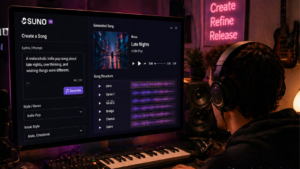
This is where things start to feel real. After shaping your idea or lyrics with ChatGPT, you take that raw concept and bring it into the Suno AI music generator—and suddenly, your words don’t just stay on a page, they turn into actual sound.
What makes this step powerful is how fast it removes the biggest barrier in music creation: production. Instead of spending days or weeks building a track, you can generate a full song in minutes.
Within a short time, it can:
- Create full instrumentals
- Add vocals to your lyrics or prompt
- Build a complete song structure
- Produce a ready-to-listen track
No studio. No engineer. No complicated setup. Just your idea transformed into music almost instantly.
This is exactly why AI music generator tools like Suno AI are a game-changer for indie artists. They remove technical barriers and let you focus purely on creativity and experimentation.
But here’s where things go wrong.
Many artists stop at this stage. They hear the AI-generated track and assume it’s the final song.
It’s not. It’s a draft.
That’s the biggest misunderstanding with Suno AI. The output is not meant to replace your creativity—it’s meant to support it. It gives you a base that you can listen to, evaluate, and improve.
Because even though it can create structure, melody, and vocals, it still doesn’t fully capture your emotion, intention, or story.
That’s why successful indie artists don’t stop here. They treat it as a starting point, refine what works, fix what doesn’t, and then shape it into a polished, release-ready track.
Step 3: Combine AI tools for full music creation
Now the real workflow begins.
Successful indie artists don’t rely on just one tool—they combine multiple AI music tools to build a complete creation system from start to finish.
Here’s how the process usually looks:
- ChatGPT for songwriting → helps with lyrics, ideas, and song structure
- Suno AI music generator → turns those ideas into sound, vocals, and a full track
- AI music production tools → refine, polish, and master the final output
This combination completely changes the speed of music creation. Instead of spending weeks moving through different stages of production, you can go from a simple idea to a full song in just a few hours.To understand where artists release these songs, explore: Top 10 Music Streaming Platforms for Artists (2026).
Why this workflow is a game-changer
Let’s break it down simply.
Before AI:
Idea → inspiration fades → weeks of production → expensive studio sessions → constant delays → songs often left unfinished
After AI:
Idea → AI music tools → instant song creation → full track in hours → quick improvements and iterations → faster releases and consistent output
This is what how to make music with AI really looks like in real-world practice.
It’s not about replacing creativity. It’s about removing delays and accelerating the entire creative process so artists can focus more on ideas and expression.
But Here’s Where Most Indie Artists Fail
AI is powerful, but it also creates new traps if you don’t use it the right way. Many indie artists get excited in the beginning, but then slowly start depending on it too much instead of guiding it creatively.
Here’s where things usually go wrong:
1. Over-reliance on AI
When you rely too much on AI music tools, your tracks can start sounding repetitive or generic. If you don’t step in and edit, refine, and personalize the output, the music loses its identity.
2. No creative direction
AI can give you plenty of options, but it doesn’t know what you actually want to express. Without your own taste and direction, you end up with random outputs instead of a focused sound.
3. Ignoring emotion
AI can generate melodies, vocals, and structure, but it cannot truly feel your story. If you ignore the emotional layer and just accept what AI gives you, the song may sound complete—but it won’t feel real.
Real-world AI workflow : How indie artists actually use ChatGPT + Suno AI
Case study: raw idea to full demo
- An indie artist starts with a simple idea:
“A song about feeling invisible in a crowded city”
Step 1: ChatGPT (lyrics creation)
- The artist prompts ChatGPT:
“Write a melancholic indie pop chorus about feeling invisible but wanting to be seen” - ChatGPT generates multiple lyric options
- The artist then:
- selects the strongest lines
- rewrites them in their own voice
- adds personal emotion and experience
- adjusts tone to make it more natural
Step 2: Song structure
- The artist then prompts ChatGPT:
“Turn this into a full song structure with verse, chorus, and bridge” - Output includes:
- Verse
- Chorus
- Bridge
- Complete song flow
Step 3: Suno AI (music generation)
- The final lyrics are taken into Suno AI
- The prompt used:
- Emotional indie pop
- Soft guitar
- Slow tempo
- Dreamy atmosphere
- Male vocals
Result
- A full demo is generated in minutes
- The idea becomes a listenable track
- No studio, no producer, no long production cycle
Key insight most artists miss
- Most people think AI is meant to create finished music for them without much effort from their side.
- This mindset leads to over-dependence on AI outputs, which often results in generic and less personal music.
- Successful indie artists see AI differently—they treat it as a tool to speed up creativity, not replace it.
- Their focus remains on human input such as emotion, direction, and artistic decision-making.
- AI music tools are used to support the process, not control it.
- Instead of accepting outputs as final, they refine, edit, and reshape them based on their own vision.
- The real advantage comes from combining human creativity with AI efficiency.
- When used correctly, AI music production tools help reduce time while still preserving originality and artistic identity.
Final takeaway: Your advantage is speed + creativity
You don’t need a studio anymore. You don’t need expensive production setups or complex equipment to create professional-level music. What matters today is how quickly you can turn ideas into finished songs.
All you need is:
- Clear ideas
- Creative direction
- The right AI music tools
These tools make music creation faster, more flexible, and help you release music more consistently instead of waiting weeks or months for one track.
They also support indie artists in reaching professional milestones like independent music certification, where finished tracks can be formally recognized.
But one truth remains:
AI won’t make you an artist—it only amplifies the artist you already are.
If you have direction and creativity, it speeds you up. If you don’t, it only creates noise.
So the real question is not whether to use AI—it’s whether you can afford to ignore it while the industry is already changing.

FAQ:
1. Can indie artists really create full songs using AI tools?
Yes, indie artists can now create complete songs using AI tools like ChatGPT for lyrics and Suno AI for music generation. These tools help turn ideas into full tracks quickly without needing a studio or production team.
2. How does ChatGPT help in songwriting?
ChatGPT helps indie artists generate lyrics, song ideas, and full structures like verses and choruses. It removes creative blocks and speeds up the songwriting process by providing instant drafts that can be refined.
3. What does Suno AI do in music creation?
Suno AI is an AI music generator that converts lyrics or prompts into full songs. It can create instrumentals, vocals, and complete track structures, making music production faster and more accessible.
4. Is AI-generated music good enough for release?
AI-generated music can be a strong starting point, but it usually needs refinement. Successful indie artists edit, personalize, and improve AI outputs to match their unique style before releasing tracks.
5. How can I protect and certify my AI-created music?
After creating your music, you can use platforms like IndieChain to verify ownership, certify your tracks, and ensure proper recognition and royalties. This helps turn your songs into official, protected assets.