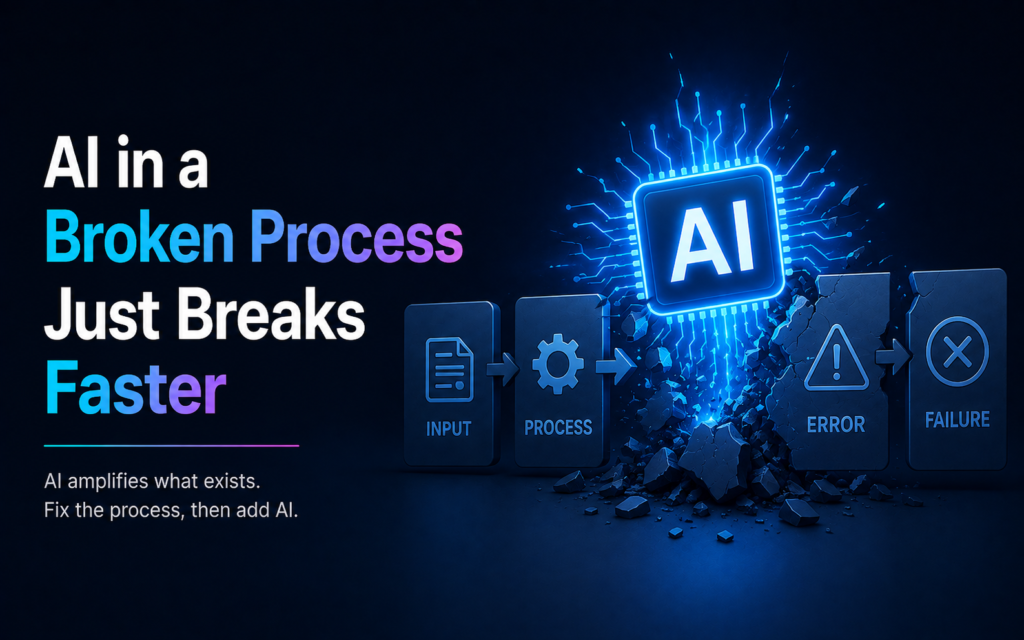
A slow, error-prone process does not improve when you point a model at it. It gets faster at producing the same errors, and now with a confident interface on top. That is the quiet failure mode behind most stalled programs, and it explains a pattern many leaders recognize: dashboards full of activity, budgets spent, and no movement in the numbers that matter. Buying capability is the easy part. Fixing the work underneath it is the job.
The market for AI ML services keeps expanding, and the pitch usually treats the model as the product. The model is not the product. The redesigned process is. When a pilot skips that redesign, the result is predictable. A lot of AI ML projects get abandoned after a proof of concept, undone by poor data quality, unclear business value, and rising cost. None of those failures are model problems. They are process problems wearing a model costume.
Why Faster Is Not Better When the Workflow Is Broken
Picture an insurance claims team that takes 11 days to close a routine case. Five of those days are handoffs, rework, and waiting on documents from three disconnected systems. Drop a classification model into step two, and step two speeds up. The claim still waits on the same handoffs, still bounces between the same systems, still gets reopened at the same rate. Cycle time barely moves. The team now processes bad inputs faster and generates more downstream corrections.
Speed applied to a flawed sequence multiplies the flaws. Automating a step that should not exist entrenches it. When an approval loop runs three times because nobody trusts the data, artificial intelligence (AI) and machine learning (ML) make each loop quicker without removing a single loop. Measured honestly, the outcome is more compute cost, more oversight, and the same result.
This is why activity metrics mislead. Prompt counts, model calls, and user logins all rise during a rollout. Those are inputs. The outputs, first-pass yield, days to resolution, cost per transaction, and customer effort, tell a different story when the workflow was never touched.
A second cost runs deeper. A model dropped into a flawed process tends to launder the flaw. Because the output looks polished and arrives quickly, people trust it more than the manual version, even though the underlying logic is the same or worse. A pricing error that once got caught in a slow manual review now sails through because the model produced it and the review step was cut to save time. Confidence in the interface outruns confidence in the process. That gap is where the expensive mistakes live, and it grows precisely because the tool made everything feel faster and cleaner.
What AI ML Services Actually Do Inside a Redesigned Workflow
Set against a redesigned process, the same technology behaves differently. The value of AI ML services shows up when a model removes a decision a human should never have had to make, or catches an exception before it reaches a customer. The starting question is not “where can a model fit,” but “which steps in this process create delay, error, or cost, and which of those a model can absorb.”
A grounded engagement usually covers a few capabilities:
- Prediction and classification: routing a claim, scoring a lead, or flagging a transaction so the next step starts with a decision already made.
- Extraction and understanding: pulling structured fields from contracts, invoices, and clinical notes so downstream systems stop waiting on manual entry.
- Generation with guardrails: drafting a response, a summary, or code against retrieved, source-of-truth data rather than open-ended guessing.
- Forecasting: turning demand, capacity, and risk signals into numbers a planner acts on the same day.
Each of these earns its place only where the surrounding steps have been simplified first. A model that classifies a claim is useful when the claim then flows straight to settlement. It is theater when the claim still routes through the same manual queue afterward.
Notice what these capabilities share. Each replaces a specific decision or a specific piece of manual toil that sits on the critical path. None of them is valuable in the abstract. A generation feature that drafts responses looks impressive in a demo and does nothing for a support team whose real bottleneck is a knowledge base three versions out of date. Scoping the work to the constraint, rather than to the most marketable capability, is the difference between a line item that pays back and one that quietly gets cut in the next budget review.
The Payoff Case: Where Redesign Plus a Model Compounds
Consider a mid-market lender processing loan applications. Before any model, the team maps the flow and finds that 40 percent of applications stall for missing documents and re-keyed data. The redesign cuts four steps, consolidates two intake forms, and connects the underwriting system to the document store. Only then does a model enter: extraction for incoming paperwork, a risk score for straightforward cases, and a routed exception path for the rest.
The compounding matters. The redesign alone shortens the cycle. The model alone would have sped up one step. Together, straightforward applications clear in hours instead of days, underwriters spend their time on genuine edge cases, and the error rate on funded loans drops because clean data reaches the decision point. That is the shape of AI and machine learning solutions that return real value: process gains and model gains reinforcing each other, not a model bolted onto a queue nobody fixed.
The same logic holds across functions. In support, resolution improves when knowledge is consolidated before a model retrieves from it; retrieval against a tangle of outdated articles just returns wrong answers faster. In finance, close cycles shorten when reconciliation logic is rebuilt before automation runs against it. In supply chain, a demand forecast helps only when the planner has the authority and the tooling to act on it the same day. The pattern repeats: sequence first, model second.
None of this argues against ambition. It argues against sequence errors. The lender in the example above could have started with the flashiest generative feature and demoed it in a week. Instead the team spent the first month with the data nobody wanted to look at and the steps nobody wanted to defend. That month is the reason the model paid off. Skipping it is the reason most do not.
Redesign First, Model Second: A Practical Approach
A dependable sequence keeps the order honest and prevents the “faster broken process” outcome. An experienced team offering AI and ML services tends to work through five moves:
-
- Map the real workflow: not the documented one, the actual path work takes, including the shadow steps and rework loops nobody put on a diagram.
- Find the constraint: locate where delay, error, and cost concentrate, then quantify each so the case rests on numbers rather than opinion.
- Redesign the sequence: remove steps, merge systems, and fix the data handoffs before any model is scoped.
- Place the model where it earns its keep: apply prediction, extraction, or generation to the constraint, with a human check where the stakes justify it.
- Instrument outcomes: track cycle time, first-pass yield, and cost per transaction, not model calls, so value is visible and defensible.
</ol
Skipping step three is the common failure. It is also the tempting one, because redesign is slower and less photogenic than a demo. The team that resists the shortcut earns the compounding; the team that skips it funds a faster version of the problem.
Choosing a delivery partner follows the same discipline. A capable AI and ML development company will ask about the process before the algorithm, insist on baseline metrics, and decline to automate a step it cannot justify. A vendor that opens with a model catalog and a licensing tier is selling the costume, not the outcome.
The Technology Stack Behind AI and Machine Learning Services
Under the hood, most AI and machine learning services draw on the same building blocks, and the choice among them is an engineering decision, not a branding one. Classical ML, gradient-boosted trees and regression, still handles a large share of tabular prediction and forecasting with less cost and more explainability than anything larger. Deep learning covers vision and speech. Large language models (LLMs) handle language tasks, and retrieval-augmented generation grounds them in a company’s own data so answers trace back to a source instead of a guess.
Around the model sits the part that decides success: the data layer. Feature stores, vector databases, pipelines that keep training and serving data consistent, and monitoring that catches drift before it reaches a user. Model context protocol and agent frameworks now let models call tools and trigger actions, which raises the stakes on the workflow question. An agent turned loose on a broken process automates the mess at machine speed.
Cost and explainability deserve a place in the same conversation. A large model called on every transaction can dwarf the value it creates, while a smaller classical model often does the job for a fraction of the spend and produces a decision a regulator or an auditor can follow. Matching the technique to the task, rather than reaching for the largest model available, is much of what separates a program that scales from one that stalls at the invoice.
The lesson holds at every layer. Better models do not rescue worse processes. They expose them.
Challenges, Compliance, and Security Belong in the Design
The hard parts of an AI program are rarely the mathematics. Data quality tops the list: models trained on inconsistent, incomplete, or stale records inherit every flaw and amplify it. Change management sits close behind, because a redesigned workflow asks people to work differently, and adoption stalls when the new path is not clearly better for the person doing the work.
Governance cannot be an afterthought. For regulated work in healthcare, finance, and the public sector, design decisions carry compliance weight from day one:
-
-
- Data protection: personal and sensitive data needs handling consistent with HIPAA, GDPR, and sector rules, with access controls and retention built into the pipeline.
- Auditability: high-stakes decisions need a record of what the model saw and why it produced an output, which is far easier to build in than to reconstruct later.
- Human oversight: a defined checkpoint for consequential decisions, sized to the risk rather than applied uniformly.
- Security: prompt injection, data leakage through model outputs, and model access all widen the attack surface, and the controls need to be part of the architecture.
-
Fold these into the redesign and they cost little. Retrofit them after go-live and they cost a rebuild. Emerging rules, including the EU AI Act’s phased obligations, reward teams that treated governance as a design input rather than a cleanup task.
The through-line across every one of these challenges is the same as the through-line across the wins: the process decides the outcome, and the model only ever amplifies whatever the process already does.
Speed is not the goal. A better result is. AI ML services earn their budget only when the workflow beneath them has been rebuilt to deserve the acceleration, which is why the strongest programs start with a process map and a baseline, not a model catalog. Match the redesign with the right AI and ML development services, instrument the outcomes that matter, and the next model added compounds the gains instead of the flaws. The organizations pulling ahead are not the ones running the most pilots. They are the ones that fixed the work first, then let the technology make good work faster.