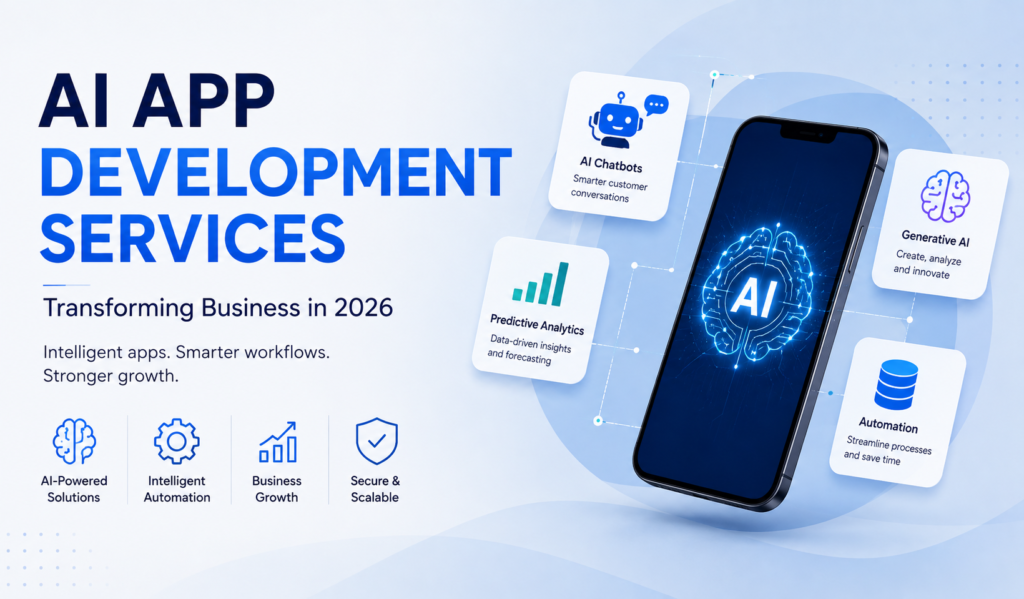
Artificial intelligence has moved from being an experimental technology to becoming part of everyday business operations. Companies are using AI to automate repetitive work, understand customer behavior, improve decision-making, and build more personalized digital experiences.
In 2026, this shift is becoming even more visible through AI-powered applications. Businesses are no longer looking only for basic chatbots or recommendation features. They are exploring applications that can understand natural language, work with business data, use external tools, and complete tasks with limited human intervention.
This is why AI app development services are gaining importance across industries.
What Are AI App Development Services?
AI app development services involve designing and building applications that use artificial intelligence to perform specific business or user-focused tasks.
An AI application may use machine learning, generative AI, natural language processing, computer vision, AI agents, or a combination of these technologies.
For example, an AI-powered application can:
- Answer customer questions
- Analyze documents and business data
- Recommend products or services
- Predict customer behavior
- Automate repetitive workflows
- Generate text, images, or reports
- Understand voice and natural-language commands
- Assist employees with internal information
- Connect with business systems and APIs
The objective is not simply to add AI to an application. The real goal is to solve a business problem more efficiently.
Why Are Businesses Investing in AI-Powered Applications?
Businesses are investing in AI applications because traditional software often requires users to follow fixed processes. AI can make those interactions more flexible and intelligent.
Consider an internal company knowledge application. Instead of searching through hundreds of documents, an employee can ask a question in natural language and receive an answer based on approved company information.
Similarly, a customer service application can understand a customer’s request, retrieve relevant account information, and provide a suitable response.
This can improve productivity while creating a smoother user experience.
How Is AI App Development Changing in 2026?
One of the biggest changes is the movement from AI that simply responds to AI that can perform tasks.
Earlier AI applications were often designed around a single function. Modern applications can combine several AI capabilities.
For example, an application may understand a user’s request, retrieve information, decide which tool is needed, call an API, and return the result.
This development is closely connected with AI agent development and agentic AI.
AI agents can be designed to perform multi-step tasks based on a defined goal. In a business environment, an agent might qualify a lead, update a CRM record, schedule an appointment, or assist with an internal workflow.
What Role Does Generative AI Play in App Development?
Generative AI has become an important component of modern AI application development.
Large language models can help applications understand and generate natural language. This allows businesses to create more conversational and flexible interfaces.
Common examples include:
- AI writing assistants
- Intelligent search applications
- Enterprise knowledge assistants
- Customer support applications
- AI-powered document analysis
- Conversational commerce platforms
- Software development assistants
However, simply connecting an application to an LLM does not automatically make it a useful enterprise solution.
The application may also need retrieval systems, business rules, APIs, security controls, user permissions, monitoring, and evaluation.
How Are AI Agents Changing Applications?
AI agents are making applications more action-oriented.
A traditional chatbot may answer:
“What is the status of my order?”
An AI agent could potentially check the order system, review the shipping status, identify a delay, and provide the customer with the next available option.
This difference is important.
The application is no longer only providing information. It is interacting with other systems and helping complete a task.
For businesses, this creates opportunities for intelligent automation across sales, customer service, operations, IT support, finance, and employee productivity.
What Types of AI Applications Can Businesses Build?
The right application depends on the business requirement.
Customer Service Applications
AI can help businesses automate frequently asked questions, classify support requests, summarize conversations, and assist human support teams.
AI-Powered Recommendation Applications
Recommendation engines can analyze user behavior and preferences to provide more relevant products, content, or services.
Enterprise Knowledge Applications
Businesses can build internal AI assistants that allow employees to search approved company information using natural language.
Predictive Applications
Machine learning models can analyze historical data to support forecasting, risk assessment, demand planning, and other business decisions.
AI Automation Applications
AI can be combined with APIs and workflow systems to automate repetitive processes that previously required several manual steps.
How Do AI Apps Improve Customer Experience?
Customers increasingly expect quick and relevant digital interactions.
AI can help applications provide personalized responses instead of forcing every user through the same workflow.
For example, an ecommerce application can understand what a customer is looking for, recommend suitable products, answer questions about those products, and provide assistance during the buying process.
In financial services, AI can help customers understand account information or navigate common requests.
The key is to use AI where it genuinely improves the experience rather than adding unnecessary complexity.
What Are the Benefits of Custom AI App Development?
Custom AI app development allows businesses to build applications around their own workflows, data, users, and technology environment.
Some important benefits include:
- Greater control over functionality
- Integration with existing business systems
- Personalized user experiences
- Workflow automation
- Better use of proprietary data
- Flexible AI model selection
- Scalability for future requirements
A ready-made AI tool may be sufficient for a simple task. Custom development becomes more valuable when a business needs deeper integrations or specialized functionality.
How Does AI App Development Work?
A successful AI application usually starts with a clearly defined business problem.
The development process may include:
- Identify the use case: Define what the application should achieve.
- Select the AI approach: Determine whether the solution needs machine learning, generative AI, RAG, AI agents, computer vision, or another technology.
- Prepare the data: Organize and secure the information required by the application.
- Build the application: Develop the user interface, AI components, APIs, databases, and integrations.
- Test and evaluate: Measure accuracy, reliability, response time, security, and user experience.
- Deploy and monitor: Launch the application and continuously monitor its performance.
This approach helps businesses avoid building AI technology without a clear purpose.
How Much Does AI App Development Cost?
There is no fixed cost for AI app development because projects vary significantly.
A basic AI-powered application using an existing model may require considerably less investment than an enterprise application involving custom models, large datasets, multiple integrations, advanced security, and AI agents.
The main factors affecting cost include:
- Application complexity
- AI model selection
- Data requirements
- Number of integrations
- User volume
- Security requirements
- Cloud infrastructure
- Customization and fine-tuning
- Ongoing maintenance
Businesses should therefore evaluate AI projects based on expected business value rather than development cost alone.
How to Choose an AI App Development Company
Choosing the right AI app development company requires looking beyond a list of technologies.
Businesses should evaluate the company’s experience with AI applications, software engineering, cloud platforms, APIs, data security, and system integration.
It is also useful to ask:
- Have they built similar AI applications?
- Can they recommend the right AI architecture?
- How do they handle sensitive business data?
- How will AI performance be measured?
- Can the application scale with business growth?
- What support is available after launch?
A strong development partner should be able to explain technical decisions in terms of business outcomes.
What Is the Future of AI App Development?
The future of AI applications is likely to be more connected, multimodal, and task-oriented.
Applications will increasingly combine text, voice, images, structured data, APIs, and AI agents. Instead of opening separate software tools for every task, users may interact with intelligent applications that understand context and coordinate multiple actions.
This does not mean every application needs an autonomous AI agent. Businesses still need to consider accuracy, security, privacy, human oversight, and the cost of running AI systems.
The companies that benefit most will be those that connect AI adoption to clear business objectives.
Conclusion
AI app development services are helping businesses move beyond traditional software experiences and build applications that can understand users, analyze information, automate workflows, and support better decisions.
From generative AI applications and intelligent search to AI agents, recommendation systems, and predictive tools, the possibilities are expanding quickly.
The most effective approach is not to adopt AI simply because it is trending. Businesses should identify meaningful use cases, select the right technology, protect their data, and measure whether the application delivers real value.
In 2026, AI is becoming less about adding a smart feature to an application and more about creating software that can understand, assist, and act. For businesses ready to make that transition, the right AI app development services can turn an idea into a scalable digital solution.