Most businesses that adopt AI hit the same three walls: AI gives answers that aren’t quite right, important data sits in too many systems, and staff still spend hours on tasks a machine could handle. AI agents, Retrieval-Augmented Generation (RAG), and workflow automation each address one of these problems. Used together, they make AI answers more accurate, business data easier to reach, and daily operations faster.
Why Businesses Need More Than Standalone AI Tools
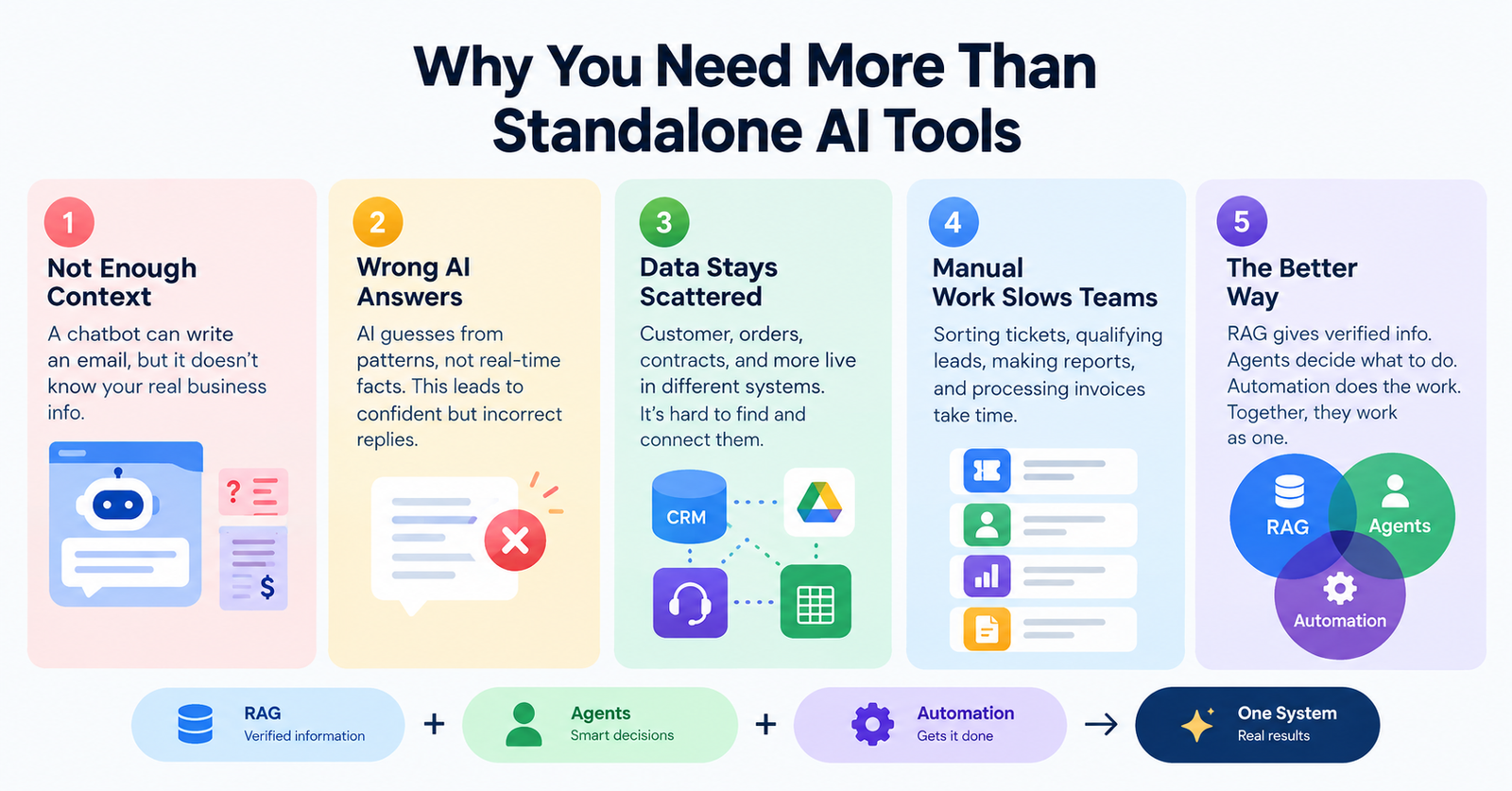
A general-purpose chatbot can write a good email, but it doesn’t know your refund policy, your latest price list, or the status of a customer’s order. Using it alone usually creates new problems instead of solving old ones.
What Causes Wrong AI Answers?
Language models generate answers from patterns in their training data. When they lack the right information, they still produce fluent replies, which is why hallucinations happen. In a business setting, a confident but incorrect answer about pricing or policy can cost money and customer trust.
Why Does Business Data Stay Scattered?
Customer details live in a CRM, contracts sit in shared drives, support history is in a helpdesk, and product specs are in spreadsheets. Employees waste time searching across these systems, and AI tools that can’t see them give partial answers.
Which Tasks Slow Teams Down?
Ticket sorting, lead qualification, report preparation, and invoice processing follow predictable steps. People do them by hand because the steps weren’t connected, and the work piles up during busy periods.
Why Combine AI Agents, RAG, and Automation?
Each technology covers a gap the others leave open. RAG supplies verified information. Agents decide what to do with it. Automation carries out the steps. Together they form a system instead of a set of disconnected experiments.
Also Read – AI Agents, Copilot Development, RAG Solutions & AI Automation for Businesses
Understanding AI Agents, RAG, and Automation
Before combining these tools, it helps to know what each one does.
What Are AI Agents and How Do They Make Decisions?
An AI agent is a program that reads a request, works out the steps needed, and uses tools to complete them. For example, an agent handling a support email might read the message, identify the product, check the order system, and decide whether to send a standard reply or escalate it to a person. Good agents operate within limits set by the business.
What Is RAG and How Does It Ground AI Responses in Business Data?
RAG works in two stages. First, it searches an indexed set of approved documents, such as manuals, policies, and databases, for the passages relevant to a question. Second, it passes those passages to the language model, which writes an answer based on them. The response can then point to its source, which makes it easier to check.
What Is AI Automation and How Does It Reduce Manual Work?
Automation follows predefined rules: when a form arrives, create a record, notify a manager, and file a copy. It doesn’t interpret anything, which makes it fast and predictable for routine steps.
How Do These Three Technologies Work Together?
Think of RAG as the memory, agents as the decision-makers, and automation as the hands. A RAG system supplies the facts, an agent chooses the next action, and automation completes it and records the result.
7 Ways to Combine AI Agents, RAG & Automation to Solve Business Challenges
1. How Can RAG Reduce Wrong AI Answers?
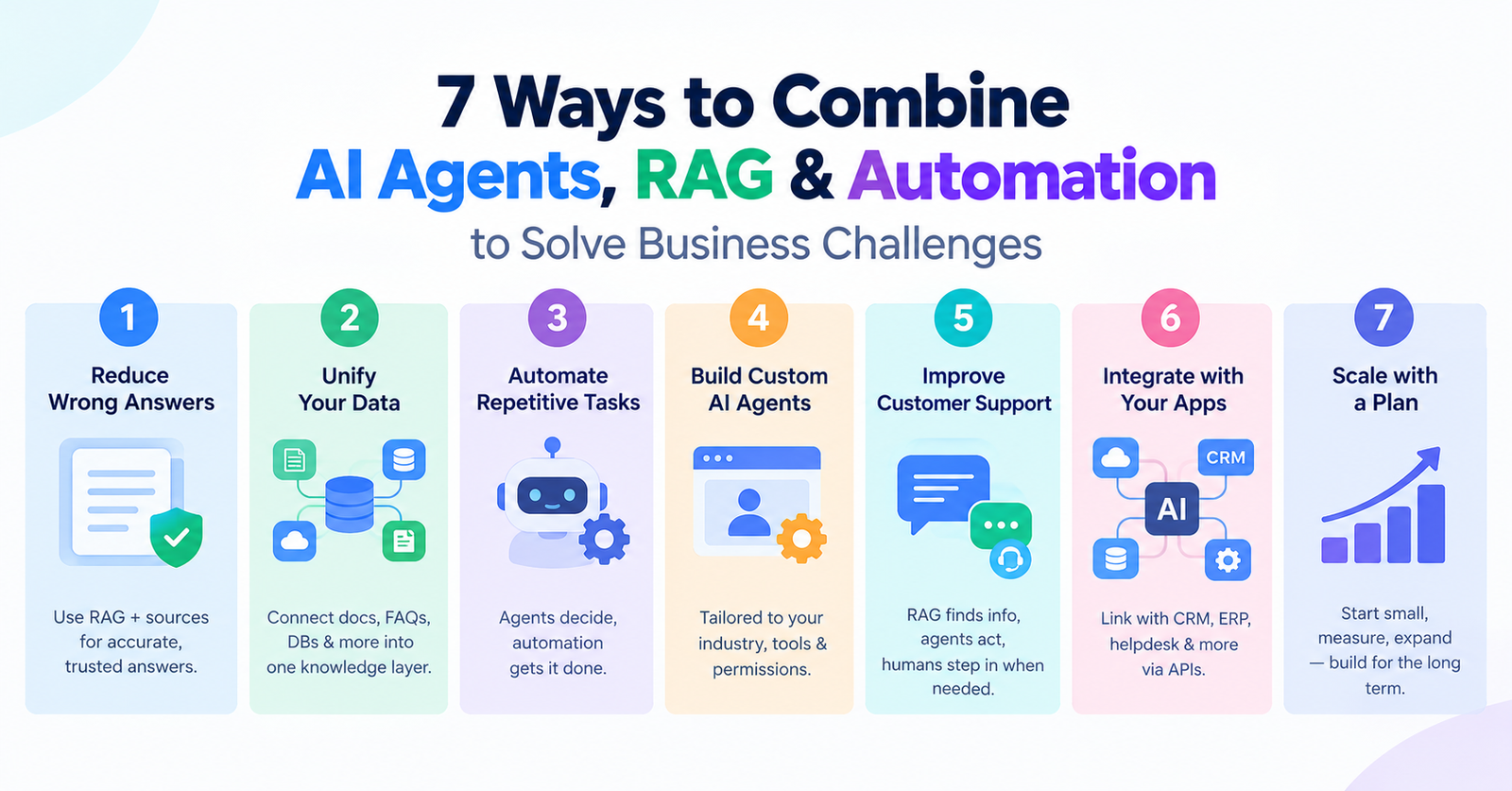
RAG limits AI responses to information from approved sources, so the model draws on your documents rather than guessing. An agent can then show which document each answer came from. For sensitive topics, such as legal or financial questions, add access controls and require human review before the answer reaches a customer. Explore RAG development services to see how knowledge-grounded systems are built.
2. How Do You Connect Scattered Data into One Knowledge System?
RAG can index documents, FAQs, databases, and other sources into one searchable layer. The work lies in indexing the data correctly, applying permissions so each employee sees only what they should, and refreshing the index when content changes. Once connected, an agent can answer questions that span departments, such as “What is the status of this client’s contract and open support tickets?” For an end-to-end approach, see our RAG solutions for businesses.
3. How Can Task-Oriented Agents Automate Repetitive Workflows?
Ticket classification, lead scoring, report generation, and document processing all suit this approach. The agent decides the next step, while automation carries out the predefined actions. Build in approval checkpoints for high-value decisions and clear exception handling for cases the system can’t resolve. Learn more about our AI automation services in Dubai.
4. When Should You Build Custom AI Agents?
Generic assistants often don’t match industry rules, approval chains, or legacy systems. A custom agent can be given specific tools, such as access to your order database, and role-based permissions that limit what each user can trigger. In customer support, it might handle order tracking. In sales, it might prepare quotes using current pricing. In operations, it might flag inventory shortfalls. Review our custom AI agent development in Dubai options.
5. How Do AI Agents and RAG Improve Customer Support?
RAG retrieves the relevant product, policy, and troubleshooting information. The agent classifies the request, drafts a response grounded in that information, and carries out approved actions, such as issuing a return label. When confidence is low or the request involves judgment, such as a complaint about a billing dispute, the case goes to a human agent with the context already summarized. Explore AI agent solutions in Dubai.
6. How Do You Connect AI with Existing Business Applications?
Integration links AI agents and RAG pipelines to CRM, ERP, helpdesk, and document management systems through APIs and workflow tools. This removes manual copying between systems and cuts repeated searches. Security needs equal attention: apply least-privilege access, log every action an agent takes, and set clear rules for what data can be stored or shared. See our AI development services in Dubai for integration support.
7. How Do You Scale from Experiments to an Integrated AI Strategy?
Start with a pilot in one department, measure results, and expand gradually. Track retrieval quality, answer accuracy, workflow completion rates, and cost per task. Review these metrics regularly and adjust. Businesses that plan this way avoid the common trap of running many unconnected experiments. If you need a partner to plan the rollout, consider an AI development company in Dubai or an AI automation agency in Dubai for implementation support.
Real-World Examples of AI Agents, RAG & Automation Working Together
In customer support, a customer asks whether a product works with a specific device. RAG pulls the compatibility spec, the agent drafts an accurate reply with a link to the source, and automation logs the interaction in the helpdesk.
In sales, a new inbound lead is scored against your ideal customer criteria. The agent summarizes the lead’s needs, automation creates the CRM record, and the account owner receives a briefing before the first call.
In operations, a procurement officer asks about the terms of a supplier contract. RAG finds the clauses, the agent flags an upcoming renewal date, and automation creates a reminder for the team.
For internal teams, the biggest gain is time. Instead of searching five folders for a policy, an employee asks one question and gets a sourced answer in seconds.
How to Choose the Right AI Solution for Your Business
When Should You Start with RAG?
Start with RAG when your main problem is finding and trusting information. If staff or customers repeatedly ask questions that already have documented answers, RAG is usually the fastest route to value.
When Should You Implement AI Agents?
Choose agents when tasks require judgment across several steps, such as triaging requests and choosing among possible actions.
When Should You Prioritize AI Automation?
Prioritize automation for predictable, high-volume tasks with clear rules. These often deliver quick savings with low risk.
When Does an Integrated Solution Make More Sense?
If your problems span knowledge, decisions, and routine work, an integrated approach is more efficient. Plan it as one system from the beginning rather than adding each piece separately.
What Factors Should Guide Your Decision?
Assess data readiness first, because poor data limits every option. Then consider security requirements, integration complexity, budget, and expected return. Define success metrics before you start.
Common Mistakes to Avoid When Combining AI Agents, RAG & Automation
Why Does Poor-Quality or Outdated Data Cause Problems?
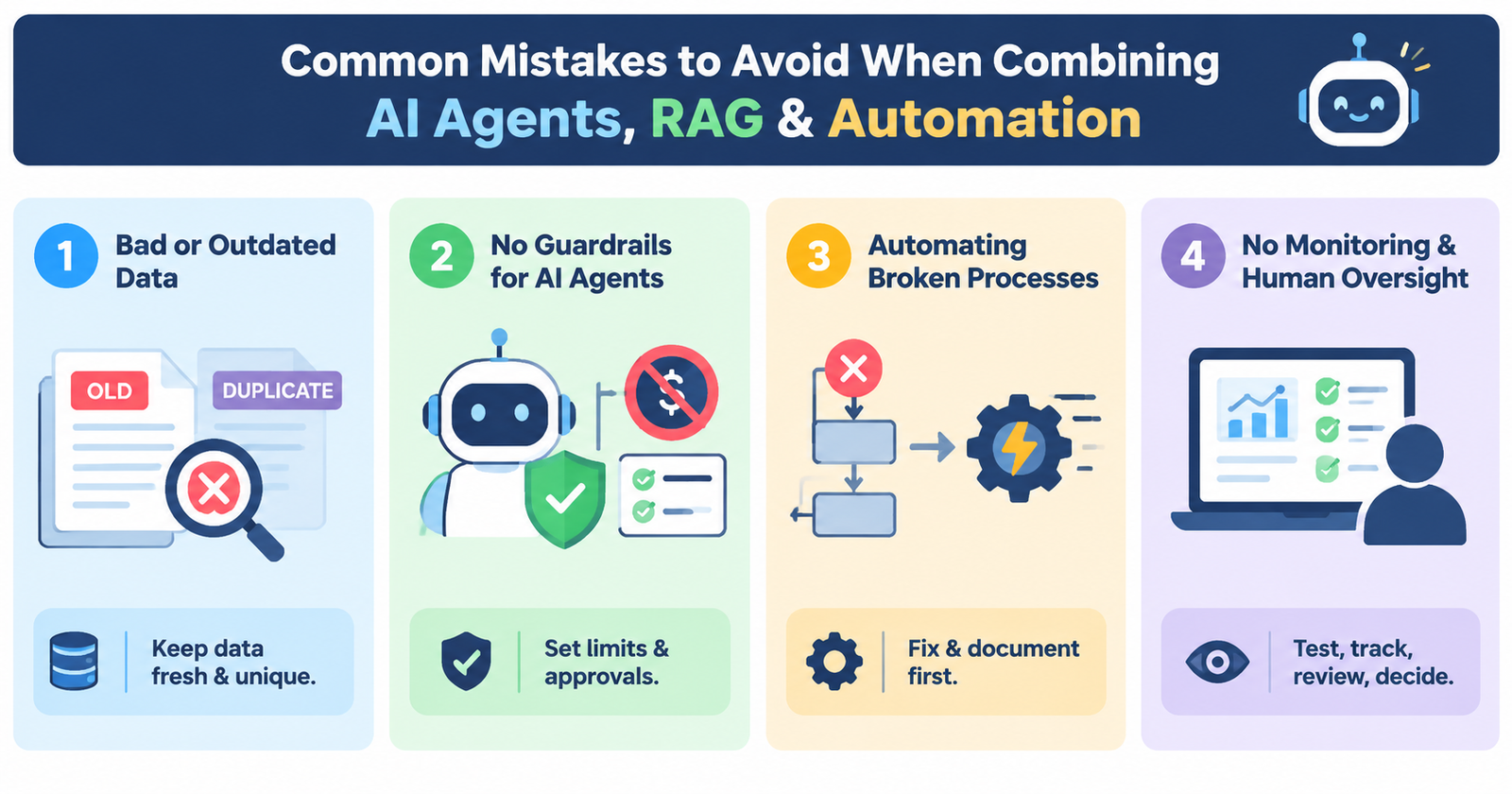
RAG can only be as accurate as the documents it indexes. Outdated price lists or duplicate policies lead to confident but wrong answers. Assign owners for each data source and set review schedules.
Why Are Guardrails Essential for AI Agents?
An agent with broad permissions can take actions you didn’t intend, such as issuing refunds beyond its limit. Define clear boundaries, spending limits, and approval steps for anything with financial or legal impact.
Why Should You Avoid Automating Broken Processes?
Automation makes a flawed process run faster, along with its errors. Simplify and document the workflow first, then automate it.
Why Is Monitoring and Human Oversight Important?
AI systems change as data and usage change. Test regularly, track errors, review sampled outputs, and keep people responsible for final decisions in sensitive areas.
Conclusion
Inaccurate answers, fragmented knowledge, and repetitive tasks are connected problems, and they respond best to connected solutions. RAG grounds AI in your own information, agents make structured decisions, and automation keeps work moving. Choose your starting point based on your data readiness, security needs, and measurable goals. Then review your current workflows and identify the one task where a connected system would save the most time.
Ready to Make Your Business AI Work Smarter?
If you’re dealing with unreliable AI answers, scattered data, or workflows that drain your team, we can help you assess where to start. Get in touch to discuss your RAG implementation, custom AI agents, or automation opportunities, and we’ll suggest the right first step for your business.
Frequently Asked Questions
Can RAG eliminate incorrect AI answers completely?
No. RAG greatly reduces errors by grounding answers in approved sources, but it can still retrieve the wrong passage or misread one. Source citations, testing, and human review for high-stakes answers remain necessary.
What is the difference between AI agents, RAG, and AI automation?
RAG retrieves relevant information, AI agents decide what to do with it, and automation executes predefined steps. Each handles a different part of a business process.
Can AI agents access data from multiple business applications?
Yes, through secure integrations such as APIs. Access should follow the principle of least privilege, so each agent sees only the data its role requires.
Which business processes are best suited for AI automation?
Repetitive, rule-based processes with high volume and clear inputs, such as invoice processing, form routing, and standard report generation, are strong candidates.
How do businesses implement AI agents and RAG securely?
Apply role-based access controls, encrypt data in transit and at rest, log all agent actions, limit what data is stored or shared, and review vendor data policies before connecting sensitive systems.
Should a business implement RAG, AI agents, or automation first?
Start with the problem that costs you the most time or causes the most errors. If information retrieval is the bottleneck, begin with RAG. If routine steps dominate, begin with automation.
How can businesses measure the ROI of an integrated AI solution?
Measure time saved per task, reduction in error rates, faster response times, and cost per completed workflow. Compare these figures against a baseline taken before implementation.