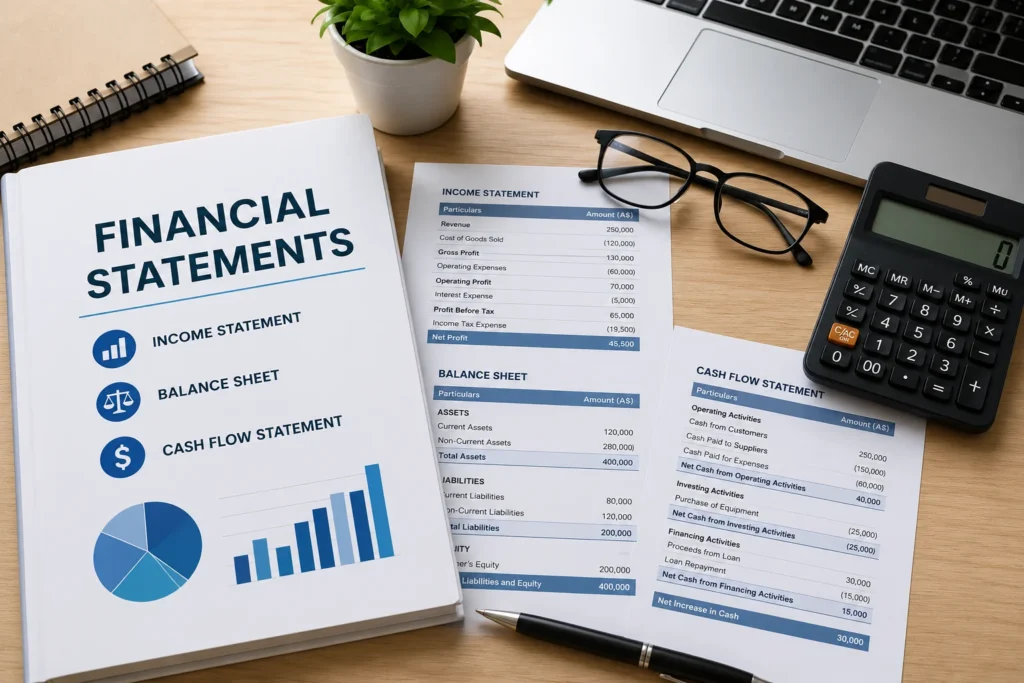
Financial statements are the backbone of every successful business. They provide a clear picture of an organisation’s financial health, helping business owners, investors, managers, and stakeholders make informed decisions. Whether you are a university student learning accounting principles, a small business owner in Australia, or an aspiring finance professional, understanding how to prepare accurate financial statements is an essential skill.
This practical guide to preparing accurate financial statement reports will walk you through the key steps, common challenges, and best practices that ensure financial records are reliable, compliant, and useful for decision-making.
Why Accurate Financial Statements Matter
Financial statements are more than just compliance documents. They serve as valuable tools for evaluating business performance and planning future growth.
Accurate financial statements help:
- Monitor profitability and cash flow
- Support strategic business decisions
- Meet taxation and regulatory requirements
- Build trust with investors and lenders
- Identify financial risks and opportunities
- Ensure compliance with Australian accounting standards
Even minor inaccuracies can lead to poor business decisions, regulatory penalties, or difficulties securing funding.
Understanding the Three Main Financial Statements
Before diving into the preparation process, it is important to understand the three primary financial statements.
1. Income Statement
The income statement, also known as the profit and loss statement, shows a company’s revenues, expenses, and profits over a specific period.
Key components include:
- Sales revenue
- Cost of goods sold (COGS)
- Operating expenses
- Interest expenses
- Tax expenses
- Net profit or loss
This statement helps determine whether a business is operating profitably.
2. Balance Sheet
The balance sheet provides a snapshot of a company’s financial position at a particular point in time.
It consists of:
- Assets
- Liabilities
- Owner’s equity
The fundamental accounting equation applies:
Assets = Liabilities + Equity
A balanced balance sheet indicates that financial records have been properly maintained.
3. Cash Flow Statement
The cash flow statement tracks how cash moves into and out of the business.
It is divided into:
- Operating activities
- Investing activities
- Financing activities
This statement helps assess liquidity and the company’s ability to meet short-term obligations.
A Step-by-Step Guide to Preparing Accurate Financial Statements
Step 1: Organise Financial Records
The foundation of accurate financial reporting is organised record-keeping.
Gather all relevant financial documents, including:
- Sales invoices
- Purchase receipts
- Bank statements
- Payroll records
- Loan agreements
- Tax documents
Using accounting software such as Xero, MYOB, or QuickBooks can significantly improve record accuracy and efficiency.
Step 2: Record Transactions Correctly
Every financial transaction must be recorded accurately and promptly.
Common transaction categories include:
- Revenue
- Expenses
- Asset purchases
- Loan repayments
- Owner contributions
Apply the double-entry bookkeeping system to ensure every transaction affects at least two accounts.
For example:
| Transaction | Debit | Credit |
|---|---|---|
| Equipment Purchase | Equipment Asset | Cash |
| Customer Payment | Cash | Revenue |
Accurate transaction recording reduces the likelihood of errors appearing in final reports.
Step 3: Reconcile Accounts Regularly
Account reconciliation involves comparing internal financial records with external documents.
Areas to reconcile include:
- Bank accounts
- Credit card statements
- Loan balances
- Supplier accounts
Regular reconciliation helps identify:
- Duplicate entries
- Missing transactions
- Bank errors
- Fraudulent activities
Many Australian businesses perform monthly reconciliations to maintain financial accuracy throughout the year.
Step 4: Adjust Journal Entries
Not all financial events are recorded automatically during daily operations.
Adjusting entries account for:
- Depreciation
- Accrued expenses
- Prepaid expenses
- Unearned revenue
- Inventory adjustments
For example, if annual insurance is paid upfront, only the portion applicable to the current reporting period should be recognised as an expense.
Making these adjustments ensures compliance with accrual accounting principles.
Step 5: Prepare a Trial Balance
A trial balance summarises all ledger account balances before financial statements are prepared.
The purpose is simple:
Total Debits = Total Credits
If the totals do not match, investigate and correct any discrepancies before proceeding.
The trial balance acts as a critical checkpoint in the financial reporting process.
Step 6: Create the Income Statement
Once the trial balance is verified, prepare the income statement.
Calculate:
- Total Revenue
- Total Expenses
- Net Profit or Loss
Formula:
Net Profit = Revenue – Expenses
A properly prepared income statement provides valuable insight into business performance over a given period.
Step 7: Prepare the Balance Sheet
Next, use ledger balances to prepare the balance sheet.
Categorise assets and liabilities into:
Current Assets
- Cash
- Accounts receivable
- Inventory
Non-Current Assets
- Property
- Equipment
- Vehicles
Current Liabilities
- Accounts payable
- Short-term loans
Non-Current Liabilities
- Long-term debt
Ensure the accounting equation remains balanced.
Step 8: Generate the Cash Flow Statement
Many profitable businesses still face cash flow problems.
The cash flow statement identifies:
- Cash received from customers
- Payments to suppliers
- Capital investments
- Loan repayments
Monitoring cash flow is particularly important for Australian small businesses navigating seasonal fluctuations and changing economic conditions.
Common Mistakes to Avoid
Even experienced professionals occasionally make reporting errors.
Some of the most common mistakes include:
Misclassifying Transactions
Incorrect categorisation can distort financial reports.
For example:
- Recording a loan as income
- Treating equipment purchases as operating expenses
Always review account classifications carefully.
Ignoring Accrual Adjustments
Failing to account for accrued expenses or prepaid costs can result in misleading profits.
Proper adjusting entries improve reporting accuracy.
Poor Documentation
Missing receipts or incomplete records make verification difficult.
Maintain organised documentation throughout the year rather than scrambling at tax time.
Failing to Reconcile Accounts
Unreconciled accounts often contain hidden errors that affect final financial statements.
Regular reconciliation prevents small mistakes from becoming major issues.
Relying Solely on Manual Processes
Manual calculations increase the risk of human error.
Modern accounting software automates many tasks and improves data accuracy.
Best Practices for Financial Statement Accuracy
Following proven best practices can significantly improve the reliability of financial reports.
Establish Internal Controls
Implement procedures such as:
- Approval workflows
- Segregation of duties
- Regular audits
- Expense verification
Strong internal controls reduce fraud and accounting errors.
Conduct Periodic Reviews
Review financial records monthly rather than waiting until year-end.
Regular reviews help identify issues early and simplify reporting.
Use Reliable Accounting Software
Popular Australian accounting platforms offer features such as:
- Automatic bank feeds
- Invoice tracking
- Payroll integration
- Real-time reporting
Automation reduces administrative workload while improving accuracy.
Stay Updated on Accounting Standards
Businesses in Australia must comply with relevant accounting regulations and reporting requirements.
Regular training helps accounting professionals stay informed about changes in standards and legislation.
How Students Can Improve Financial Statement Preparation Skills
Many accounting students struggle with financial statement preparation because they focus on memorising formulas instead of understanding the flow of information.
To strengthen your skills:
- Practise preparing complete financial statements regularly
- Work through real-world case studies
- Understand the relationship between accounts
- Learn how transactions affect multiple statements
- Review common accounting errors and corrections
Students seeking additional academic support can explore resources that provide help with accounting assignments to gain practical experience and improve their understanding of financial reporting concepts.
The Growing Importance of Financial Reporting in Australia
As Australian businesses face increasing regulatory scrutiny and economic uncertainty, accurate financial reporting has become more important than ever.
Financial statements are essential for:
- Securing business loans
- Attracting investors
- Managing taxation obligations
- Supporting business growth
- Meeting compliance requirements
Whether you operate a startup in Sydney, manage a retail store in Melbourne, or study accounting at university, strong financial reporting skills provide a significant advantage.
Conclusion
This practical guide to preparing accurate financial statement reports demonstrates that financial reporting is not simply about completing paperwork—it is about creating a trustworthy representation of a business’s financial position. By maintaining organised records, recording transactions accurately, reconciling accounts regularly, and following sound accounting principles, businesses and students can produce reliable financial statements that support informed decision-making.
As financial regulations and business environments continue to evolve, mastering the preparation of accurate financial statements remains a valuable skill. By applying the strategies outlined in this guide to preparing accurate financial statement reports, you can improve accuracy, strengthen compliance, and build greater confidence in your financial reporting processes.