In modern manufacturing, production efficiency depends on more than the speed of individual machines. Manufacturers must also consider drilling accuracy, repeatability, cycle time, component quality, and the ability to handle increasing production volumes. When standard drilling equipment cannot meet specific requirements, a customized drilling solution may be a more practical investment.
Choosing the Best Drilling Machine Manufacturer in India involves evaluating engineering expertise, machine capabilities, customization options, technical support, and long-term operating costs. The right manufacturing partner can help businesses develop drilling systems suited to their components, production targets, and quality standards.
MT Industries works in the field of special purpose machines (SPMs), precision engineering, and industrial automation. Understanding how customized drilling equipment is designed and evaluated can help manufacturers make informed purchasing decisions and identify solutions that fit their production processes.
What Is a Custom Drilling Machine?
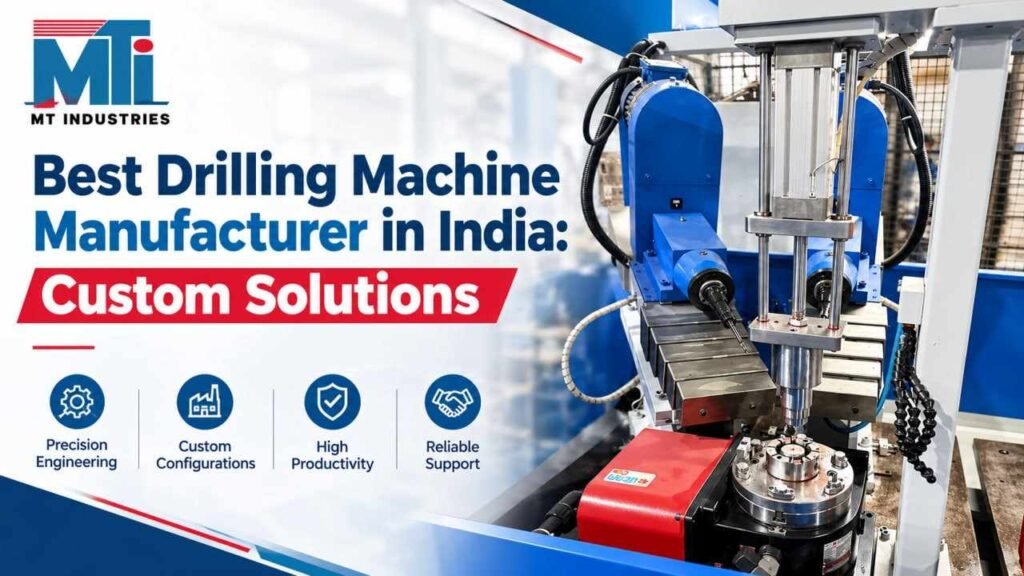
A custom drilling machine is designed or configured to perform drilling operations according to specific component dimensions, hole patterns, material properties, and production requirements. Unlike general-purpose drilling equipment, a customized system can integrate dedicated tooling, fixtures, multiple drilling heads, automatic feeding, and other production-specific features.
For example, a manufacturer producing automotive components may need several holes drilled at precise distances in every workpiece. Performing each operation separately can increase handling time and create opportunities for positioning errors. A customized drilling machine can hold the component in a dedicated fixture and perform multiple operations in a controlled sequence.
Common applications include:
- Automotive components and transmission parts
- Pump and valve components
- Electrical and electronic housings
- Metal brackets and industrial fittings
- Engineering components requiring repeated hole patterns
- Components requiring drilling followed by tapping
The final configuration depends on the workpiece, required tolerances, production volume, and the operations that need to be completed.
Why Do Manufacturers Need Custom Drilling Solutions?
Standard drilling machines remain useful for workshops, maintenance operations, and production environments handling varied components. However, high-volume manufacturing may require a more specialized approach.
A custom machine becomes worth evaluating when the existing process creates recurring production limitations.
1. Higher Production Requirements
When a component requires several holes, completing them individually can increase the overall cycle time. A multi-spindle drilling machine can perform multiple drilling operations simultaneously, provided the hole arrangement, tool access, and machine design allow it.
This approach can reduce repeated positioning and improve throughput for suitable components.
2. Consistent Hole Positioning
Component positioning is critical when hole locations must remain consistent across production batches. A dedicated fixture helps locate and support the workpiece in a repeatable position.
Machine rigidity, spindle alignment, tooling condition, and fixture accuracy also influence the final result. Customization should address these factors rather than relying on automation alone.
3. Reduced Manual Handling
When operators repeatedly remove, reposition, and clamp a component, handling time becomes part of the production cycle. Dedicated workholding and suitable automation can reduce unnecessary movements.
This can improve workflow consistency and help operators focus on loading, inspection, and other essential tasks.
4. Integration of Multiple Operations
Some components require drilling, tapping, reaming, or other machining processes. Depending on the component and process requirements, a customized special purpose machine (SPM) may combine compatible operations within one machine or production station.
The benefit depends on the process sequence, tool accessibility, material, and required quality level.
How to Choose the Best Drilling Machine Manufacturer in India
Selecting a supplier requires more than comparing quotations. Manufacturers should assess whether the supplier can translate production requirements into a reliable, maintainable machine design.
1. Evaluate Engineering and Application Expertise
Begin by examining the supplier’s experience with similar components, materials, drilling patterns, and production volumes.
Ask whether the engineering team can review component drawings, identify machining constraints, and recommend suitable spindle arrangements, fixtures, tooling, and automation levels.
An experienced Drilling Machine Manufacturer in India should be able to explain why a proposed configuration suits the application, rather than simply recommending the most complex machine.
2. Check Customization Capabilities
Customization may involve spindle spacing, the number of drilling heads, fixture design, tool selection, workpiece loading, and the integration of additional operations.
Before finalizing a design, provide the supplier with:
- Component drawings and relevant dimensions
- Material grade and workpiece condition
- Hole diameters, depths, and positional tolerances
- Expected daily or monthly production volume
- Current cycle time and quality challenges
- Available floor space and utility requirements
These details help the manufacturer assess feasibility and prepare a more accurate proposal.
3. Review Machine Accuracy and Repeatability
A machine’s suitability depends on its ability to produce components consistently under actual operating conditions.
Ask how the proposed machine will be tested against the required specifications. Discuss spindle runout, fixture repeatability, tool selection, machine rigidity, and the inspection method used to verify finished components.
Where tight tolerances apply, acceptance criteria should be documented before manufacturing begins.
4. Understand Cycle Time and Production Capacity
Do not evaluate a machine’s performance only by spindle speed or the number of drilling heads. Actual cycle time includes loading, clamping, machining, unclamping, unloading, and any required inspection.
Ask for an estimated cycle-time breakdown and clarify the assumptions behind the expected output.
A machine that performs several operations simultaneously may increase productivity, but the real benefit depends on bottlenecks, tool changes, material handling, and the availability of operators.
5. Assess After-Sales Support
Maintenance requirements should be considered before purchasing the equipment. Ask about installation, commissioning, operator training, spare parts, troubleshooting, and service response arrangements.
A practical maintenance plan should identify wear components, lubrication points, inspection intervals, and the procedure for replacing cutting tools.
These factors affect long-term availability and the total cost of ownership.
Types of Custom Drilling Machines Used in Industry
Different applications require different machine configurations. The following options illustrate common approaches.
| Machine type | Typical application |
| Multi-spindle drilling machine | Drilling several holes in one cycle |
| Multi-head drilling machine | Machining multiple positions or surfaces |
| Automatic drilling machine | Repetitive operations with reduced manual intervention |
| CNC drilling machine | Programmable machining where flexibility and controlled positioning are required |
| Drilling and tapping SPM | Combining compatible hole-making and threading operations |
| Custom fixture-based drilling machine | Maintaining repeatable workpiece positioning |
The correct option depends on component geometry, production volume, accuracy requirements, and budget. CNC equipment may be preferable when product variety is high, whereas a dedicated SPM can be suitable for stable, repetitive production.
What Factors Affect the Cost of a Custom Drilling Machine?
There is no single price that applies to every custom drilling machine. The cost depends on the engineering and production requirements of the application.
Key factors include:
Machine configuration: The number of spindles, drilling heads, axes, and stations influences the complexity of the system.
Automation level: Manual loading, pneumatic clamping, automatic feeding, sensors, and robotic handling have different cost implications.
Tooling and fixtures: Special-purpose fixtures, precision components, and application-specific cutting tools can add to the initial investment.
Accuracy requirements: Tighter tolerances may require more precise components, improved rigidity, and additional inspection procedures.
Safety and controls: Guarding, interlocks, control systems, and monitoring features must be suitable for the intended operation.
Installation and commissioning: Transportation, setup, trials, training, and integration with existing production equipment may affect the total project cost.
When comparing quotations, consider the complete delivered solution rather than the initial machine price alone.
How to Calculate the Value of a Custom Drilling Machine
A custom machine should be evaluated against measurable production improvements. The most useful comparison considers the current process and the expected process after installation.
Start by recording current cycle time, operator involvement, rejected components, tool consumption, and downtime. Then request realistic estimates from the manufacturer and validate them through component trials where possible.
For example, if a machine reduces cycle time, the improvement may increase available production capacity. However, the actual financial benefit depends on demand, staffing, maintenance, and whether the machine becomes a new bottleneck elsewhere.
A basic evaluation should include:
- Cost per acceptable component
- Production output per shift
- Scrap and rework rates
- Tooling and maintenance expenses
- Operator requirements
- Expected machine availability
- Installation and training costs
This approach makes it easier to compare standard equipment with a customized solution using operational evidence instead of assumptions.
Why Consider MT Industries for Custom Drilling Applications?
MT Industries operates in the special purpose machine and precision engineering sector, where machine configuration must align with the needs of the component and the production process.
When evaluating a custom drilling project, manufacturers should discuss the required hole pattern, workpiece material, production target, accuracy expectations, and possibilities for combining operations. These details provide the foundation for determining whether a dedicated drilling solution is appropriate.
MT Industries’ focus on SPMs and multi-operation machining is relevant to manufacturers exploring ways to streamline repetitive production tasks. The suitability of any proposed machine should be established through technical discussions, application review, and clearly defined performance requirements.
Before making a purchase decision, request a review of the component drawing, proposed machine layout, tooling approach, cycle-time estimate, and acceptance criteria. These steps help ensure that the final configuration addresses the actual manufacturing challenge.
Common Mistakes to Avoid When Buying a Custom Drilling Machine
Even a technically capable machine can underperform if the original requirements are incomplete.
Avoid these common mistakes:
- Choosing only by price: A low initial quotation may not include all necessary fixtures, tooling, installation, or commissioning.
- Ignoring the complete cycle: Machining time alone does not represent total production time.
- Overlooking future requirements: Consider whether product changes or higher volumes may require additional flexibility.
- Failing to define acceptance criteria: Specify the required output, tolerances, and testing method before ordering.
- Neglecting maintenance access: Ensure routine servicing and tool replacement can be performed safely and efficiently.
- Assuming automation guarantees quality: Workholding, tool condition, process control, and inspection remain essential.
A structured technical evaluation reduces uncertainty and improves the chances of selecting equipment that performs as expected.
Conclusion
Finding the Best Drilling Machine Manufacturer in India requires a clear understanding of production needs, machine capabilities, accuracy requirements, and long-term operating costs. Custom drilling solutions can be valuable when standard equipment cannot deliver the required combination of throughput, repeatability, and process integration.
Manufacturers should compare suppliers based on engineering expertise, customization capability, documented performance expectations, maintenance support, and total cost of ownership. A well-defined specification and realistic machine trials are important steps toward a successful investment.
For businesses evaluating specialized drilling and multi-operation machining, MT Industries is one manufacturer to consider during the technical evaluation process. The priority should always be to select a machine configuration that meets the component requirements and supports measurable production goals.
Frequently Asked Questions (FAQs)
1. How do I choose the best drilling machine manufacturer in India?
Compare manufacturers based on application experience, customization capabilities, machine accuracy, cycle-time estimates, technical support, and the ability to meet your component specifications. Request a detailed proposal and, where possible, a machine trial.
2. What is the difference between a standard and a custom drilling machine?
A standard drilling machine is designed for general-purpose operations, while a custom drilling machine is configured for specific components, hole patterns, production volumes, or integrated machining requirements.
3. How much does a custom industrial drilling machine cost in India?
The cost depends on spindle configuration, automation, tooling, fixtures, accuracy requirements, and installation needs. Manufacturers should provide a quotation based on the actual application and clearly state what is included.
4. Are multi-spindle drilling machines suitable for mass production?
Yes. Multi-spindle drilling machines can be suitable for high-volume production when several holes must be drilled in a repeatable arrangement. Their suitability depends on component design, hole spacing, material, tooling, and quality requirements.
5. Does MT Industries provide special purpose drilling machine solutions?
MT Industries works in special purpose machines, precision engineering, and industrial automation. Businesses considering a drilling application should discuss their component drawings, required operations, tolerances, and production targets to determine the appropriate machine configuration.