Modern manufacturing depends on components that deliver consistent quality, accurate dimensions, and reliable performance. From automotive assemblies to industrial machinery, every component must meet specific engineering requirements to support safe and efficient operation. Even minor dimensional errors can create assembly problems, increase maintenance costs, or affect the performance of finished products.
This is why CNC Machined Components are important across modern industries. Computer Numerical Control (CNC) machining allows manufacturers to produce parts according to programmed instructions, helping achieve repeatable dimensions and complex designs. When supported by appropriate materials, skilled engineering, and effective quality checks, this manufacturing method can meet the diverse requirements of industrial buyers.
Understanding CNC Machined Components
CNC machined components are parts produced using computer-controlled equipment that removes material from a workpiece to achieve the required shape and dimensions. Common processes include CNC turning, milling, drilling, and boring.
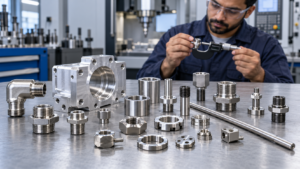
These operations can produce components such as shafts, bushings, spacers, housings, brackets, and customized mechanical parts. Depending on the application, manufacturers may work with stainless steel, carbon steel, aluminium, brass, and other suitable engineering materials.
One of the main advantages of CNC machining is repeatability. Once a machining program and production process have been properly established, the same instructions can be used to manufacture multiple components with consistent results. Actual accuracy, however, depends on machine capability, tooling, material properties, workholding, and inspection procedures.
Key Benefits of CNC Machining for Industrial Applications
1. Improved Dimensional Accuracy
Many industrial assemblies require parts to fit together within defined tolerances. CNC machining helps manufacturers control tool movements and machining operations to achieve specified dimensions.
Accurate components are particularly valuable in mechanical assemblies, rotating equipment, and industrial systems where alignment and fitment affect performance. Buyers should ensure that specified tolerances reflect actual functional requirements rather than imposing unnecessarily restrictive limits.
2. Consistent Manufacturing Quality
Production consistency is essential for businesses ordering components repeatedly. CNC machining can help reduce variation between parts by following programmed operations and established manufacturing procedures.
However, consistent quality requires more than automation. Tool wear, machine maintenance, raw material variations, and process monitoring must also be managed effectively.
3. Efficient Production
Computer-controlled machining can automate repetitive operations and improve production planning. Appropriate tooling, optimized cutting parameters, and efficient programming may reduce cycle times and material waste.
For industrial businesses, these improvements can support predictable manufacturing schedules and help manage production costs. The actual benefits depend on component complexity, order quantity, and the selected machining process.
Choosing the Right Machining Process and Material
Selecting the appropriate manufacturing process starts with understanding the component’s design and intended use.
CNC turning is commonly used for cylindrical parts, including shafts, pins, and bushings. CNC milling is suitable for components requiring flat surfaces, slots, pockets, and complex shapes. Drilling and boring operations help create or refine holes according to engineering specifications.
Material selection is equally important. Stainless steel may be appropriate where corrosion resistance is needed, while aluminium can offer a useful combination of low weight and machinability. Carbon steel and brass may suit other applications depending on strength, conductivity, environmental exposure, and operating conditions.
Engineers should also consider surface finish, heat treatment, and protective coatings where necessary. Any finishing process must be compatible with the component’s dimensional and functional requirements.
The Importance of Quality Control
Quality assurance helps confirm that manufactured parts meet agreed specifications. A suitable inspection process may include incoming material verification, first-piece inspection, in-process measurements, and final dimensional checks.
Depending on the component, manufacturers may use micrometers, vernier calipers, bore gauges, or coordinate measuring machines. Material certificates and inspection reports may also be required for applications with specific traceability requirements.
Buyers should establish acceptance criteria before production starts. This includes identifying critical dimensions, required tolerances, material grades, surface finishes, and any relevant industry standards.
Clear documentation makes it easier for manufacturers and procurement teams to evaluate whether the finished parts meet the intended requirements.
How to Select a Reliable Manufacturing Partner
Choosing among CNC Machined Components Manufacturers requires careful consideration of technical capability, quality procedures, communication, and production capacity.
Before placing an order, businesses should evaluate:
- Technical expertise: Confirm that the manufacturer can produce the required geometry and tolerances.
- Material availability: Check whether suitable grades and specifications can be sourced and verified.
- Quality procedures: Ask about inspection equipment, process controls, and documentation.
- Production capacity: Ensure the supplier can manage the required quantity and anticipated repeat orders.
- Communication: Confirm that drawings, revisions, and technical questions are handled clearly.
- Delivery planning: Discuss production schedules, packaging, and realistic lead times.
Providing a detailed engineering drawing, material specification, estimated quantity, and finishing requirements helps the manufacturer assess the job accurately.
EASCO Fasteners is an option for businesses exploring precision component solutions. Interested buyers can review its CNC machining webpage to understand the available offerings and discuss their requirements.
Common Mistakes to Avoid When Ordering Components
Incomplete technical drawings can lead to incorrect assumptions about dimensions, tolerances, and finishing requirements. Similarly, selecting materials based only on price may result in unsuitable performance under actual operating conditions.
Another common mistake is specifying extremely tight tolerances without considering their functional importance. Such requirements can increase manufacturing and inspection costs without necessarily improving the finished product.
To reduce these risks, buyers should confirm the drawing revision, material grade, critical dimensions, surface finish, inspection criteria, and delivery requirements before approving production.
Conclusion
CNC machining provides manufacturers with a practical method for producing precision components for diverse industrial applications. Its effectiveness depends on appropriate process selection, material suitability, controlled production, and reliable quality inspection.
For industrial buyers, selecting the right supplier begins with clear specifications and a realistic understanding of the component’s operating requirements. Careful evaluation of manufacturing capabilities and quality procedures can reduce sourcing risks and support consistent production performance.
FAQs
What are CNC machined components used for?
They are used in automotive assemblies, industrial machinery, automation equipment, electrical products, agricultural machinery, and other applications requiring accurately manufactured parts.
Which materials are commonly used in CNC machining?
Common materials include stainless steel, carbon steel, aluminium, brass, and selected engineering plastics. The right choice depends on strength, corrosion resistance, weight, and operating conditions.
How do I choose a CNC machining manufacturer?
Evaluate the manufacturer’s equipment, technical expertise, material sourcing, inspection procedures, production capacity, and communication practices before placing an order.
Is CNC machining suitable for custom components?
Yes. CNC machining can produce customized parts based on engineering drawings, specified dimensions, and application requirements, including prototypes and production quantities.
How is the quality of CNC machined components checked?
Quality checks may include dimensional measurements, material verification, surface inspection, and review of inspection documentation against the agreed specifications.