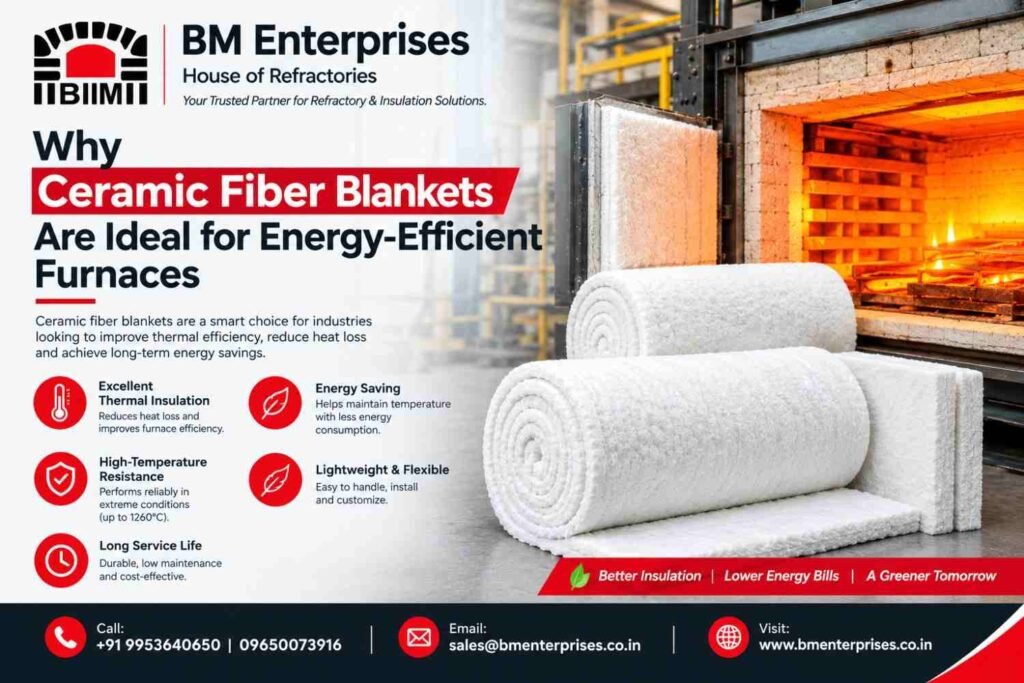
Efficiency in energy use has increasingly gained importance among industries working with furnaces, boilers, kilns, heat treatment facilities, etc. Excess heat loss from the walls and roofs of furnaces increases fuel consumption, operational costs, and makes temperature control harder. It is, thus, important to use the appropriate insulation material.
The use of ceramic fiber blankets has been common as an insulating material due to their low thermal conductivity, lightweight nature, flexible construction, and thermal shock resistance. This makes them ideal for installation in new furnaces, replacement of refractory lining, and insulation of industrial materials.
BM Enterprises was founded in 1988 and manufactures refractory and insulating materials for various industries. The company manufactures ceramic fiber insulation materials, Shree Cera ceramic blankets in particular, which can be used by customers who are looking for suitable Heat Insulation Materials.
Important technical note: Classification temperature is not necessarily the recommended continuous operating temperature. The maximum permissible service temperature depends on the specific grade and service conditions. Always use the manufacturer’s current technical documentation for engineering decisions.
What Are Ceramic Fiber Blankets?
The Ceramic Fiber Blanket is an insulating material in the form of a flexible blanket, composed of alumina-silica ceramic fiber material. The ceramic fibers are formed in a lightweight, needle-punched blanket form to provide insulation properties along with flexibility to cut and shape the blanket to fit around the equipment geometry. As compared to standard dense refractory brick lining, the refractory insulation blankets have relatively lower thermal mass. This helps to reduce heat transfer through insulated surfaces and consumes less energy for heating of the insulating layer itself at start-up. Hence, they are very useful for industrial applications requiring rapid heating, controlled cooling, and thermal management. There are different grades of Ceramic Fiber Blankets, which differ in densities, thickness, width, and temperature range of use. For example, standard densities of Ceramic Fiber Blankets are: 64 kg/m³, 96 kg/m³, 128 kg/m³, and 160 kg/m³.Why Ceramic Fiber Blankets Improve Furnace Energy Efficiency
1. Decreased Heat Loss through Furnace Walls
Ceramic fiber blankets help decrease the heat flow through furnace walls and roofs, enabling efficient heat retention and decreased energy usage.2. Low Thermal Capacity for Fast Heating
Because of their light structure, ceramic fiber blankets require little energy to heat up, which makes them well-suited for furnaces that have often recurring periods of heating and cooling.3. Better Temperature Control
Ceramic fiber blankets enable improved temperature control within the furnace.4. Lightweight Structure
Being easy to cut and install around furnace walls, doors, ducts, and irregular surfaces, ceramic fiber blankets offer good insulation while being lightweight.5. Ability to Withstand Thermal Shock
Being designed for high-temperature applications, proper ceramic fiber blankets can withstand temperature changes throughout their operational range.6. Possible Decrease in Operating Costs
Because of heat loss reduction and increased energy efficiency, ceramic fiber blankets may help save on energy expenses of a furnace. Savings vary depending on insulation type, operational mode, and installation quality.Types of Ceramic Fiber Blankets Available from BM Enterprises
BM Enterprises provides industrial clients with ceramic fiber insulation materials. The choice of the density and thickness of the material depends on the needs of the project and technical information from the manufacturer.Ceramic Fiber Blankets 64 kg/m³
The ceramic fiber blankets 64 kg/m³ are lightweight insulation materials that may be used where it is important to have lightness and thermal resistance. It will depend on the thickness needed for the insulation, its strength during handling, installation configuration, and operating environment. If there are stresses applied to the structure or the need for maintenance is high, a heavier material should be used.Ceramic Fiber Blanket Density 128 kg/m³
A company supplying ceramic fiber blanket density 128 kg/m³ is another common request by industrial consumers looking for furnace insulation products. For example, BM Enterprises provides ceramic blankets having an average density of 128 kg/m³. Among those that are specified in the company’s list is a Shree Ceramic blanket specification with a roll size of about 7.30 m × 0.61 m × 25 mm and a temperature rating of 1260°C. The thermal conductivity of the material is about 0.15 W/m·K at 600°C. The above-mentioned data can be used only for reference purposes, as it is specific to each particular product. It is necessary to verify all the parameters of the material.Ceramic Blankets in Different Thicknesses
There are different thicknesses of ceramic blankets ranging from 6 mm, 12 mm, 20 mm, 25 mm, and 50 mm. While thicker insulation can lower the heat transfer, the ultimate effectiveness of the insulation depends on the thermal conductivity at the mean temperature, quality of insulation, emissivity of surfaces, and other system parameters. Thermal design calculations must be done to find out the necessary thickness.Technical Specifications of Ceramic Fiber Blankets
The following table provides an overview of commonly specified ceramic blanket options. Availability and exact values should be verified for the selected product grade.| Specification | Typical options or reference details |
| Material composition | Alumina-silica ceramic fiber |
| Colour | White |
| Density | 64, 96, 128 and 160 kg/m³, depending on grade |
| Thickness | 6, 12, 20, 25 and 50 mm, depending on product |
| Reference temperature classification | Up to 1260°C for the listed standard configuration |
| Listed roll size | Approximately 7.30 m × 0.61 m × 25 mm |
| Thermal conductivity | Approximately 0.15 W/m·K at 600°C for the listed 128 kg/m³ configuration |
| Form | Flexible blanket rolls |
| Packaging | HDPE wrapping or box, depending on the product |
| Typical applications | Furnaces, boilers, kilns, ducts and industrial heating equipment |