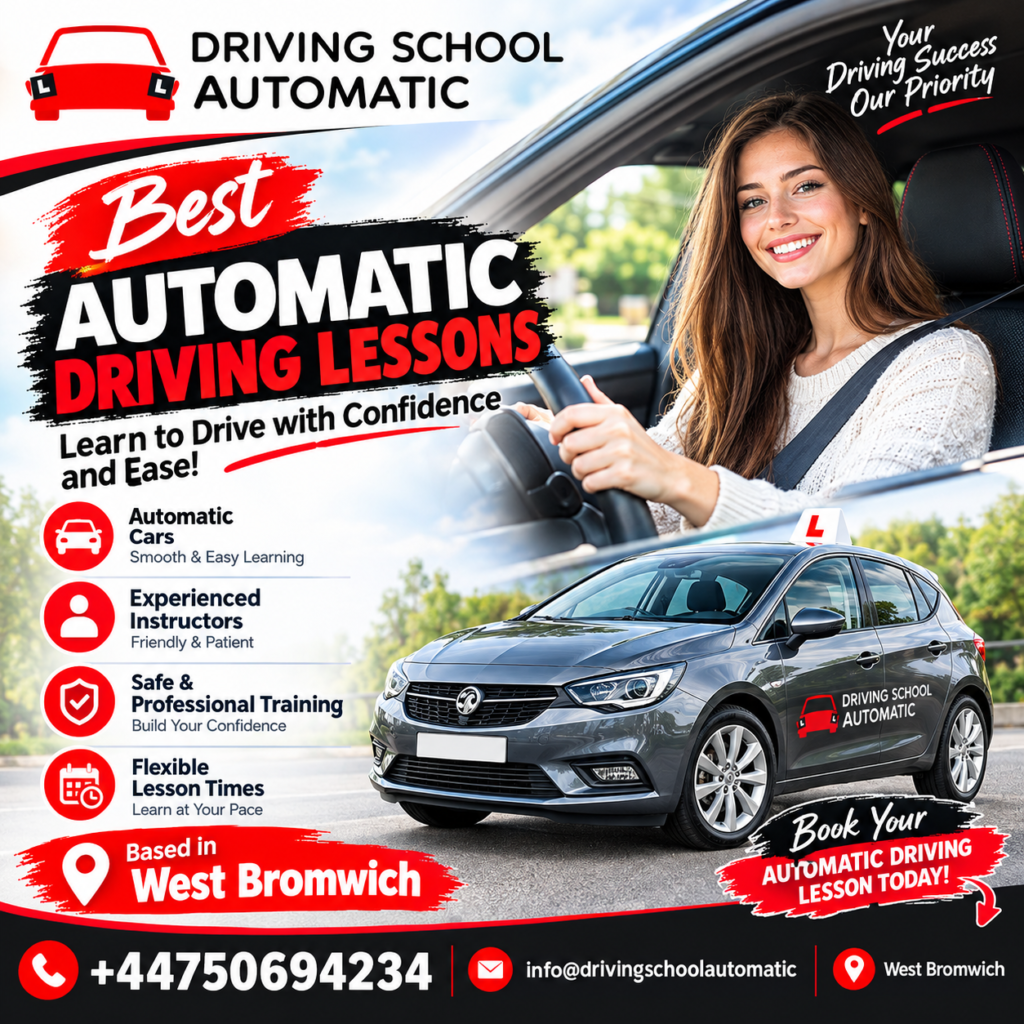
Learning to drive is a significant step toward independence, but the cost of driver training is an important consideration for many learners. Choosing automatic tuition can also make the learning process more straightforward because there is no clutch pedal or manual gear changing to coordinate. However, affordable driving lessons should not mean sacrificing instructor quality, structured learning, or road safety.
For learners looking for driving lessons Kingstanding, understanding what makes driving tuition good value can help them make a more informed decision. The right approach combines effective instruction, consistent practice, sensible lesson planning, and preparation for driving independently after passing the test.
What Makes Automatic Driving Lessons Different?
Automatic vehicles manage gear changes without requiring the driver to operate a clutch manually. This allows learners to focus more attention on observation, steering, road positioning, speed management, and hazard awareness.
For some beginners, reducing the number of vehicle controls can make the early stages of learning less complicated. Instead of coordinating clutch control and gear selection, learners can concentrate on developing the wider skills required for safe driving.
An automatic lesson may cover:
- Vehicle controls and basic manoeuvring
- Mirror and observation routines
- Moving away and stopping
- Junctions and traffic lights
- Roundabouts
- Lane positioning
- Parking and reversing
- Speed management
- Hazard perception
- Independent driving
Automatic tuition is not necessarily easier in every respect. Learners still need to develop strong judgement and awareness, particularly when dealing with busy urban roads and unpredictable traffic.
How to Find Affordable Driving Lessons in Kingstanding
The word “affordable” should be considered in terms of overall value rather than simply choosing the lowest advertised lesson price.
A cheaper lesson may not represent good value if the teaching is inconsistent, the lesson structure is unclear, or the learner requires significantly more training because important skills have not been properly developed.
When comparing automatic driving lessons Kingstanding, learners can look at several factors.
1. Lesson duration
Compare the actual amount of tuition provided. A lesson advertised at a particular price may have a different duration from another provider’s lesson.
Looking at the cost per hour can make comparisons more meaningful.
2. Instructor experience
An experienced instructor should be able to identify weaknesses and adapt teaching accordingly. This can be particularly useful for nervous beginners or learners who have previously struggled with driving.
3. Progress monitoring
Good instruction should involve more than simply driving around for an hour. Learners should understand what they are practising, what needs improvement, and what the next stage of training involves.
4. Additional costs
Learners should consider whether there are separate charges associated with test preparation, vehicle use for the practical test, cancellations, or other services.
Understanding the full cost structure helps prevent unexpected expenses.
Building Driving Skills Around Kingstanding
Kingstanding and the surrounding Birmingham area provide a mixture of residential streets, busier urban routes, junctions, roundabouts, pedestrian areas, and roads connecting neighbouring communities.
This variety can be useful during driver training because learners need to become comfortable in more than one type of environment.
A structured course may gradually introduce different situations rather than exposing a beginner to everything immediately.
Residential roads
Quiet residential areas can be useful for developing fundamental vehicle control and observation.
Learners can practise:
- Appropriate speed
- Passing parked vehicles
- Meeting oncoming traffic
- Reading road signs
- Checking for pedestrians
- Emerging safely from side roads
Busier urban roads
Once basic control has developed, learners can work on handling heavier traffic, multiple lanes, traffic lights, and more complex junctions.
The key objective is to make decisions early and maintain an appropriate safety margin.
Roundabouts
Roundabouts are a common challenge for learners. They require observation, lane discipline, signalling, speed control, and accurate assessment of approaching traffic.
Rather than memorising one particular roundabout, learners should understand the principles that can be applied to different layouts.
Common Challenges With Automatic Driving Tuition
Automatic vehicles remove clutch and manual gear changes, but several other learning challenges remain.
Nervousness
Some beginners become anxious when traffic builds up around them. Nervousness can lead to excessive braking, hesitation, or difficulty making timely decisions.
A gradual progression from simpler roads to busier situations can help learners build confidence without becoming overwhelmed.
Poor observation
One of the most important habits for a learner is looking beyond the immediate vehicle ahead.
Good observation involves scanning the road, checking mirrors regularly, identifying potential hazards, and anticipating what other road users might do.
Inconsistent speed
Automatic vehicles can make acceleration smooth, but learners still need to understand how road conditions affect appropriate speed.
A driver should consider visibility, road layout, pedestrians, cyclists, weather, traffic density, and potential hazards rather than focusing only on the posted speed limit.
Junction hesitation
Beginners may sometimes wait too long at junctions because they are unsure whether a gap is safe.
An instructor can help learners develop better judgement by explaining how to assess approaching vehicles, available gaps, visibility, and road positioning.

How Learners Can Reduce the Overall Cost of Training
The number of lessons required differs from one person to another. Previous experience, confidence, private practice, learning ability, and lesson frequency can all influence the total amount of tuition required.
While nobody can guarantee a specific number of lessons, learners can take practical steps to make their training more efficient.
Practise consistently
Long gaps between lessons can make it harder to retain newly developed skills. Where appropriate and legal, supervised practice outside formal lessons can reinforce what an instructor has taught.
Private practice should focus on specific objectives rather than simply driving without a plan.
Prepare before each lesson
Learners can think about the previous lesson before arriving for the next one.
For example, if roundabouts were difficult, the learner can identify exactly what caused the problem:
- Lane positioning?
- Observation?
- Signalling?
- Speed?
- Choosing a safe gap?
Identifying the underlying issue makes subsequent practice more focused.
Study the Highway Code
Practical lessons are only one part of becoming a safe driver. Understanding road signs, markings, priorities, speed limits, vulnerable road users, and stopping distances can support better decision-making.
Knowledge and practical skills should develop together.
Avoid rushing toward the test
Some learners become focused on booking a test before they are ready. Although passing the test is an important milestone, learning should ultimately prepare someone for independent driving.
A learner who understands why a particular manoeuvre or decision is correct is better prepared than someone who has simply memorised a test route.
The Growing Role of Automatic Vehicles
Automatic vehicles are becoming increasingly visible in the UK vehicle market, particularly as hybrid and electric vehicles become more common.
Many electric vehicles do not use traditional manual transmissions, while numerous hybrid models also use automatic systems. This trend means automatic driving skills may be increasingly relevant to new drivers planning their future vehicle choices.
However, learners should understand the licensing implications of taking a practical test in an automatic vehicle.
In the UK, passing the practical test in an automatic generally results in an automatic-only driving entitlement. Anyone who later wants to drive manual vehicles would need to meet the relevant requirements and pass a manual practical test.
The decision between manual and automatic should therefore be based on individual circumstances rather than simply which option appears easier at first.
What Should Learners Look For in a Driving Instructor?
Price is only one part of choosing driving tuition. The instructor’s communication style and teaching approach can have a significant effect on progress.
A suitable instructor should be able to explain concepts clearly, provide constructive feedback, and adjust lessons according to the learner’s ability.
Useful questions to consider include:
- Does the instructor explain mistakes clearly?
- Is progress reviewed regularly?
- Are lessons adapted to individual weaknesses?
- Does training include different road environments?
- Is independent driving encouraged?
- Are practical test requirements explained?
- Is the vehicle suitable and properly maintained?
- Are lesson policies clear?
For learners researching driving tuition in the wider West Bromwich area, Driving School Automatic can be considered as one example of a provider offering automatic-focused training. As with any driving service, learners should assess whether the teaching structure and approach match their individual requirements.
Making Automatic Driving Lessons More Effective
Effective driver training is not simply about accumulating hours behind the wheel. The quality of practice matters.
Learners can improve their progress by setting realistic goals for each lesson. One session might focus on junctions, while another concentrates on parking or independent navigation.
It is also useful to learn from mistakes immediately. If a learner repeatedly makes the same error, simply repeating the situation without understanding the cause may not produce meaningful improvement.
A useful cycle is:
Learn → Practise → Receive feedback → Correct → Repeat
Over time, this process helps transform individual driving tasks into automatic habits while maintaining active awareness of the surrounding road environment.
Final Thoughts
Finding affordable driving lessons Kingstanding involves more than comparing prices. Learners should consider lesson duration, instructor experience, progress tracking, vehicle suitability, and the overall quality of training.
Automatic tuition can reduce the mechanical workload associated with learning to drive, allowing beginners to concentrate more closely on observation, road positioning, hazard awareness, and decision-making. However, these skills still require consistent practice.
For anyone considering automatic driving lessons in Kingstanding or the wider West Bromwich area, the most effective approach is to choose structured tuition, practise consistently, understand the Highway Code, and focus on becoming a capable independent driver rather than simply preparing to pass a test.