Radon Testing St. Louis
Quick Answer
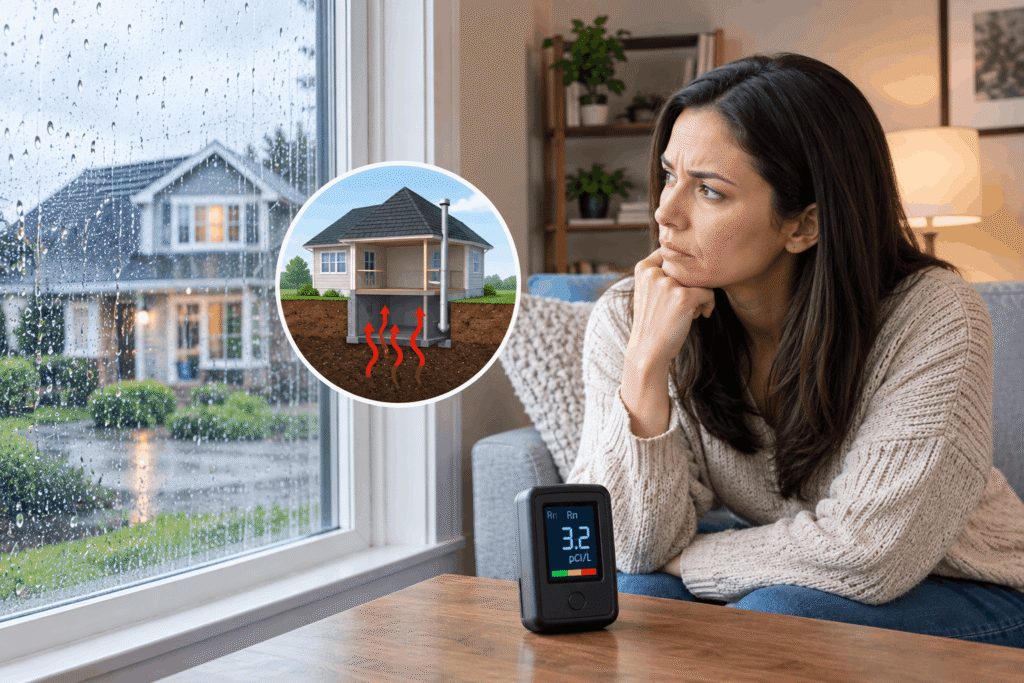
Yes, rain can temporarily increase indoor radon levels, though not because of the water itself. Two separate mechanisms drive this: the barometric pressure drops that typically accompany storm systems, and soil saturation from heavy rain that physically pushes radon-laden soil gas upward and outward. The effect is usually short-lived, lasting hours to a few days, which is exactly why a proper 48-hour minimum test naturally averages through these temporary spikes rather than being thrown off by them, a key reason radon testing St. Louis professionals don’t reschedule around forecasts.
The Two Real Mechanisms Behind Rain and Radon
1. Barometric Pressure Drops During Storms
Storm systems typically arrive with a drop in atmospheric pressure, and lower outdoor pressure relative to the air beneath your foundation creates a bigger pressure differential pulling soil gas upward into your home. This isn’t unique to rain specifically, it’s really a barometric pressure effect that happens to correlate with storms since storms and pressure drops travel together.
2. Soil Saturation Pushing Gas Upward
Here’s the mechanism that’s actually about the rain itself. When soil becomes saturated with water, the water fills pore spaces in the ground that would otherwise hold air, including radon gas. With less room to disperse through the soil normally, that displaced gas gets pushed toward the path of least resistance, which is often straight up through your foundation. Think of it like squeezing a sponge, the water displaces whatever air was sitting in those tiny pockets, and that air has to go somewhere.
How Much of a Difference Rain Actually Makes
1. Typical Magnitude and Duration of the Spike
In homes I’ve monitored with continuous electronic monitors during heavy rain events, I’ve seen temporary increases ranging from modest, maybe 10 to 20 percent above baseline, up to more dramatic spikes during particularly intense or prolonged storms. The exact magnitude depends heavily on soil type, how saturated the ground already was, and how quickly the pressure system moves through.
2. Why It’s Usually Temporary
Once soil drains and barometric pressure normalizes after a storm passes, radon levels typically settle back toward their baseline within a day or two. This isn’t a permanent shift, it’s a temporary spike layered on top of whatever your home’s underlying radon potential already is.
What This Means for Testing During Rainy Periods
1. Should You Avoid Testing During Storms?
You don’t need to reschedule a test because rain is in the forecast. A properly conducted 48-hour test captures whatever conditions occur during that window as part of a legitimate average, storms included. Trying to time testing around perfect weather isn’t realistic anyway, and honestly a slightly elevated reading due to rain reflects a real condition your home experiences periodically, not a false result worth avoiding. Most radon testing St. Louis appointments proceed on schedule regardless of the forecast for exactly this reason.
2. Why 48-Hour Averages Absorb the Noise
This is really the whole point of the minimum testing window. A single stormy day layered into a 48-hour average gets diluted by the surrounding hours of more typical conditions. If you’re deeply concerned about weather-related variability specifically, a long-term test spanning months smooths this out even further, capturing multiple weather patterns rather than whatever happened to occur during one short window, and any radon mitigation St Louis contractor can help you decide which testing length fits your situation.
A Test That Coincided With a Week of Heavy Storms
I ran a test for a client in Manchester that happened to fall during an unusually wet stretch of spring storms, multiple heavy rain events within the 48-hour window. The result came back at 5.3 pCi/L, and the homeowner initially wondered if the storms had skewed the number unfairly. I pulled the hourly data from the continuous monitor and showed her exactly what happened, brief spikes up to around 7 pCi/L during the heaviest rain, settling back toward 4 to 4.5 pCi/L between storm bands. The averaged result still landed above the EPA’s action level even accounting for those swings, which told us the underlying baseline was genuinely elevated, not just a weather artifact. We installed a mitigation system, and her post-test, conducted during a completely dry week, came back at 0.6 pCi/L, confirming the fix worked regardless of what the sky was doing. That radon mitigation St Louis installation addressed the actual baseline, not just the storm-related noise sitting on top of it.
What Actually Matters More Than Weather
Your home’s underlying radon potential, driven by soil composition and foundation condition, matters far more than any single weather event layered on top of it. Weather causes noise around that baseline, not the baseline itself. This is why radon testing St. Louis professionals rely on proper testing duration and averaging rather than trying to predict or avoid specific weather conditions when scheduling a test, and it’s also why a properly designed radon mitigation St Louis system is built to handle that baseline continuously rather than reacting to weather day by day.
Conclusion
Rain genuinely can increase indoor radon levels temporarily, through both barometric pressure drops and soil saturation pushing gas upward, but the effect is short-lived and gets absorbed into a proper 48-hour test average rather than distorting your results. Radon mitigation St Louis installation is designed to handle these normal fluctuations continuously, not just under calm, dry conditions, which is exactly why a properly functioning system keeps levels low regardless of what the weather’s doing outside. If you’re wondering whether recent storms affected your home’s radon situation, or if you’ve never tested at all, reach out to Air Sense Environmental and I’ll help you get an accurate, weather-independent answer.
FAQs
- Should I wait for a dry week to schedule my radon test? No, a proper radon testing St. Louis appointment accounts for normal weather variability over its 48-hour window, so there’s no need to time it around a dry forecast specifically.
- Does snow affect radon levels the same way rain does? Snow itself has less immediate soil saturation effect, though the barometric pressure changes accompanying winter storms can still contribute to temporary fluctuations.
- Can a single rainy day push a normally low home above the EPA action level? It’s possible for a temporary spike to occur, but a properly averaged 48-hour test reflects your true baseline rather than one isolated high reading.
- Does radon mitigation St Louis installation account for future rain events automatically? Yes, a properly running radon mitigation St Louis system continuously depressurizes the soil beneath your foundation regardless of weather, handling normal fluctuations as part of its ongoing operation.
- Is it worth running a long-term test specifically to average out weather effects? If you want the most complete picture across various weather conditions and seasons, a long-term radon testing St. Louis option spanning months does capture that variability more thoroughly than a short-term test.