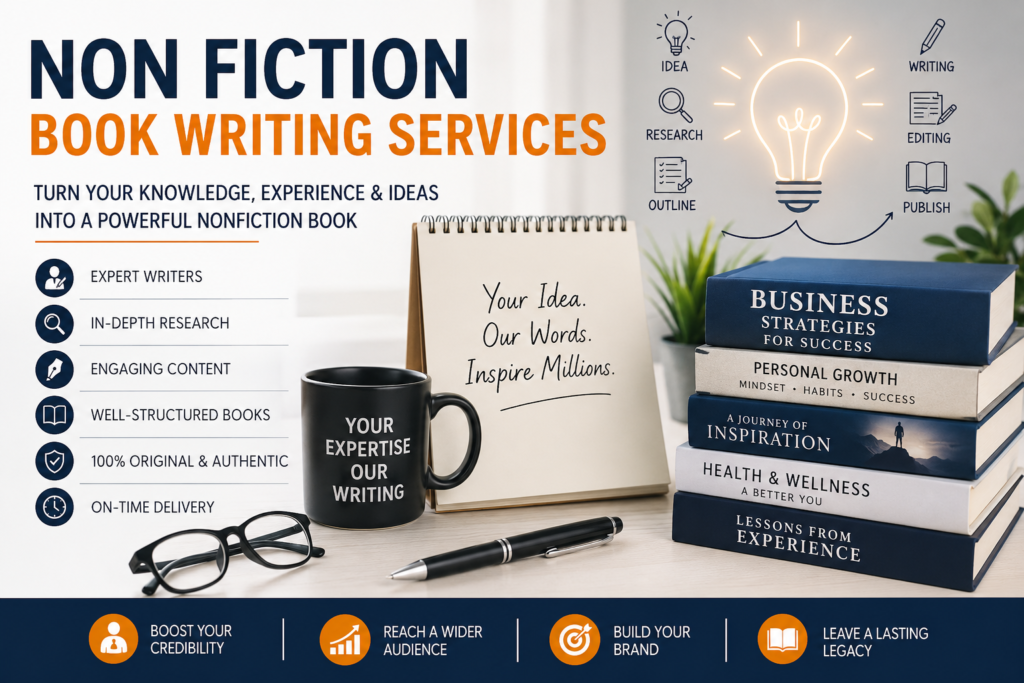
Non Fiction Book Writing Services Turn Your Expertise Into a Powerful Book
A nonfiction book can do far more than share information. It can establish authority, educate readers, preserve valuable experiences, support a business, and give an expert a platform to reach a wider audience. But turning knowledge, research, or personal experience into a well-structured book requires more than simply putting words on a page.
This is where Non Fiction Book Writing Services can make a significant difference.
Professional nonfiction writers understand how to transform ideas into organized, engaging, and reader-focused manuscripts. They combine research, structure, storytelling, and clear communication to create books that inform readers without becoming difficult to follow.
Whether you are an entrepreneur with years of industry experience, a coach with a proven methodology, a professional with an important message, or someone with a personal story to preserve, working with an experienced nonfiction writer can help turn your concept into a finished book.
What Are Non Fiction Book Writing Services?
Non Fiction Book Writing Services provide professional support for developing and writing books based on real information, experiences, research, expertise, or ideas.
Unlike fiction, where writers create imaginary characters and events, nonfiction focuses on factual content. However, factual information alone does not automatically create a compelling book. Readers still need structure, context, examples, and a narrative that keeps them interested.
Professional nonfiction writers help bridge that gap.
They can take:
- A basic book idea
- Personal notes
- Research materials
- Interviews
- Existing articles
- Business knowledge
- An unfinished manuscript
- A personal life story
- A professional methodology
…and transform these materials into a coherent manuscript.
The goal is not simply to produce a large amount of text. The goal is to create a book with a clear purpose, logical organization, consistent voice, and meaningful value for the intended audience.
Why Is Writing a Nonfiction Book Challenging?
Many people have enough knowledge to write a book but struggle to turn that knowledge into a complete manuscript.
One reason is that experts often know their subject so well that they find it difficult to determine what a beginner actually needs to know. Another challenge is organizing years of experience into chapters that follow a logical progression.
Research can also become overwhelming. A nonfiction book may require information from books, interviews, reports, studies, historical records, industry sources, or other credible references.
Then comes the writing itself.
A professional book must maintain consistency from the first chapter to the last. Ideas need to connect naturally, terminology needs to remain consistent, and complicated concepts may need to be explained in accessible language.
Professional writing support can make these challenges much easier to manage.
The Importance of Research in Nonfiction Writing
Research is one of the foundations of quality nonfiction.
A writer cannot simply make assumptions when presenting factual information. Claims should be evaluated carefully, sources should be checked, and relevant information should be organized before it becomes part of the manuscript.
A strong research process may involve:
- Identifying the central topic.
- Understanding the target audience.
- Collecting credible sources.
- Comparing information from multiple sources.
- Organizing research according to chapters.
- Checking important facts.
- Identifying areas requiring expert clarification.
- Maintaining references where appropriate.
Research becomes particularly important for books covering history, science, business, technology, education, or other specialized subjects.
However, research should support the reader rather than overwhelm them. A professional writer knows how to convert complex research into understandable and engaging prose.
Finding the Right Structure for Your Book
A strong structure gives a nonfiction book direction.
Before writing thousands of words, professional writers typically consider what the book is trying to accomplish and how readers should move through the subject.
For example, a business book might begin by explaining a common problem, introduce a new approach, demonstrate how the approach works, and then provide practical examples.
A self-help book may introduce a challenge, explain why it occurs, present a framework for addressing it, and give readers actionable steps.
A memoir might use important experiences to create a meaningful chronological or thematic journey.
The right structure depends on the subject, audience, and purpose of the book.
This is why creating a detailed outline before drafting can save considerable time. It provides a roadmap for the entire manuscript and reduces the risk of repetitive or disconnected chapters.
Types of Nonfiction Books You Can Create
Nonfiction is an extremely broad category. Professional writers can work across numerous subjects and formats.
1. Business Books
Business books allow entrepreneurs, executives, consultants, and industry professionals to share knowledge and establish credibility.
A business book might discuss leadership, entrepreneurship, marketing, management, sales, innovation, company culture, or a specialized industry process.
For business owners, a well-written book can also become part of a broader personal-brand strategy.
2. Self-Help Books
Self-help books provide readers with practical guidance for improving some area of their lives.
Topics can include productivity, confidence, relationships, career development, mindset, leadership, communication, and personal growth.
The strongest self-help books usually combine useful information with practical examples and clear actions readers can apply.
3. Memoirs
Memoirs focus on selected experiences, periods, themes, or lessons from a person’s life.
Writing a memoir is not simply documenting everything that happened. It requires identifying meaningful experiences and presenting them in a way that creates emotional and intellectual connections with readers.
A professional writer can interview the author, identify important themes, and organize memories into a compelling narrative.
4. Biographies
Biographies tell the story of another person’s life.
They may require extensive research, interviews, historical documents, personal records, and other sources. The writer must balance factual accuracy with storytelling so the biography feels informative without becoming a simple list of dates and events.
5. Historical Books
Historical nonfiction requires particularly careful research.
Authors need to consider dates, events, people, cultural contexts, and available historical evidence. A skilled writer can transform detailed research into a readable narrative that helps modern audiences understand the past.
6. Educational Books
Professionals and educators often create nonfiction books to explain complicated subjects to a specific audience.
The challenge is presenting technical information in a way that remains accurate while being accessible.
Examples include educational guides, professional manuals, instructional books, and specialized reference materials.
7. Health and Wellness Books
Health, wellness, fitness, and lifestyle topics are popular nonfiction categories. However, content in these areas should be handled responsibly and supported by appropriate sources.
A professional writer can help organize expert-provided information into a clear format while maintaining appropriate distinctions between general educational content and professional medical advice.
How Professional Nonfiction Writers Add Value
Hiring a writer does not mean handing over your ideas and disappearing from the process.
The best nonfiction projects are collaborative.
The author provides expertise, experiences, opinions, research, and direction. The writer brings professional writing skills, organization, research ability, and storytelling techniques.
This combination can produce a stronger manuscript than either person working entirely alone.
A professional nonfiction writer can help you:
- Develop your initial concept.
- Define the book’s purpose.
- Identify the target audience.
- Create a chapter outline.
- Conduct supporting research.
- Organize your existing material.
- Capture your personal voice.
- Turn interviews into written content.
- Develop chapters consistently.
- Improve readability.
- Incorporate examples and stories.
- Revise the manuscript.
- Prepare content for editing and publication.
Why Your Voice Still Matters
One common concern about professional writing services is whether the final book will sound like the author.
This is especially important for memoirs, business books, personal-development books, and expert-led publications.
A skilled ghostwriter should not replace the author’s identity with their own writing style. Instead, they should learn how the author thinks, communicates, explains ideas, and tells stories.
This can involve interviews, questionnaires, existing articles, recordings, presentations, social media posts, or other writing samples.
The objective is to create polished writing that still feels authentic to the person whose name appears on the book.
From an Idea to a Finished Manuscript
One of the biggest advantages of professional Non Fiction Book Writing Services is having a defined process.
While every project is different, the journey often begins with a consultation.
Step 1: Discuss the Concept
The writer needs to understand what the book is about and why you want to write it.
Questions might include:
- What is the central idea?
- Who is the intended reader?
- What problem does the book address?
- What experience or expertise do you bring?
- What should readers learn?
- What makes your perspective different?
Step 2: Develop the Outline
The next stage is organizing the book.
Chapters are planned according to the central argument, subject matter, and reader journey. A detailed outline can identify gaps before substantial writing begins.
Step 3: Research and Gather Material
The writer collects relevant information and works with the author’s existing materials.
Depending on the project, this may include interviews, documents, research papers, books, articles, notes, or other reliable sources.
Step 4: Write the Manuscript
Once the direction is approved, the writing begins.
Many projects are developed chapter by chapter so the author can provide feedback throughout the process.
Step 5: Review and Revise
Feedback helps ensure the manuscript accurately reflects the author’s ideas and expectations.
Revisions can improve structure, clarity, tone, pacing, and consistency.
Step 6: Prepare the Final Manuscript
After revisions, the completed manuscript can move toward editing, proofreading, formatting, publishing, and marketing.
How to Choose the Right Nonfiction Writing Service
Choosing a writing service is an important decision because the writer may be responsible for translating your knowledge or personal experiences into an entire book.
Consider the following factors before hiring a service.
Experience
Look for writers who understand nonfiction rather than relying solely on general writing ability.
Different nonfiction categories have different requirements. A memoir, business book, and historical book may require completely different approaches.
Research Ability
Ask how the writing team handles research and fact-checking.
For research-heavy books, this can be one of the most important parts of the project.
Communication
Book writing is collaborative. You should be able to communicate your ideas, provide feedback, and ask questions throughout the project.
Revision Process
Understand how revisions work before the project begins.
A clear process helps prevent misunderstandings and gives both the author and writer realistic expectations.
Writing Samples
Review relevant samples whenever possible. A portfolio can help you determine whether the service’s writing style is appropriate for your intended audience and subject.
Confidentiality and Ownership
Before starting, make sure the agreement clearly explains confidentiality, rights, ownership, payment, deliverables, and revision terms.
A professional agreement helps protect both parties and establishes clear expectations.
Why Authors Work With Hire eBook Writer Now
Writing a complete nonfiction book requires time, discipline, research, and professional writing ability. Many aspiring authors have the knowledge but simply do not have enough time to manage the entire writing process themselves.
Hire eBook Writer Now’s Non Fiction Book Writing Services are designed to help authors turn ideas, expertise, research, and real-life experiences into professionally written nonfiction books.
The service page highlights expertise across areas such as memoirs, business books, historical content, self-help, and other nonfiction subjects, with an emphasis on research, authenticity, and engaging presentation.
Whether you are starting with a simple concept or already have extensive research and notes, professional writing support can help bring structure to the project.
A Nonfiction Book Can Become More Than a Book
Publishing a nonfiction book can create opportunities beyond the manuscript itself.
For professionals and entrepreneurs, a book can become a long-term authority asset. Individual chapters can potentially inspire blog content, newsletters, presentations, social media posts, workshops, podcasts, or educational resources.
For coaches and consultants, a book can communicate a methodology to prospective clients.
For experienced professionals, it can preserve knowledge that might otherwise remain limited to conversations and presentations.
For individuals writing memoirs, the book can preserve experiences and lessons for future generations.
The value of nonfiction therefore extends beyond the number of pages. A well-developed book can become a lasting representation of the author’s knowledge and perspective.
Common Mistakes to Avoid When Writing a Nonfiction Book
Even strong ideas can become difficult books when certain mistakes are overlooked.
Writing Without a Clear Audience
Trying to write for everyone often results in a book that feels too broad. Define who you want to help before developing the manuscript.
Overloading the Reader With Information
More information does not necessarily mean more value. Readers need explanations, examples, context, and practical takeaways.
Ignoring Structure
Without a logical structure, even excellent research can feel confusing.
Using Excessive Jargon
Specialists may understand technical terminology, but general readers may not. Explain complex ideas clearly when your audience requires it.
Neglecting Revision
The first draft is rarely the final draft. Revision is where structure, clarity, and consistency can be significantly improved.
Forgetting the Human Element
Even factual nonfiction can benefit from stories, examples, case studies, experiences, and relatable explanations.
Frequently Asked Questions
How long does it take to write a nonfiction book?
The timeline depends on the book’s length, complexity, research requirements, availability of source material, and revision process. A shorter project may take weeks, while a comprehensive book can require several months.
Can I hire someone to write my nonfiction book?
Yes. Professional nonfiction writers and ghostwriters can develop manuscripts based on your ideas, expertise, interviews, research, and existing materials.
Do I need to have the entire book planned before hiring a writer?
No. You can begin with an idea, notes, research, or even an unfinished manuscript. A professional writer can help develop the concept and create an appropriate structure.
Can a nonfiction writer preserve my personal writing style?
Yes. Through interviews, conversations, questionnaires, and existing writing samples, a writer can learn your communication style and develop content that reflects your voice.
Is research necessary for every nonfiction book?
The level of research varies by subject. A memoir based primarily on personal experiences may require a different research process from a historical or technical book. However, factual claims should always be handled carefully.
What makes a good nonfiction book?
A strong nonfiction book generally combines useful information with clear organization, credible content, engaging writing, and a strong understanding of its intended audience.
Turn Your Knowledge Into a Book
You may already have the information your audience needs. Perhaps you have spent years building a business, developing a professional methodology, overcoming challenges, researching a subject, or collecting experiences that deserve to be shared.
The challenge is turning that knowledge into a book that readers can actually follow and enjoy.
That is where professional Non Fiction Book Writing Services can help.
With the right writer, your scattered notes can become organized chapters. Your expertise can become accessible explanations. Your experiences can become meaningful stories. And your ideas can become a complete manuscript that is ready for the next stage of its publishing journey.
If you have a nonfiction book idea but are unsure how to begin, consider working with experienced professionals who can guide the project from concept and research through writing and revisions.
Your knowledge has value. Your story has a purpose. Your ideas deserve to become a book.
Start your nonfiction book journey with Hire eBook Writer Now and take the next step toward turning your expertise into a professionally written nonfiction manuscript.